## Bar Chart: Correct first step vs Incorrect first step accuracy (%)
### Overview
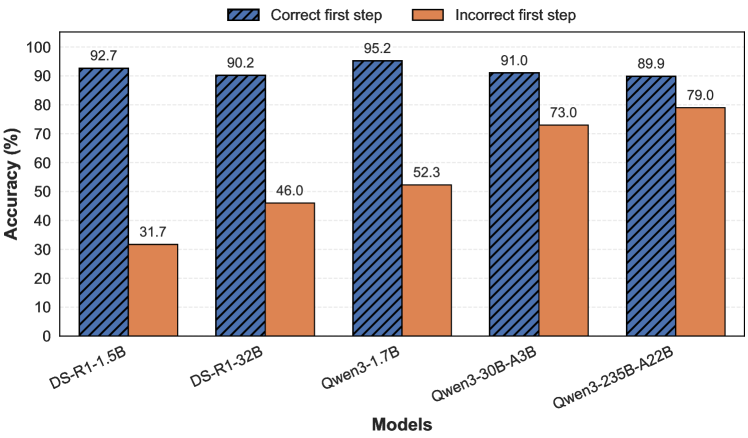
The chart compares the accuracy of two metrics ("Correct first step" and "Incorrect first step") across five AI models. Accuracy is measured in percentages, with values ranging from 0% to 100%. Each model has two grouped bars: blue (striped) for "Correct first step" and orange for "Incorrect first step".
### Components/Axes
- **X-axis**: Labeled "Models", listing five AI models:
- DS-R1-1.5B
- DS-R1-32B
- Qwen3-1.7B
- Qwen3-30B-A3B
- Qwen3-235B-A22B
- **Y-axis**: Labeled "Accuracy (%)", with ticks from 0 to 100 in increments of 10.
- **Legend**: Located at the top, with:
- Blue (striped): "Correct first step"
- Orange: "Incorrect first step"
### Detailed Analysis
- **DS-R1-1.5B**:
- Correct first step: 92.7% (blue)
- Incorrect first step: 31.7% (orange)
- **DS-R1-32B**:
- Correct first step: 90.2% (blue)
- Incorrect first step: 46.0% (orange)
- **Qwen3-1.7B**:
- Correct first step: 95.2% (blue)
- Incorrect first step: 52.3% (orange)
- **Qwen3-30B-A3B**:
- Correct first step: 91.0% (blue)
- Incorrect first step: 73.0% (orange)
- **Qwen3-235B-A22B**:
- Correct first step: 89.9% (blue)
- Incorrect first step: 79.0% (orange)
### Key Observations
1. **Consistent Dominance of Correct Steps**: All models show significantly higher accuracy for "Correct first step" (89.9–95.2%) compared to "Incorrect first step" (31.7–79.0%).
2. **Trade-off Between Metrics**: As "Correct first step" accuracy decreases slightly (e.g., Qwen3-235B-A22B: 89.9%), "Incorrect first step" accuracy increases (79.0%), suggesting a potential inverse relationship.
3. **Model-Specific Variance**:
- Qwen3-1.7B achieves the highest "Correct first step" accuracy (95.2%) but has a moderate "Incorrect first step" rate (52.3%).
- Qwen3-235B-A22B has the lowest "Correct first step" accuracy (89.9%) and the highest "Incorrect first step" rate (79.0%).
### Interpretation
The data suggests that while all models excel at "Correct first step" tasks, there is a trade-off between the two metrics. Larger models (e.g., Qwen3-235B-A22B) exhibit lower "Correct first step" accuracy but higher "Incorrect first step" rates, potentially indicating overcomplexity or misalignment in task prioritization. The Qwen3 series shows a clear trend where increased model size correlates with reduced performance in the primary metric ("Correct first step"), raising questions about optimization strategies. This could imply that simpler models (e.g., DS-R1-1.5B) better balance accuracy and error rates, while larger models may prioritize breadth over precision.