## Diagram: Closed-Loop Neural System in Simulated Pong Environment
### Overview
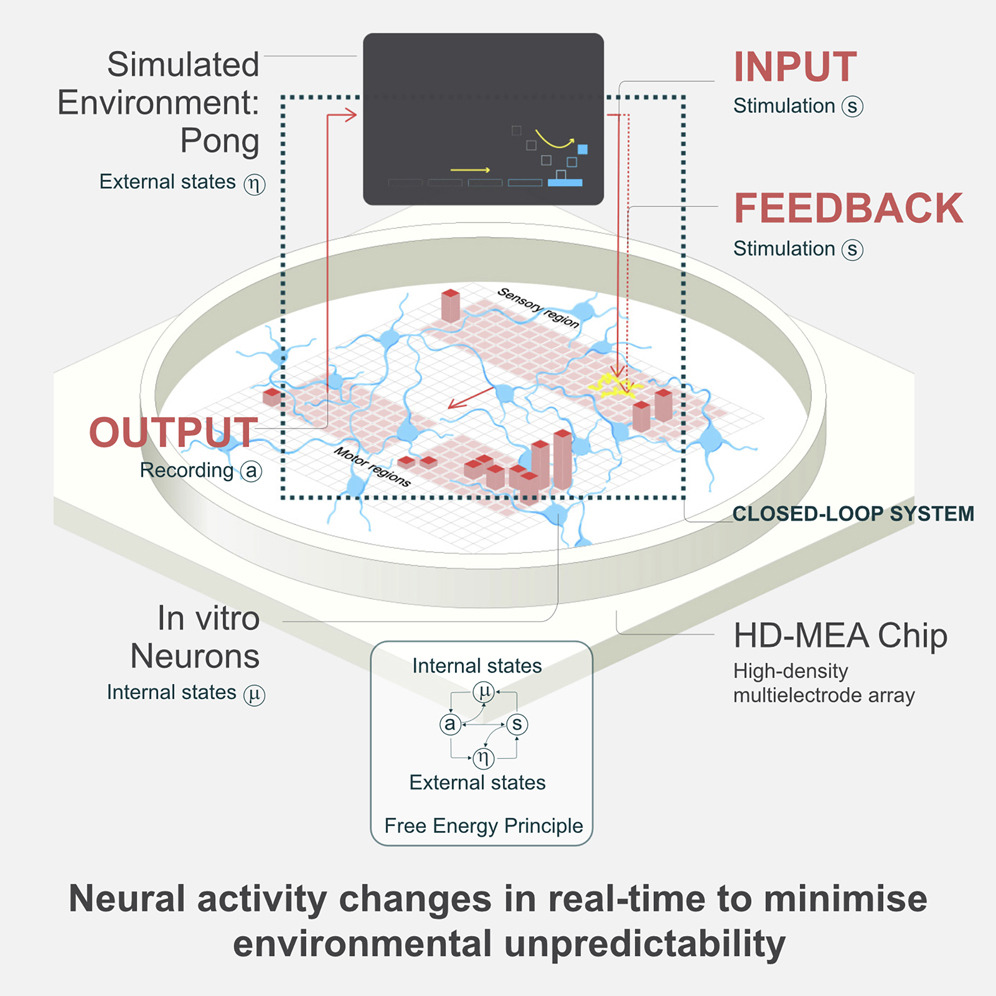
The diagram illustrates a closed-loop neural system where in vitro neurons interact with a simulated pong environment. The system uses an HD-MEA (High-Density Multielectrode Array) chip to record neural activity, process stimuli, and adjust internal states to minimize environmental unpredictability. Key components include input stimulation, feedback mechanisms, and output recording.
### Components/Axes
1. **Simulated Environment: Pong**
- Labeled as the external environment with "External states" (η).
- Includes a visual representation of a pong game (paddle, ball, grid).
2. **HD-MEA Chip**
- Positioned on the right side of the diagram.
- Described as a "High-density multielectrode array" for neural recording.
3. **In Vitro Neurons**
- Located in the central circular region.
- Labeled with "Internal states" (μ) and "External states" (η).
- Connected to "Sensory region" and "Motor regions" via blue lines.
4. **Closed-Loop System**
- Arrows indicate bidirectional flow:
- **INPUT Stimulation (S)**: From the environment to neurons.
- **FEEDBACK Stimulation (S)**: From neurons back to the environment.
- **OUTPUT Recording (a)**: From neurons to external systems.
5. **Free Energy Principle**
- Noted as the guiding framework for neural activity adjustments.
### Detailed Analysis
- **Neural Activity Flow**:
- Input stimulation (S) from the pong environment triggers neural responses.
- Neurons process stimuli, updating internal states (μ) and external states (η).
- Feedback stimulation (S) from neurons modifies the environment to reduce unpredictability.
- Output recording (a) captures neural activity for analysis.
- **HD-MEA Chip Role**:
- High-density electrodes enable precise recording of neural activity.
- Positioned adjacent to the neuron cluster, suggesting direct interaction.
- **Free Energy Principle**:
- Neural activity dynamically adjusts to minimize the gap between predicted (internal states) and observed (external states) outcomes.
### Key Observations
1. **Bidirectional Communication**:
- The system emphasizes real-time feedback between neurons and the environment, critical for adaptive behavior.
2. **High-Density Recording**:
- The HD-MEA chip’s placement suggests it captures granular neural data, essential for closed-loop control.
3. **Simplified Pong Environment**:
- The pong simulation likely serves as a controlled testbed for studying neural adaptation.
### Interpretation
This diagram demonstrates a bio-inspired closed-loop system where neural activity is continuously modulated by environmental feedback. The HD-MEA chip’s role in high-resolution neural recording enables precise adjustments to internal states (μ), aligning with the free energy principle’s goal of reducing uncertainty. By minimizing the mismatch between predicted and actual environmental states (η), the system achieves robust adaptability. The pong environment acts as a simplified model to test these mechanisms, highlighting the interplay between sensory input, neural processing, and motor output in dynamic systems.
**Note**: No numerical data or quantitative values are provided in the diagram. All descriptions are based on textual labels and spatial relationships.