## Diagram: Comparison of 3D Gaussian Splatting (3DGS) Methods
### Overview
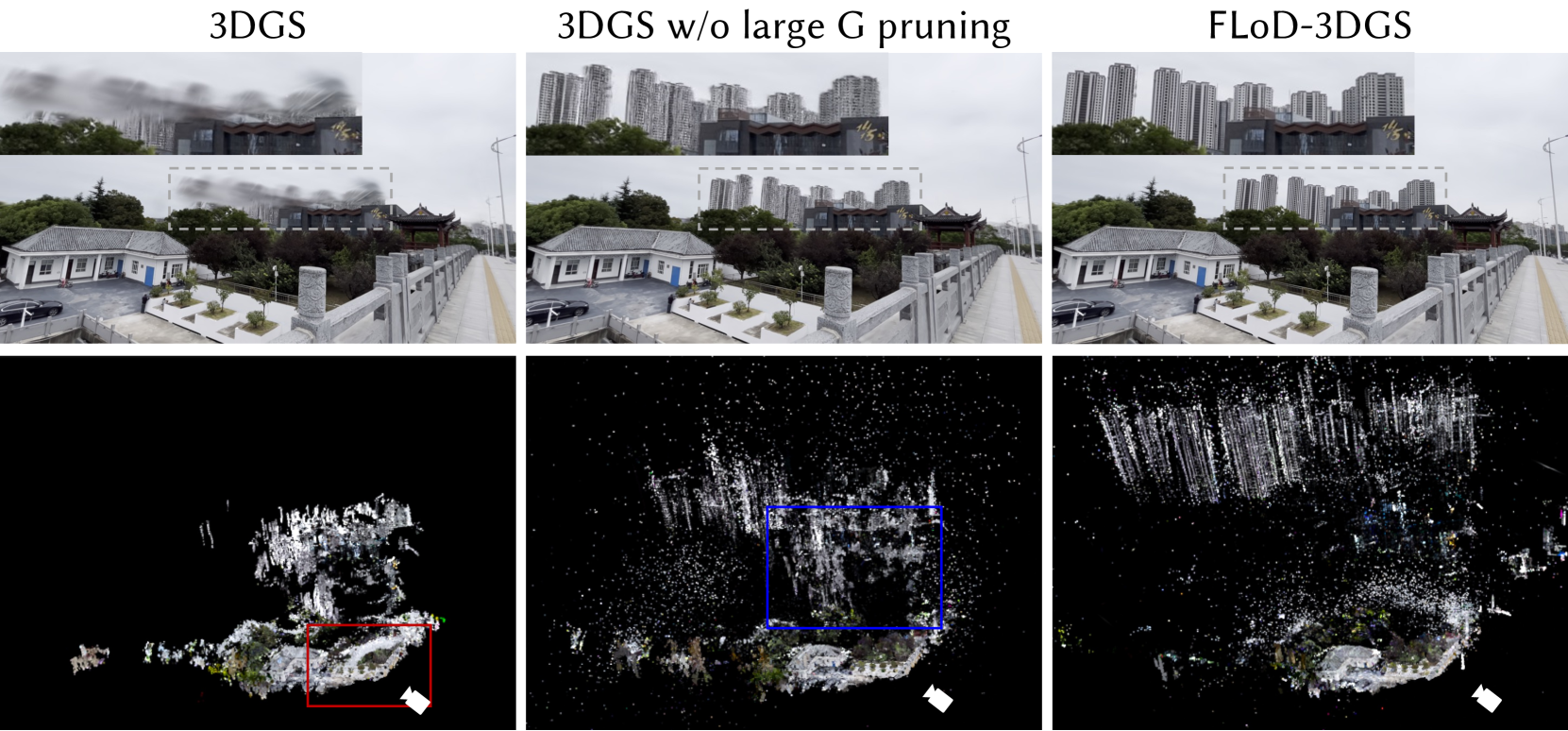
This image is a technical comparison figure, likely from a research paper or presentation, demonstrating the visual and structural differences between three variants of a 3D Gaussian Splatting (3DGS) reconstruction method. The figure is organized into a 3x2 grid. The top row shows rendered views of a 3D scene from a specific viewpoint. The bottom row shows the corresponding underlying 3D point cloud or Gaussian representation for each method against a black background.
### Components/Axes
The image is divided into three vertical columns, each labeled with a method name at the top:
1. **Left Column:** `3DGS`
2. **Middle Column:** `3DGS w/o large G pruning`
3. **Right Column:** `FLoD-3DGS`
Each column contains two vertically stacked panels:
* **Top Panel:** A photorealistic rendered image of an outdoor scene.
* **Bottom Panel:** A visualization of the 3D data structure (point cloud/Gaussians) used to generate the render above.
**Scene Elements (Visible in all top-row renders):**
* A traditional Chinese-style building with a grey tiled roof and white walls in the foreground left.
* A stone balustrade and walkway leading towards the right.
* A dense cluster of modern high-rise apartment buildings in the background.
* Trees and greenery.
* A black car parked near the traditional building.
* A dashed white rectangular box is overlaid on the background buildings in each render, indicating a region of interest for comparison.
* **Text within the scene:** On the dark grey building behind the traditional structure, there are gold-colored Chinese characters: `华` (Huá) and `侨` (Qiáo), which together form `华侨` (Huáqiáo), meaning "Overseas Chinese."
**Data Visualization Elements (Bottom-row panels):**
* The visualizations show white/colored points or splats on a black background, representing the 3D reconstruction.
* **Left (`3DGS`):** A red rectangular box highlights a dense, somewhat noisy cluster of points in the lower-right quadrant.
* **Middle (`3DGS w/o large G pruning`):** A blue rectangular box highlights a region in the center-right, showing a denser, more vertically oriented structure compared to the left panel.
* **Right (`FLoD-3DGS`):** No colored box is present. The point cloud appears the most structured and dense, particularly in the upper region corresponding to the background buildings.
* A small white arrow icon (likely indicating camera viewpoint or orientation) is present in the bottom-right corner of each bottom panel.
### Detailed Analysis
**Top Row - Rendered Scene Quality:**
* **`3DGS` (Left):** The render is significantly degraded. The background high-rise buildings are extremely blurry and lack any fine detail, appearing as smudged grey shapes. The foreground elements (traditional building, walkway) are somewhat clearer but still soft.
* **`3DGS w/o large G pruning` (Middle):** A dramatic improvement over the left panel. The background buildings are now clearly resolved, showing individual windows and structural lines. The overall scene is much sharper.
* **`FLoD-3DGS` (Right):** Visually very similar to the middle panel. The background buildings are sharp and detailed. The difference in render quality between the middle and right panels is subtle to the naked eye in this static image.
**Bottom Row - 3D Data Structure:**
* **`3DGS` (Left):** The point cloud is sparse and fragmented. The red box highlights a concentrated but messy cluster of points, likely corresponding to the poorly reconstructed background area. The overall structure lacks clear definition of the large buildings.
* **`3DGS w/o large G pruning` (Middle):** The point cloud is much denser and more widespread. The blue box highlights a region where points form distinct vertical columns, clearly representing the high-rise buildings. There is a significant amount of "noise" or stray points scattered throughout the volume.
* **`FLoD-3DGS` (Right):** This point cloud appears the most organized and dense. The vertical structures of the background buildings are very well-defined and prominent in the upper half of the visualization. The distribution of points seems more efficient and less noisy than the middle panel, with a clearer separation between the building structures and the surrounding space.
### Key Observations
1. **Progressive Improvement:** There is a clear visual progression from left to right. The standard `3DGS` fails to reconstruct distant/background geometry (the high-rises). Removing the "large G pruning" (`3DGS w/o large G pruning`) dramatically improves the reconstruction of these structures. `FLoD-3DGS` appears to refine this further, potentially with better point distribution or efficiency.
2. **Correlation Between Data and Render:** The quality of the rendered image (top row) is directly correlated with the density and organization of the underlying 3D data (bottom row). Sparse, noisy data leads to blurry renders; dense, structured data leads to sharp renders.
3. **Highlighted Regions:** The colored boxes (red and blue) are used to draw attention to specific areas in the 3D data that explain the differences in the rendered output. The red box in the left column shows the problematic, under-reconstructed area. The blue box in the middle column shows the successfully reconstructed building geometry.
4. **Text Language:** The embedded text in the scene (`华侨`) is in **Chinese (Simplified)**. It translates to **"Overseas Chinese"** in English.
### Interpretation
This figure serves as a qualitative ablation study and comparison for a 3DGS-based method. It demonstrates that a specific algorithmic component—referred to as "large G pruning"—is detrimental to the reconstruction of large, distant structures like the background skyscrapers. By disabling this pruning (`w/o large G pruning`), the method retains more Gaussian primitives (the "G"s), allowing for a much more complete and accurate 3D model, which in turn produces a high-fidelity render.
The `FLoD-3DGS` method is presented as the proposed or superior approach. While its rendered output is similar to the middle panel, its underlying data structure (bottom-right) suggests it achieves comparable or better visual quality potentially with a more optimized, less noisy, or more efficient representation of the 3D scene. The figure argues that `FLoD-3DGS` successfully balances detail preservation (like the middle method) with a cleaner geometric representation.
**In essence, the image communicates:** "Our method (FLoD-3DGS) fixes a flaw in standard 3DGS that caused background details to be lost, and it does so with a high-quality 3D representation, as evidenced by these side-by-side comparisons of both the final pictures and the underlying 3D data."