## Comparison of 3D Reconstruction Techniques: 3DGS, 3DGS w/o large G pruning, and FLoD-3DGS
### Overview
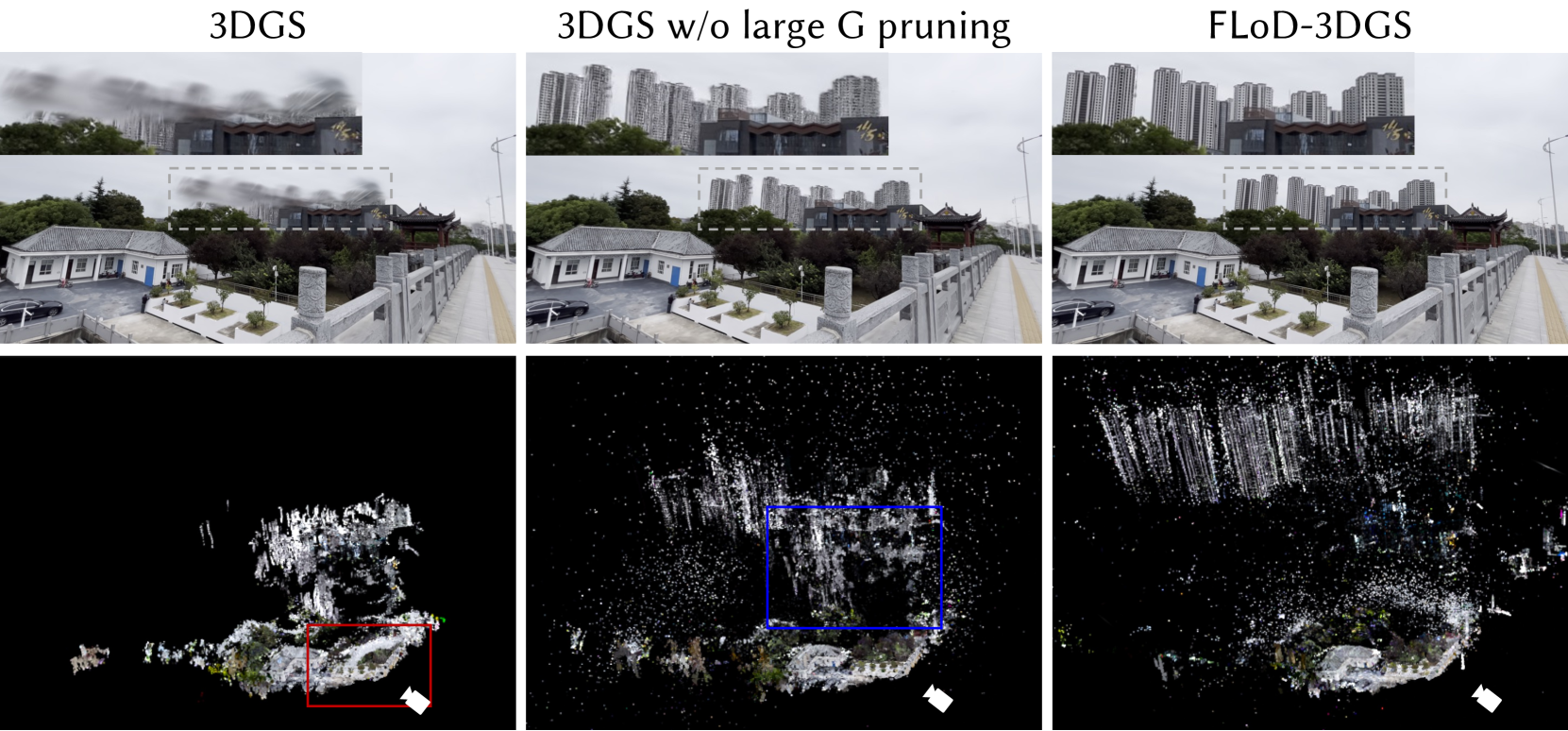
The image compares three 3D reconstruction methods using aerial imagery of a residential area with a city skyline. Each column shows:
1. **Top row**: Photorealistic renderings of the scene.
2. **Bottom row**: Sparse point cloud visualizations (black background with white points).
### Components/Axes
- **Columns**:
- Left: "3DGS" (full method).
- Middle: "3DGS w/o large G pruning" (pruned method).
- Right: "FLoD-3DGS" (proposed method).
- **Annotations**:
- Red box in the left column’s point cloud highlights a region with dense, noisy points.
- Blue box in the middle column’s point cloud highlights a region with sparse, fragmented points.
### Detailed Analysis
#### Top Row (Photorealistic Renderings):
- **3DGS**: Clear, detailed buildings and trees. Minor artifacts in distant structures.
- **3DGS w/o large G pruning**: Similar clarity but with slightly blurred textures in foliage and distant buildings.
- **FLoD-3DGS**: Highest fidelity, with sharp details in both foreground (house) and background (skyline).
#### Bottom Row (Point Clouds):
- **3DGS**:
- Dense clusters of points in the red-boxed region (foreground).
- Sparse coverage in distant skyline areas.
- **3DGS w/o large G pruning**:
- Blue-boxed region shows fragmented points, indicating reduced detail in mid-range structures.
- Overall sparser distribution compared to 3DGS.
- **FLoD-3DGS**:
- Uniform point density across the scene.
- No visible fragmentation; skyline points are more evenly distributed.
### Key Observations
1. **Artifact Reduction**:
- 3DGS w/o large G pruning exhibits blurring in foliage and distant buildings, suggesting over-smoothing.
- FLoD-3DGS eliminates these artifacts while maintaining detail.
2. **Point Cloud Density**:
- 3DGS has high density in foreground but sparse coverage elsewhere.
- FLoD-3DGS achieves balanced density, critical for accurate 3D reconstruction.
3. **Structural Integrity**:
- The red-boxed region in 3DGS shows overcrowded points, likely causing reconstruction noise.
- The blue-boxed region in 3DGS w/o large G pruning reveals gaps, indicating data loss from pruning.
### Interpretation
The comparison demonstrates that **FLoD-3DGS** outperforms both baseline methods by:
- **Balancing detail and efficiency**: Unlike 3DGS, it avoids overcrowding in foreground regions while maintaining skyline accuracy.
- **Mitigating pruning artifacts**: The absence of large G pruning in the middle column leads to fragmented reconstructions, which FLoD-3DGS resolves.
- **Improving spatial coherence**: Uniform point distribution ensures reliable 3D mesh generation, critical for applications like urban planning or virtual reality.
The red and blue boxes spatially ground the analysis, emphasizing regions where each method’s strengths and weaknesses manifest. FLoD-3DGS’s ability to preserve detail without noise suggests a more robust feature encoding strategy, likely leveraging depth-aware optimization.