## Diagram: Geometric Pattern Sequence
### Overview
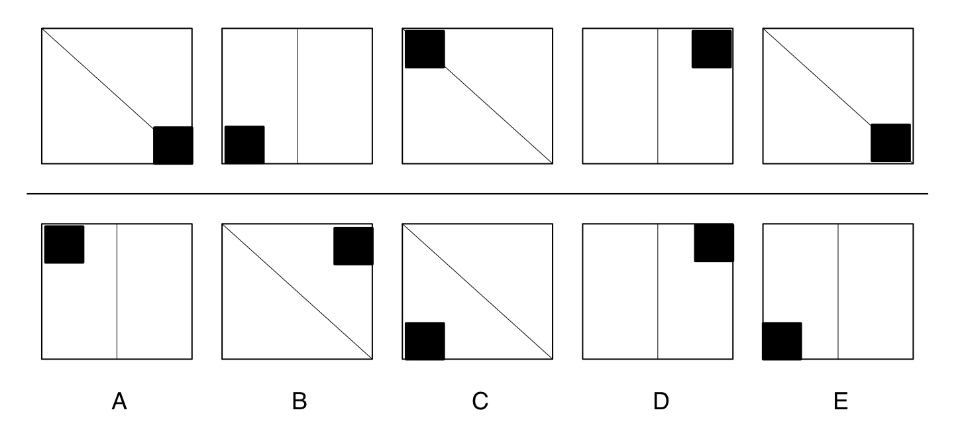
The image displays a visual reasoning puzzle consisting of two rows of five square diagrams each. The top row presents a sequence of five patterns, while the bottom row presents five labeled options (A through E), which are also individual patterns. A horizontal line separates the top sequence from the bottom options. Each individual square diagram contains a larger outer square, an internal line (either diagonal or vertical), and a small, solid black square positioned in one of the four corners or quadrants.
### Components/Elements
The image is structured into three main regions:
1. **Top Row (Sequence):** Five square diagrams arranged horizontally.
* Each diagram is a white square with a black outline.
* Each contains either a single diagonal line extending from the top-left corner to the bottom-right corner, or a single vertical line dividing the square into two equal halves.
* Each contains a small, solid black square, approximately 1/4 the width and height of the main square, positioned in one of the four corners (top-left, top-right, bottom-left, bottom-right).
2. **Separator:** A thin horizontal black line positioned below the top row of diagrams.
3. **Bottom Row (Options):** Five square diagrams, identical in structure to those in the top row, arranged horizontally.
* These diagrams are labeled 'A', 'B', 'C', 'D', and 'E' respectively, with the labels centered directly below each square.
### Detailed Analysis
Each square diagram is analyzed by its internal line type and the position of the black square.
**Top Row (Left to Right):**
1. **First Square (Top-Left):** Contains a diagonal line from the top-left to the bottom-right. The small black square is located in the **bottom-right** corner.
2. **Second Square (Top-Center-Left):** Contains a vertical line in the middle. The small black square is located in the **bottom-left** corner (specifically, the bottom-left of the left half).
3. **Third Square (Top-Center):** Contains a diagonal line from the top-left to the bottom-right. The small black square is located in the **top-left** corner.
4. **Fourth Square (Top-Center-Right):** Contains a vertical line in the middle. The small black square is located in the **top-right** corner (specifically, the top-right of the right half).
5. **Fifth Square (Top-Right):** Contains a diagonal line from the top-left to the bottom-right. The small black square is located in the **bottom-right** corner.
**Bottom Row (Left to Right), labeled A-E:**
* **Square A (Bottom-Left):** Contains a vertical line in the middle. The small black square is located in the **top-left** corner (specifically, the top-left of the left half).
* **Square B (Bottom-Center-Left):** Contains a diagonal line from the top-left to the bottom-right. The small black square is located in the **top-right** corner.
* **Square C (Bottom-Center):** Contains a diagonal line from the top-left to the bottom-right. The small black square is located in the **bottom-left** corner.
* **Square D (Bottom-Center-Right):** Contains a vertical line in the middle. The small black square is located in the **top-right** corner (specifically, the top-right of the right half).
* **Square E (Bottom-Right):** Contains a vertical line in the middle. The small black square is located in the **bottom-left** corner (specifically, the bottom-left of the left half).
### Key Observations
1. **Line Type Alternation:** In the top row, the internal line type alternates consistently: Diagonal, Vertical, Diagonal, Vertical, Diagonal.
2. **Black Square Position Rotation:** The position of the small black square in the top row follows a clockwise rotation through the four corners/quadrants:
* Bottom-Right (1st square)
* Bottom-Left (2nd square)
* Top-Left (3rd square)
* Top-Right (4th square)
* Bottom-Right (5th square)
3. **Cyclical Pattern:** The 5th square in the top row is identical to the 1st square, indicating a potential cycle of four unique patterns that repeats.
### Interpretation
The image presents a visual pattern recognition task. The top row establishes a clear, repeating sequence based on two attributes: the type of internal line and the position of the small black square.
The pattern in the top row is:
1. **Line Type:** Alternates between Diagonal (from top-left to bottom-right) and Vertical (central).
2. **Black Square Position:** Rotates clockwise through the four corners/quadrants: Bottom-Right, Bottom-Left, Top-Left, Top-Right.
Combining these, the sequence is:
* (Diagonal Line, Bottom-Right Black Square)
* (Vertical Line, Bottom-Left Black Square)
* (Diagonal Line, Top-Left Black Square)
* (Vertical Line, Top-Right Black Square)
* (Diagonal Line, Bottom-Right Black Square) - This is a repeat of the first element, completing a cycle of four unique patterns.
If the task is to identify the next element in this repeating sequence, following the 5th element (which is identical to the 1st), the 6th element would be identical to the 2nd element of the top row.
The 2nd element of the top row is: **Vertical line, with the black square in the bottom-left corner.**
Comparing this predicted pattern to the options in the bottom row:
* Option A: Vertical line, black square in top-left. (Does not match)
* Option B: Diagonal line, black square in top-right. (Does not match)
* Option C: Diagonal line, black square in bottom-left. (Does not match)
* Option D: Vertical line, black square in top-right. (Does not match)
* Option E: **Vertical line, black square in bottom-left.** (Matches the predicted next element perfectly)
Therefore, based on the established cyclical pattern, option E is the logical continuation of the sequence presented in the top row.