## Box Plot: Number of Goals Achieved by Standard Agent vs. Learning Agent
### Overview
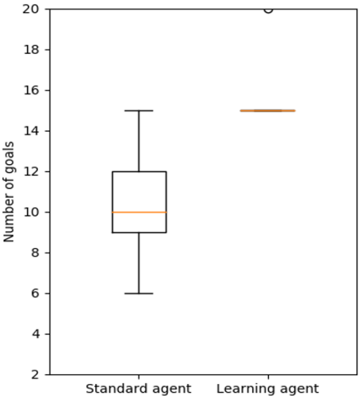
The image is a box plot comparing the number of goals achieved by a "Standard agent" and a "Learning agent." The plot visualizes the distribution of goals achieved by each agent, showing the median, quartiles, and outliers.
### Components/Axes
* **X-axis:** Agent type (categorical): "Standard agent" and "Learning agent".
* **Y-axis:** Number of goals (numerical), ranging from 2 to 20, with tick marks at intervals of 2.
* **Box Plot Components:** Each box plot shows the median (orange line), the interquartile range (IQR, the box), and the whiskers extending to the furthest data point within 1.5 times the IQR. Outliers are shown as individual points.
### Detailed Analysis
* **Standard Agent:**
* The box extends from approximately 9 goals to 12 goals.
* The median (orange line) is at approximately 10 goals.
* The lower whisker extends down to approximately 6 goals.
* The upper whisker extends up to approximately 15 goals.
* **Learning Agent:**
* The box is a single line at approximately 15 goals, indicating a very narrow interquartile range.
* The median (orange line) is at approximately 15 goals.
* There is one outlier at approximately 20 goals.
### Key Observations
* The learning agent consistently achieves a higher number of goals compared to the standard agent.
* The learning agent's performance is much less variable than the standard agent's, as indicated by the narrow box plot.
* The learning agent has one outlier, indicating a single instance of exceptionally high performance.
### Interpretation
The box plot suggests that the learning agent is significantly more effective at achieving goals than the standard agent. The learning agent's consistent performance, as indicated by the narrow box plot, suggests that it is more reliable. The outlier for the learning agent indicates that it is also capable of achieving exceptionally high performance in some instances. The standard agent's performance is more variable, suggesting that its success is more dependent on external factors or random chance.