## Photograph: Post-Collision Vehicle Damage Scene
### Overview
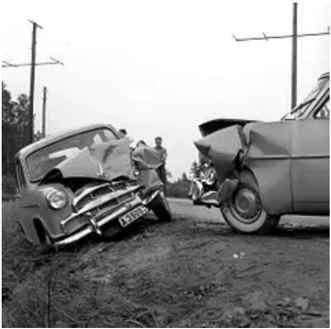
The image depicts a severe frontal collision between two vintage automobiles on a rural road. Both vehicles exhibit catastrophic structural damage, with one car tilted at an angle and the other partially elevated off the ground. A human figure stands between the wreckage, observing the scene. The environment includes utility poles, sparse vegetation, and an overcast sky.
### Components/Axes
- **No textual elements, charts, or diagrams** are present in the image.
- **Primary subjects**: Two damaged vehicles, a human figure, and environmental context (road, vegetation, infrastructure).
### Detailed Analysis
1. **Vehicles**:
- **Left vehicle**: A mid-20th-century sedan (likely 1950s–1960s) with a severely crumpled front end. The hood is detached and bent upward, the grille is distorted, and the bumper is detached. The license plate is partially visible but illegible.
- **Right vehicle**: A similar-era sedan with a completely destroyed front end. The engine compartment is exposed, the headlight assembly is shattered, and the front wheel is misaligned.
- **Damage patterns**: Both vehicles show signs of high-impact collision, with deformation concentrated at the front ends. No visible fire or fluid leaks are apparent.
2. **Human figure**:
- A person stands upright between the vehicles, facing the camera. Clothing is nondescript, and no tools or emergency equipment are visible. Their posture suggests they may be a bystander, driver, or first responder.
3. **Environment**:
- **Road**: A narrow, unpaved rural road with grass and debris scattered around the wreckage.
- **Infrastructure**: Two utility poles with crossbeams are visible in the background, spaced approximately 50 meters apart.
- **Vegetation**: Sparse trees and shrubs line the roadside, indicating a non-urban setting.
### Key Observations
- **Collision severity**: The extent of deformation suggests a high-speed impact, though no skid marks or tire marks are visible.
- **Vehicle orientation**: The left vehicle is tilted at ~30° relative to the road, while the right vehicle is partially airborne, indicating a possible rollover or secondary impact.
- **Human presence**: The individual’s proximity to the wreckage raises questions about their role (e.g., assessing damage, awaiting assistance).
### Interpretation
The scene likely results from a frontal collision, possibly caused by mechanical failure, driver error, or environmental factors (e.g., poor road conditions). The absence of emergency services or bystanders suggests the photo was taken shortly after the incident. The vintage design of the vehicles implies the event occurred decades ago, highlighting historical automotive safety standards. The human figure’s presence underscores the human element in such accidents, emphasizing the need for post-collision safety protocols.
**Note**: No factual data (e.g., speed, time, location) is extractable from the image. All interpretations are speculative based on visual evidence.