## Diagram: Confidence-Based Response Analysis for "Deep Blue" Query
### Overview
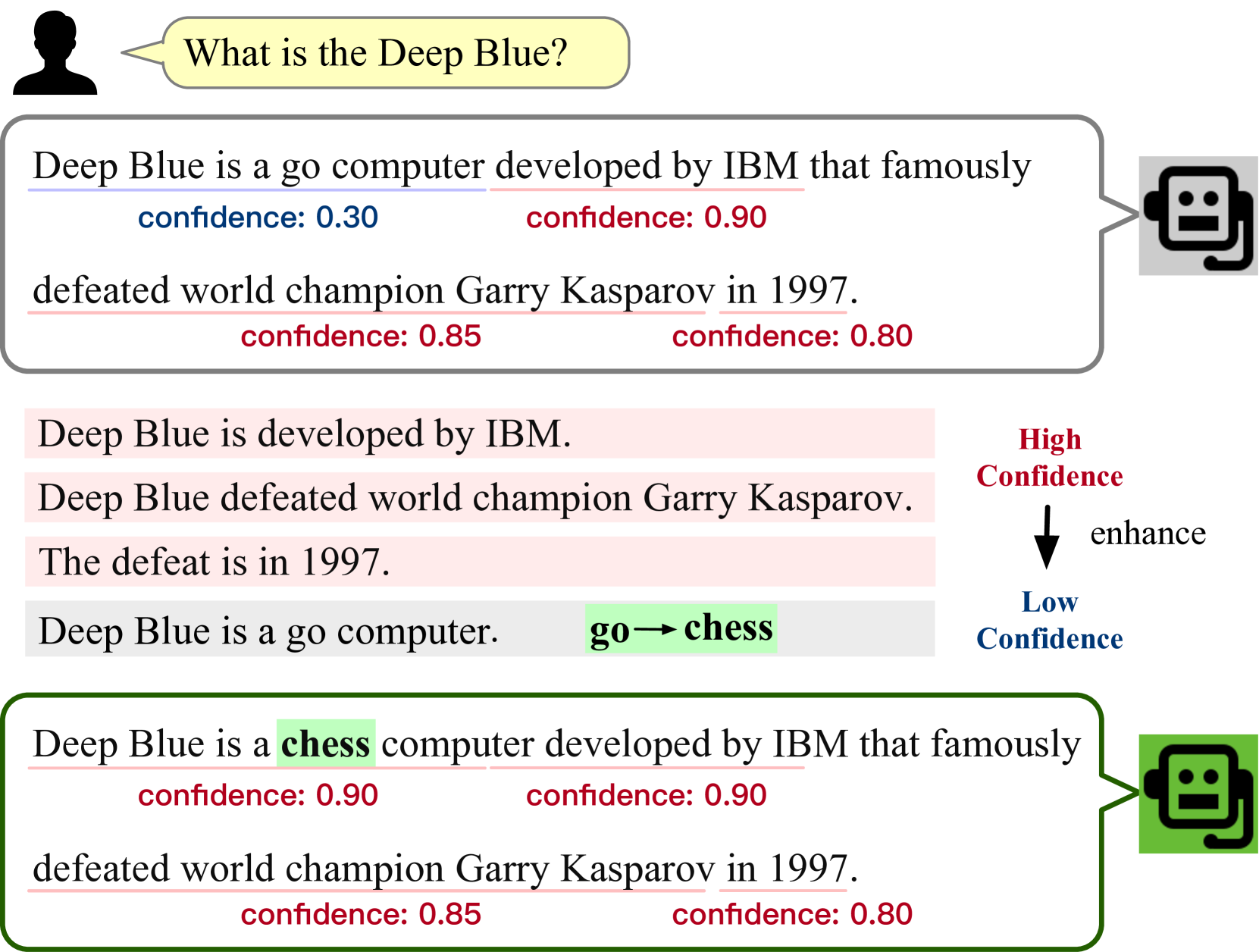
The diagram illustrates a conversational interaction between a user and a chatbot discussing "Deep Blue," a chess-playing computer developed by IBM. It visualizes confidence scores for different components of the chatbot's response, using color-coding (red for high confidence, blue for low confidence) and directional arrows to indicate confidence enhancement pathways.
### Components/Axes
1. **User Input**:
- Text: "What is the Deep Blue?"
- Position: Top-left corner.
2. **Chatbot Response**:
- Text: "Deep Blue is a go computer developed by IBM that famously defeated world champion Garry Kasparov in 1997."
- Confidence Scores:
- "developed by IBM": 0.30 (blue)
- "famously defeated world champion Garry Kasparov": 0.90 (red)
- "in 1997": 0.85 (red)
- "a go computer": 0.80 (red)
- Position: Center-left.
3. **Response Breakdown**:
- Four segmented statements with confidence scores:
- "Deep Blue is developed by IBM." (confidence: 0.90, red)
- "Deep Blue defeated world champion Garry Kasparov." (confidence: 0.85, red)
- "The defeat is in 1997." (confidence: 0.80, red)
- "Deep Blue is a go computer." (confidence: 0.30, blue)
- Position: Center-right.
4. **Confidence Enhancement Arrows**:
- Red arrow labeled "enhance" pointing from "Low Confidence" (blue) to "High Confidence" (red).
- Position: Bottom-center.
5. **Legend**:
- Red: High Confidence (0.80–0.90)
- Blue: Low Confidence (0.30)
- Position: Bottom-left.
6. **Chatbot Icon**:
- Visual representation of a chatbot (speech bubble with robot face).
- Position: Right of the chatbot response.
### Detailed Analysis
- **Confidence Distribution**:
- High-confidence statements (red) dominate the response, covering core facts (e.g., "developed by IBM," "defeated Garry Kasparov").
- Low-confidence statements (blue) include ambiguous phrasing ("a go computer") and temporal specificity ("in 1997").
- **Color Consistency**:
- Red consistently marks statements with confidence ≥0.80.
- Blue marks the lowest-confidence statement ("a go computer," 0.30).
- **Flow**:
- The user's question triggers the chatbot's response, which is then decomposed into verifiable components.
- Arrows suggest that improving low-confidence elements (e.g., correcting "go computer" to "chess computer") could enhance overall accuracy.
### Key Observations
1. **Ambiguity in "Go Computer"**:
- The chatbot initially mislabels Deep Blue as a "go computer" (confidence: 0.30), likely due to confusion with IBM's later "AlphaGo" system.
2. **Temporal Specificity**:
- The year "1997" has moderate confidence (0.80), reflecting potential uncertainty in precise event dating.
3. **Confidence Enhancement Pathway**:
- The diagram implies that refining low-confidence elements (e.g., correcting "go" to "chess") would strengthen the response's reliability.
### Interpretation
The diagram highlights the interplay between factual accuracy and model confidence in natural language processing. The chatbot's initial error ("go computer") underscores challenges in disambiguating homonymous terms (e.g., "Deep Blue" vs. "AlphaGo"). The confidence scores and color-coding provide a visual framework for identifying knowledge gaps, while the enhancement arrows suggest iterative improvement mechanisms. This analysis emphasizes the importance of contextual grounding (e.g., linking "Deep Blue" to chess history) to resolve ambiguities and improve response reliability.