## Code Snippet: Number Theory Theorems
### Overview
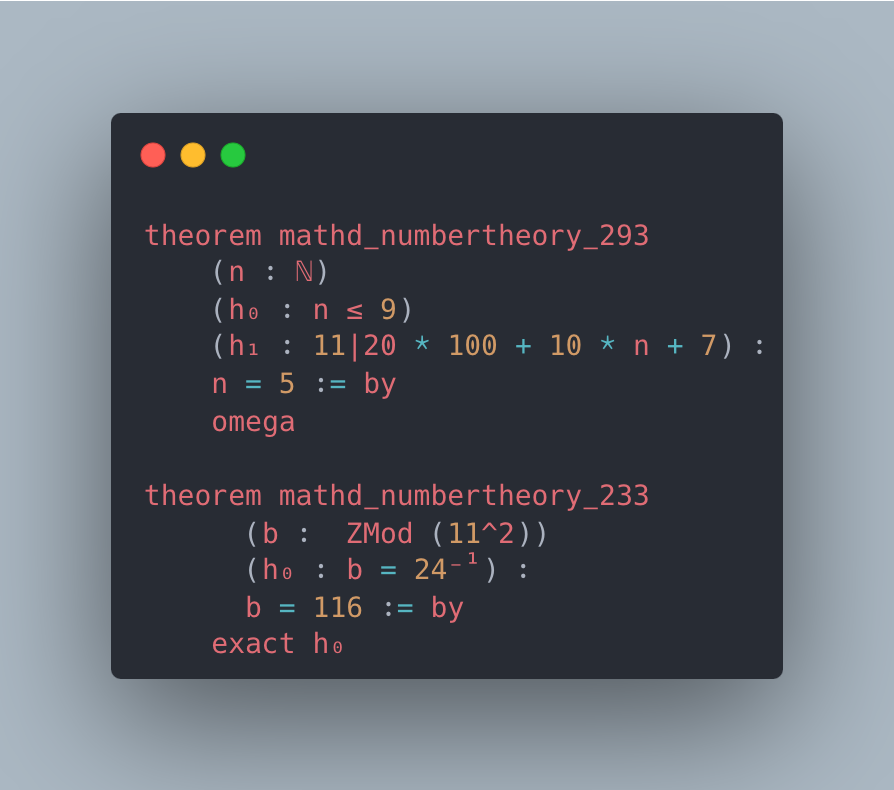
The image presents a code snippet, likely from a formal verification system or proof assistant, defining two theorems related to number theory. The code uses a specific syntax for defining theorems, assumptions, and proofs.
### Components/Axes
The image contains the following elements:
* **Window Decorations:** Standard window controls (red, yellow, green circles) in the top-left corner.
* **Theorem Definitions:** Two theorem definitions, `mathd_numbertheory_293` and `mathd_numbertheory_233`.
* **Variables and Types:** Declarations of variables with their corresponding types (e.g., `n : N`, `b : ZMod (11^2)`).
* **Assumptions:** Hypotheses or preconditions for the theorems (e.g., `h0 : n ≤ 9`, `h1 : 11|20 * 100 + 10 * n + 7`, `h0 : b = 24⁻¹`).
* **Statements:** Assertions to be proven (e.g., `n = 5`, `b = 116`).
* **Proof Strategies:** Tactics used to prove the statements (e.g., `:= by omega`, `:= by exact h0`).
### Detailed Analysis or ### Content Details
**Theorem `mathd_numbertheory_293`:**
* **Name:** `theorem mathd_numbertheory_293`
* **Variable:** `n` of type `N` (likely natural numbers).
* **Assumption `h0`:** `n ≤ 9` (n is less than or equal to 9).
* **Assumption `h1`:** `11|20 * 100 + 10 * n + 7` (11 divides 20 * 100 + 10 * n + 7).
* **Statement:** `n = 5`
* **Proof:** `:= by omega` (likely an automated proof tactic).
**Theorem `mathd_numbertheory_233`:**
* **Name:** `theorem mathd_numbertheory_233`
* **Variable:** `b` of type `ZMod (11^2)` (integers modulo 11 squared, i.e., modulo 121).
* **Assumption `h0`:** `b = 24⁻¹` (b is the modular inverse of 24 modulo 121).
* **Statement:** `b = 116`
* **Proof:** `:= by exact h0` (the statement follows directly from assumption h0).
### Key Observations
* The code uses a formal syntax, suggesting it's part of a proof assistant or formal verification tool.
* The theorems involve basic number theory concepts like divisibility, modular arithmetic, and modular inverses.
* The proofs are concise, relying on automated tactics or direct application of assumptions.
### Interpretation
The code snippet demonstrates the formalization of number theory theorems within a proof assistant. The theorems are precisely stated with explicit assumptions and types. The proofs, while brief, indicate the logical steps required to establish the truth of the statements. The use of tactics like `omega` suggests the system can automatically handle certain types of proofs. The second theorem shows a direct application of an assumption to prove the statement.