\n
## Text Block: Mathematical Theorems
### Overview
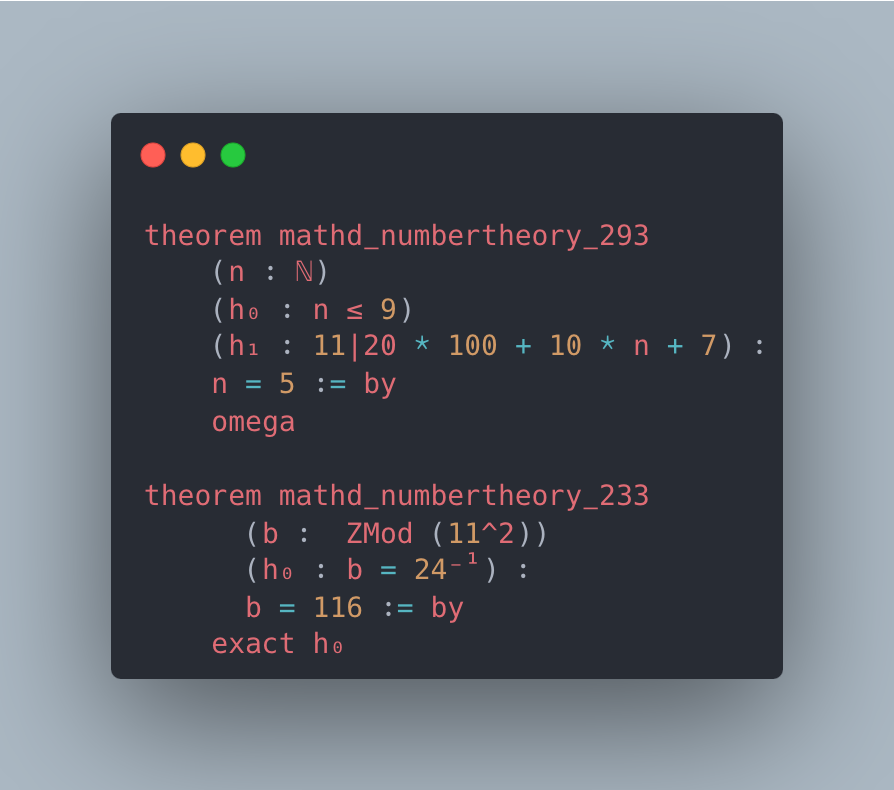
The image displays a screenshot of a code editor or similar environment containing two mathematical theorems written in a formal, likely proof-assistant language. The theorems relate to number theory and modular arithmetic.
### Components/Axes
There are no axes or charts in this image. The content is purely textual. The image contains three colored circles at the top-left corner: red, orange, and green.
### Detailed Analysis or Content Details
**Theorem 1: mathd_numbertheory_293**
* `(n : N)`: Declares a variable 'n' of type 'N' (presumably natural numbers).
* `(h₀ : n ≤ 9)`: Defines a hypothesis 'h₀' stating that 'n' is less than or equal to 9.
* `(h₁ : 11 | 20 * 100 + 10 * n + 7)`: Defines a hypothesis 'h₁' stating that 11 divides (20 * 100 + 10 * n + 7). The symbol '|' likely represents divisibility.
* `n = 5 := by omega`: States that 'n' is equal to 5, and this is proven 'by omega' (likely a proof tactic or command within the system).
**Theorem 2: mathd_numbertheory_233**
* `(b : ZMod (11^2))` : Declares a variable 'b' of type 'ZMod (11^2)' (integers modulo 11 squared, or 121).
* `(h₀ : b = 24⁻¹)`: Defines a hypothesis 'h₀' stating that 'b' is the modular inverse of 24 modulo 121.
* `b = 116 := by exact h₀`: States that 'b' is equal to 116, and this is proven 'by exact h₀' (meaning it directly follows from the hypothesis h₀).
### Key Observations
The theorems are presented in a highly structured format, typical of formal mathematical proofs. The use of hypotheses (h₀, h₁) and proof tactics (omega, exact) suggests this is code intended for a proof assistant like Lean, Coq, or Isabelle. The theorems themselves involve basic number theory concepts like divisibility and modular inverses.
### Interpretation
The image demonstrates a snippet of formal mathematical reasoning. The theorems are likely part of a larger effort to rigorously prove properties of numbers. The use of a proof assistant ensures that the proofs are logically sound and free from errors. The theorems themselves are relatively simple, but they illustrate the power of formal methods in mathematics. The 'omega' tactic in the first theorem suggests an automated proof search, while 'exact h₀' in the second theorem indicates a direct application of a previously stated hypothesis. The theorems are named with a specific naming convention, `mathd_numbertheory_XXX`, suggesting they are part of a larger library or collection of number theory results.