## Diagram: KV Cache Quantization and Compression Workflow
### Overview
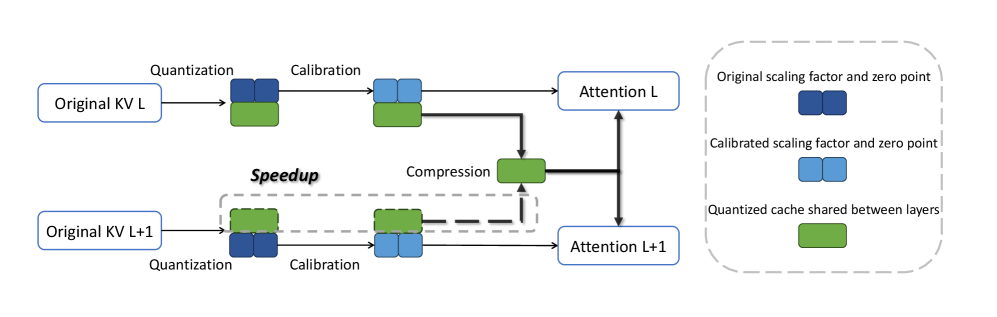
This diagram illustrates a technical workflow for optimizing Key-Value (KV) cache in a neural network, specifically targeting the attention mechanism across adjacent layers ($L$ and $L+1$). The process involves quantization, calibration, and a compression mechanism designed to share cache data between layers, with the explicit goal of achieving a "Speedup."
### Components/Axes
The diagram is organized as a flow chart reading from left to right, with a legend on the right side.
**Legend (Right side, enclosed in a dashed box):**
* **Dark Blue (Two squares):** "Original scaling factor and zero point"
* **Light Blue (Two squares):** "Calibrated scaling factor and zero point"
* **Green (One rectangle):** "Quantized cache shared between layers"
**Main Flow Components:**
* **Inputs (Far Left):** "Original KV L" and "Original KV L+1".
* **Processing Steps:** "Quantization" (arrows), "Calibration" (arrows), and "Compression" (central block).
* **Outputs (Far Right):** "Attention L" and "Attention L+1".
* **Speedup Zone (Bottom-Center):** A dashed box labeled "Speedup" highlighting the input processing of Layer $L+1$ and the compression mechanism.
### Detailed Analysis
**1. Layer L Path (Top):**
* **Input:** Starts at "Original KV L".
* **Transformation:** Passes through "Quantization" (resulting in Dark Blue blocks) and "Calibration" (resulting in Light Blue blocks).
* **Output:** The calibrated data feeds into "Attention L".
* **Compression Link:** A solid black line connects the Light Blue block (Calibrated) of Layer $L$ to the central "Compression" block (Green).
**2. Layer L+1 Path (Bottom):**
* **Input:** Starts at "Original KV L+1".
* **Transformation:** Passes through "Quantization" (resulting in Dark Blue blocks) and "Calibration" (resulting in Light Blue blocks).
* **Output:** The calibrated data feeds into "Attention L+1".
* **Compression Link:** A dashed line connects the Green block (Quantized cache shared) of Layer $L+1$ to the central "Compression" block (Green).
**3. Central Compression Hub:**
* The "Compression" block (Green) acts as a central node.
* It receives input from the Layer $L$ path (solid line) and the Layer $L+1$ path (dashed line).
* The output of this "Compression" block connects to a vertical line that bridges "Attention L" and "Attention L+1".
### Key Observations
* **Asymmetric Connections:** The connection from Layer $L$ to the Compression block is solid, while the connection from Layer $L+1$ to the Compression block is dashed. This suggests a difference in how the cache is derived or prioritized between the two layers.
* **Shared Resource:** The Green block ("Quantized cache shared between layers") is the only component that is shared/compressed, acting as a bridge between the two attention layers.
* **Speedup Context:** The "Speedup" label is spatially positioned over the Layer $L+1$ input and the compression mechanism, implying that the optimization is specifically targeting the processing of subsequent layers in the stack.
### Interpretation
This diagram depicts a memory-optimization strategy for Large Language Models (LLMs), likely related to **KV Cache Quantization**.
* **The Problem:** Storing KV caches for every layer in a transformer model consumes significant VRAM and memory bandwidth, which is a primary bottleneck during inference.
* **The Solution:** The diagram demonstrates a method to reduce this footprint by:
1. **Quantizing and Calibrating:** Converting high-precision "Original" KV data into lower-precision "Calibrated" formats (likely INT8 or INT4).
2. **Sharing/Compression:** Instead of keeping unique caches for every layer, the model compresses and shares the cache between adjacent layers ($L$ and $L+1$).
* **Why it matters:** By sharing the "Quantized cache" (the Green block) between layers, the system reduces the total memory footprint. The "Speedup" label indicates that this reduction in memory usage likely leads to faster inference times, as the system spends less time moving data between memory and the compute units (Attention mechanisms). The vertical line connecting the attention layers suggests that the compressed cache is utilized by both layers simultaneously or sequentially, effectively reusing the computed values.