## Diagram: Online and Offline Learning System
### Overview
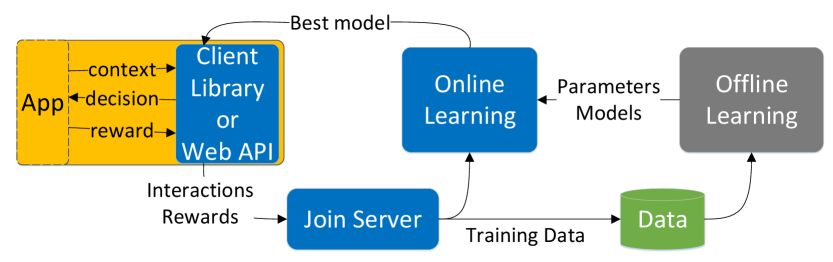
The image is a diagram illustrating a system that combines online and offline learning. It shows the flow of data and interactions between different components, including an App, Client Library/Web API, Join Server, Online Learning module, Offline Learning module, and a Data store.
### Components/Axes
* **App (Yellow):** Represents the application that interacts with the system. It provides context, makes decisions, and receives rewards.
* Input: context
* Output: decision
* Input: reward
* **Client Library or Web API (Blue):** Acts as an interface between the App and the learning system.
* Input: context, decision, reward
* Output: Best model
* **Join Server (Blue):** Receives interactions and rewards.
* Input: Interactions, Rewards
* **Online Learning (Blue):** Learns from real-time data.
* Input: Training Data, Interactions, Rewards
* Output: Parameters, Models
* **Offline Learning (Gray):** Learns from stored data.
* Input: Data, Parameters, Models
* **Data (Green):** Represents the stored data used for offline learning.
* Input: Training Data
### Detailed Analysis
* **Flow of Data:**
* The App sends context to the Client Library/Web API.
* The App receives decisions from the Client Library/Web API.
* The App sends rewards to the Client Library/Web API.
* The Client Library/Web API sends the best model to the App.
* The Client Library/Web API sends interactions and rewards to the Join Server.
* The Join Server sends training data to the Online Learning module and the Data store.
* The Online Learning module sends parameters and models to the Offline Learning module.
* The Data store sends data to the Offline Learning module.
* **Learning Processes:**
* Online Learning: Learns from real-time interactions and rewards.
* Offline Learning: Learns from stored data and models generated by online learning.
### Key Observations
* The system integrates both online and offline learning approaches.
* The App interacts with the system through the Client Library/Web API.
* The Join Server acts as a central point for collecting interactions and rewards.
* The Online Learning module provides parameters and models to the Offline Learning module.
* The Data store provides data to the Offline Learning module.
### Interpretation
The diagram illustrates a reinforcement learning system where an application interacts with an environment, and the system learns from these interactions to improve its decision-making. The online learning component allows the system to adapt to real-time changes, while the offline learning component allows the system to leverage historical data to further improve its performance. The "Best model" feedback loop from the Client Library/Web API to the App suggests that the system is continuously updating its model based on the learning process. The system is designed to learn from both real-time interactions and historical data, which can lead to more robust and effective learning.