## Diagram: Multiple-Choice and Open-Style Question Processing Path
### Overview
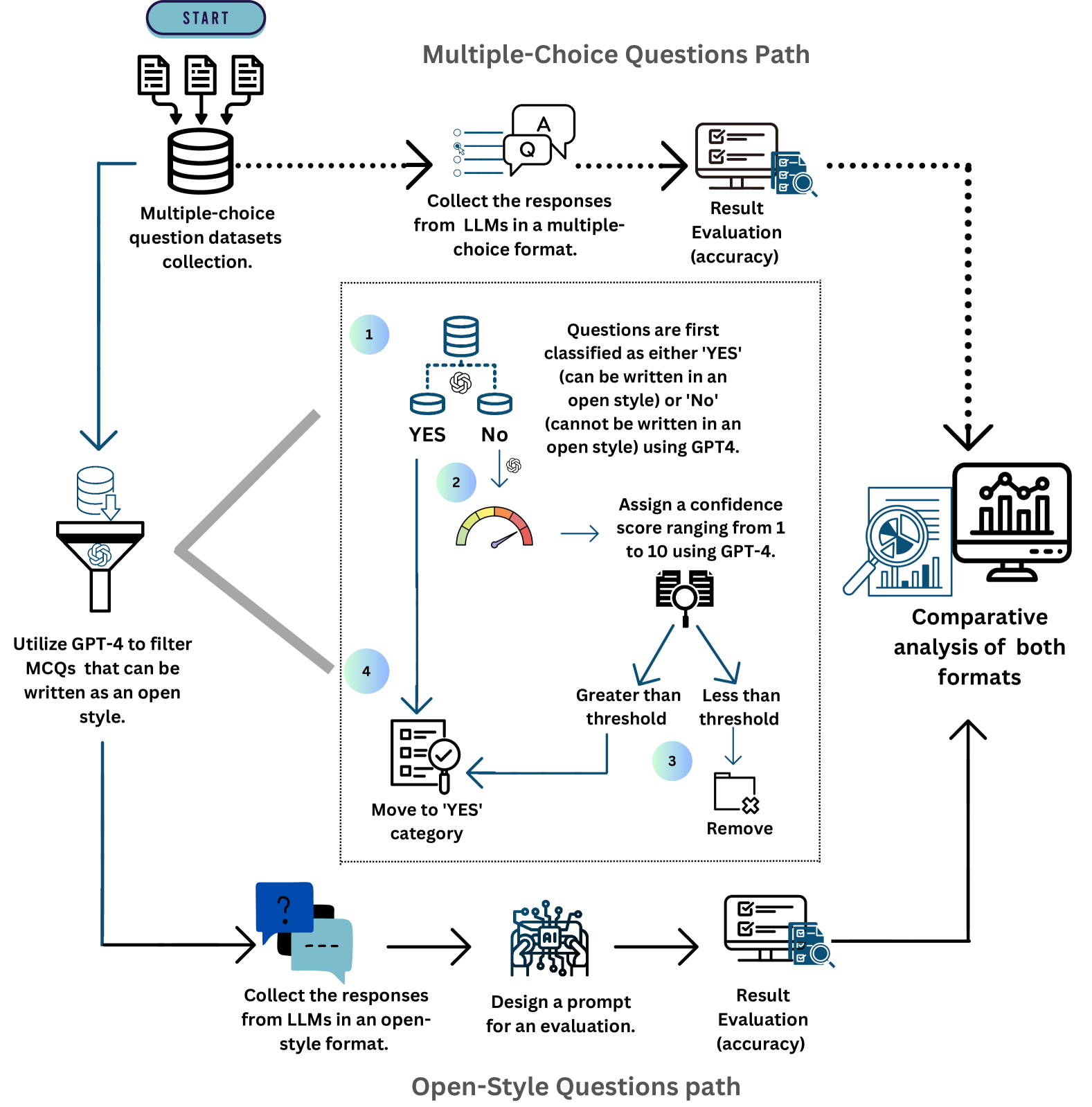
The image is a flowchart illustrating the process of handling multiple-choice and open-style questions using Large Language Models (LLMs) and GPT-4. It outlines the steps involved in filtering, classifying, evaluating, and comparing the two question formats.
### Components/Axes
The diagram is divided into two main paths: "Multiple-Choice Questions Path" at the top and "Open-Style Questions Path" at the bottom.
**Multiple-Choice Questions Path:**
* **Start:** A rounded rectangle labeled "START" at the top-left.
* **Multiple-choice question datasets collection:** A database icon with multiple documents flowing into it.
* **Collect the responses from LLMs in a multiple-choice format:** A speech bubble icon with "A" and "Q" inside.
* **Result Evaluation (accuracy):** A computer screen icon displaying a checklist.
* **Decision Point 1:** A database icon split into "YES" and "No" categories, indicating whether questions can be written in an open style.
* **Decision Point 2:** A gauge icon representing the confidence score assignment (ranging from 1 to 10) using GPT-4.
* **Decision Point 3:** A branching point based on whether the confidence score is "Greater than threshold" or "Less than threshold."
* **Decision Point 4:** "Move to 'YES' category"
* **Remove:** A trash can icon.
* **Comparative analysis of both formats:** A computer screen icon displaying a chart and a pie chart.
**Open-Style Questions Path:**
* **Collect the responses from LLMs in an open-style format:** A speech bubble icon with a question mark.
* **Design a prompt for an evaluation:** An AI chip icon.
* **Result Evaluation (accuracy):** A computer screen icon displaying a checklist.
**Shared Elements:**
* **Utilize GPT-4 to filter MCQs that can be written as an open style:** A funnel icon.
### Detailed Analysis or Content Details
**Multiple-Choice Questions Path:**
1. **Start:** The process begins with a collection of multiple-choice question datasets.
2. **Collect Responses:** LLMs generate responses in a multiple-choice format.
3. **Result Evaluation:** The accuracy of the responses is evaluated.
4. **Classification:** Questions are classified as either 'YES' (can be written in an open style) or 'No' (cannot be written in an open style) using GPT-4.
5. **Confidence Score:** A confidence score ranging from 1 to 10 is assigned using GPT-4.
6. **Thresholding:** If the confidence score is greater than a threshold, the question is moved to the 'YES' category. If it is less than the threshold, the question is removed.
7. **Comparative Analysis:** A comparative analysis of both formats (multiple-choice and open-style) is performed.
**Open-Style Questions Path:**
1. **Collect Responses:** LLMs generate responses in an open-style format.
2. **Prompt Design:** A prompt is designed for evaluation.
3. **Result Evaluation:** The accuracy of the responses is evaluated.
**Filtering:**
* GPT-4 is used to filter MCQs that can be written as an open style.
### Key Observations
* The diagram illustrates a comprehensive process for handling both multiple-choice and open-style questions using LLMs and GPT-4.
* The multiple-choice path includes a classification and confidence scoring step, while the open-style path focuses on prompt design and evaluation.
* A comparative analysis is performed to compare the results of both formats.
### Interpretation
The diagram demonstrates a systematic approach to leveraging LLMs for question processing. The multiple-choice path incorporates a filtering mechanism to identify questions suitable for open-style conversion, potentially enhancing the dataset's versatility. The confidence scoring step adds a layer of quality control, ensuring that only reliable questions are moved to the 'YES' category. The comparative analysis suggests an effort to understand the strengths and weaknesses of each question format, potentially informing future question design and evaluation strategies. The use of GPT-4 throughout the process highlights its role in question classification, confidence scoring, and filtering, indicating its importance in the overall workflow.