## Scatter Plots and Heatmaps: Acoustic Field Visualization
### Overview
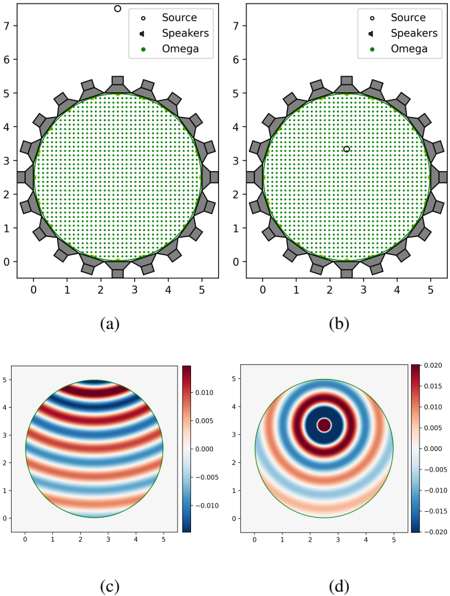
This image displays four subplots arranged in a 2x2 grid, labeled (a), (b), (c), and (d). Subplots (a) and (b) are scatter plots showing the spatial distribution of "Source," "Speakers," and "Omega" points within a circular region surrounded by a toothed gear-like structure. Subplots (c) and (d) are heatmaps visualizing a scalar field within a circular domain, with associated color bars indicating the value range.
### Components/Axes
**Subplot (a):**
* **Title:** (a)
* **X-axis:** Range from 0 to 5, with tick marks at 0, 1, 2, 3, 4, 5. Labeled implicitly by the numerical markers.
* **Y-axis:** Range from 0 to 7, with tick marks at 0, 1, 2, 3, 4, 5, 6, 7. Labeled implicitly by the numerical markers.
* **Legend:** Located in the top-right corner.
* **Source:** Represented by a black circle (o).
* **Speakers:** Represented by black triangles (▲).
* **Omega:** Represented by green dots (•).
* **Visual Elements:**
* A circular region filled with green dots (Omega points). The circle has a radius of approximately 2.5 units, centered at (2.5, 2.5).
* A toothed gear-like structure surrounding the circular region, with 16 teeth. The outer boundary of the gear structure extends to approximately x=5.5 and y=5.5.
* A single black circle (Source) is located at approximately (2.5, 7.5).
* No black triangles (Speakers) are visible in this subplot.
**Subplot (b):**
* **Title:** (b)
* **X-axis:** Range from 0 to 5, with tick marks at 0, 1, 2, 3, 4, 5. Labeled implicitly by the numerical markers.
* **Y-axis:** Range from 0 to 7, with tick marks at 0, 1, 2, 3, 4, 5, 6, 7. Labeled implicitly by the numerical markers.
* **Legend:** Located in the top-right corner, identical to subplot (a).
* **Source:** Represented by a black circle (o).
* **Speakers:** Represented by black triangles (▲).
* **Omega:** Represented by green dots (•).
* **Visual Elements:**
* A circular region filled with green dots (Omega points), similar to subplot (a).
* A toothed gear-like structure surrounding the circular region, similar to subplot (a).
* A single black circle (Source) is located at approximately (2.7, 3.4).
* No black triangles (Speakers) are visible in this subplot.
**Subplot (c):**
* **Title:** (c)
* **X-axis:** Range from 0 to 5, with tick marks at 0, 1, 2, 3, 4, 5. Labeled implicitly by the numerical markers.
* **Y-axis:** Range from 0 to 5, with tick marks at 0, 1, 2, 3, 4, 5. Labeled implicitly by the numerical markers.
* **Color Bar:** Located to the right of the heatmap.
* **Range:** From -0.010 to 0.010.
* **Markers:** At -0.010, -0.005, 0.000, 0.005, 0.010.
* **Color Gradient:** Blue (negative values) through white (zero) to red (positive values).
* **Visual Elements:**
* A circular heatmap representing a scalar field within a circular domain. The circle is centered at approximately (2.5, 2.5) and has a radius of approximately 2.5 units.
* The heatmap displays a pattern of alternating red and blue bands, indicating regions of positive and negative scalar values. The bands are roughly horizontal.
**Subplot (d):**
* **Title:** (d)
* **X-axis:** Range from 0 to 5, with tick marks at 0, 1, 2, 3, 4, 5. Labeled implicitly by the numerical markers.
* **Y-axis:** Range from 0 to 5, with tick marks at 0, 1, 2, 3, 4, 5. Labeled implicitly by the numerical markers.
* **Color Bar:** Located to the right of the heatmap.
* **Range:** From -0.020 to 0.020.
* **Markers:** At -0.020, -0.015, -0.010, -0.005, 0.000, 0.005, 0.010, 0.015, 0.020.
* **Color Gradient:** Blue (negative values) through white (zero) to red (positive values).
* **Visual Elements:**
* A circular heatmap representing a scalar field within a circular domain, similar to subplot (c). The circle is centered at approximately (2.5, 2.5) and has a radius of approximately 2.5 units.
* The heatmap displays a pattern of concentric rings of alternating red and blue, indicating regions of positive and negative scalar values. The pattern is radially symmetric.
### Detailed Analysis
**Subplots (a) and (b): Spatial Configuration**
* **Omega Points:** Both subplots show a dense grid of green dots representing "Omega" points within a circular area. This suggests a discretized domain for some simulation or analysis. The circular domain appears to have a radius of approximately 2.5 units, centered at (2.5, 2.5) in both cases.
* **Gear Structure:** A consistent gear-like boundary encloses the circular domain in both (a) and (b). This structure has 16 teeth and extends outwards from the circular region.
* **Source Location:**
* In subplot (a), the "Source" (black circle) is located at approximately (2.5, 7.5), significantly above the circular domain.
* In subplot (b), the "Source" (black circle) is located at approximately (2.7, 3.4), near the center of the circular domain.
* **Speakers:** No "Speakers" (black triangles) are explicitly marked in either subplot (a) or (b). This might imply they are not present in these specific configurations or are represented by other elements not explicitly labeled as such.
**Subplots (c) and (d): Scalar Field Visualization**
* **Domain:** Both heatmaps visualize a scalar field within a circular domain of approximately radius 2.5 units, centered at (2.5, 2.5). The axes range from 0 to 5 for both x and y.
* **Subplot (c) - Horizontal Wave Pattern:**
* The scalar field exhibits a pattern of approximately horizontal sinusoidal waves.
* The color bar indicates values ranging from -0.010 to 0.010.
* The red bands (positive values) are observed at approximately y=1.5, y=3.5, and y=5.5 (extrapolated).
* The blue bands (negative values) are observed at approximately y=0.5, y=2.5, and y=4.5.
* The amplitude of the waves appears to be highest at the center and decreases towards the edges, though the color bar suggests a consistent range across the domain.
* **Subplot (d) - Radial Wave Pattern:**
* The scalar field exhibits a pattern of concentric circular waves.
* The color bar indicates values ranging from -0.020 to 0.020, with a higher maximum amplitude than in subplot (c).
* The innermost region shows a red ring (positive value), followed by a blue ring (negative value), then red, then blue, and so on, extending outwards.
* The amplitude of these radial waves appears to be highest at the center and decreases outwards.
### Key Observations
* Subplots (a) and (b) depict different spatial arrangements of a "Source" point relative to a discretized circular domain ("Omega" points) and a surrounding gear-like boundary.
* Subplots (c) and (d) visualize two distinct scalar field patterns within a similar circular domain.
* The scalar field in (c) shows a pattern consistent with horizontal wave propagation or excitation.
* The scalar field in (d) shows a pattern consistent with radial wave propagation or excitation, with a higher peak amplitude than in (c).
* The presence of the "Source" point in (b) near the center of the domain, and the radial wave pattern in (d), might suggest a relationship between the source location and the resulting field.
* The "Source" in (a) is located far from the circular domain, and the field in (c) has a horizontal wave pattern, which could imply a different excitation mechanism or boundary condition.
### Interpretation
The image appears to be illustrating the results of a simulation or analysis related to wave propagation or acoustic fields within a specific geometry.
* **Subplots (a) and (b)** likely represent the setup of an experiment or simulation. The "Omega" points define the spatial grid where a field is calculated. The "Source" point represents an excitation point. The gear-like structure might represent a physical boundary or a specific acoustic environment. The difference between (a) and (b) highlights the impact of the "Source" location on the system. Placing the source at the center (b) versus far away (a) is a significant change in the initial conditions. The absence of visible "Speakers" might mean they are not relevant to these specific visualizations, or they are implicitly part of the "Source" or boundary conditions.
* **Subplots (c) and (d)** visualize the resulting scalar field (e.g., pressure, displacement, or amplitude) at different points in time or for different configurations.
* The horizontal wave pattern in **(c)** could represent a mode of oscillation or a wave propagating primarily in the y-direction, possibly influenced by the boundary conditions or the absence of a central source.
* The radial wave pattern in **(d)** strongly suggests a source located at or near the center of the circular domain, which is consistent with the "Source" position in subplot (b). This pattern is characteristic of spherical or cylindrical waves emanating from a point source. The higher amplitude in (d) compared to (c) might also be a consequence of the central source.
**Overall, the image demonstrates how the spatial placement of a source can dramatically alter the resulting wave patterns within a confined geometry.** Subplots (a) and (c) might represent a scenario with a distant source or a different excitation, leading to horizontal wave modes. Subplots (b) and (d) likely represent a scenario with a central source, leading to radial wave modes. The gear-like boundary might be designed to influence these wave patterns, perhaps by creating resonances or scattering effects, though these are not explicitly visualized here. The "Omega" points serve as the discrete sampling points for the simulated field.