## Chart Type: Acoustic Simulation Diagrams
### Overview
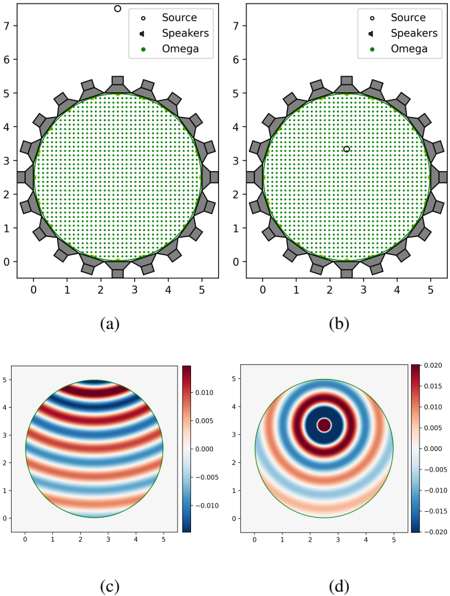
The image presents four diagrams (a, b, c, d) depicting acoustic simulations within a circular space. Diagrams (a) and (b) show the setup with sources, speakers, and the simulation area (Omega). Diagrams (c) and (d) display the acoustic pressure distribution within the same circular space, with color gradients indicating pressure levels.
### Components/Axes
**Diagrams (a) and (b):**
* **X and Y Axes:** Both axes range from 0 to 7, with tick marks at integer values.
* **Legend (Top-Right):**
* White Circle: "Source"
* Black Triangle: "Speakers"
* Green Dot: "Omega"
* **Circular Boundary:** A green circle represents the boundary of the simulation area (Omega).
* **Speakers:** Gray, gear-shaped objects are positioned around the circumference of the circle, representing speakers.
* **Source:**
* Diagram (a): A white circle (Source) is located at approximately (0.5, 7.2).
* Diagram (b): A white circle (Source) is located at approximately (2.5, 3.4).
* **Omega:** Green dots fill the circular area, representing the simulation space.
**Diagrams (c) and (d):**
* **X and Y Axes:** Both axes range from 0 to 5, with tick marks at integer values.
* **Colorbar (Right):**
* Top: Positive pressure (red)
* Diagram (c): +0.010
* Diagram (d): +0.020
* Middle: Zero pressure (white)
* Diagram (c): 0.000
* Diagram (d): 0.000
* Bottom: Negative pressure (blue)
* Diagram (c): -0.010
* Diagram (d): -0.020
* **Circular Boundary:** A green circle represents the boundary of the simulation area (Omega).
* **Pressure Distribution:**
* Diagram (c): Shows horizontal wave patterns, alternating between red (positive pressure) and blue (negative pressure).
* Diagram (d): Shows concentric circular wave patterns, alternating between red and blue.
### Detailed Analysis
**Diagram (a):**
* The source is located outside the circular region Omega, near the top-left corner of the plot.
* Speakers are evenly distributed around the circumference of the circle.
**Diagram (b):**
* The source is located inside the circular region Omega, near the center of the circle.
* Speakers are evenly distributed around the circumference of the circle.
**Diagram (c):**
* The pressure distribution shows a series of approximately horizontal bands.
* The bands alternate between positive (red) and negative (blue) pressure.
* The pressure is highest near the top and bottom of the circle and lowest in the middle.
**Diagram (d):**
* The pressure distribution shows a series of concentric rings.
* The rings alternate between positive (red) and negative (blue) pressure.
* The pressure is highest near the center of the circle and decreases outwards.
### Key Observations
* Diagrams (a) and (b) illustrate two different source placements: outside and inside the simulation area.
* Diagrams (c) and (d) show the resulting pressure distributions for these two source placements.
* The pressure distribution patterns are significantly different depending on the source location.
### Interpretation
The diagrams demonstrate the impact of source placement on acoustic pressure distribution within a defined space. When the source is outside the space (Diagram a), the resulting pressure distribution (Diagram c) exhibits a wave-like pattern. Conversely, when the source is inside the space (Diagram b), the pressure distribution (Diagram d) forms a radial pattern. This suggests that the location of a sound source significantly influences the acoustic field within an enclosed environment. The gear-shaped speakers around the edge likely contribute to the overall acoustic field and could be used to control or shape the sound within the space.