\n
## Technical Document: Structured Q&A Task Specification
### Overview
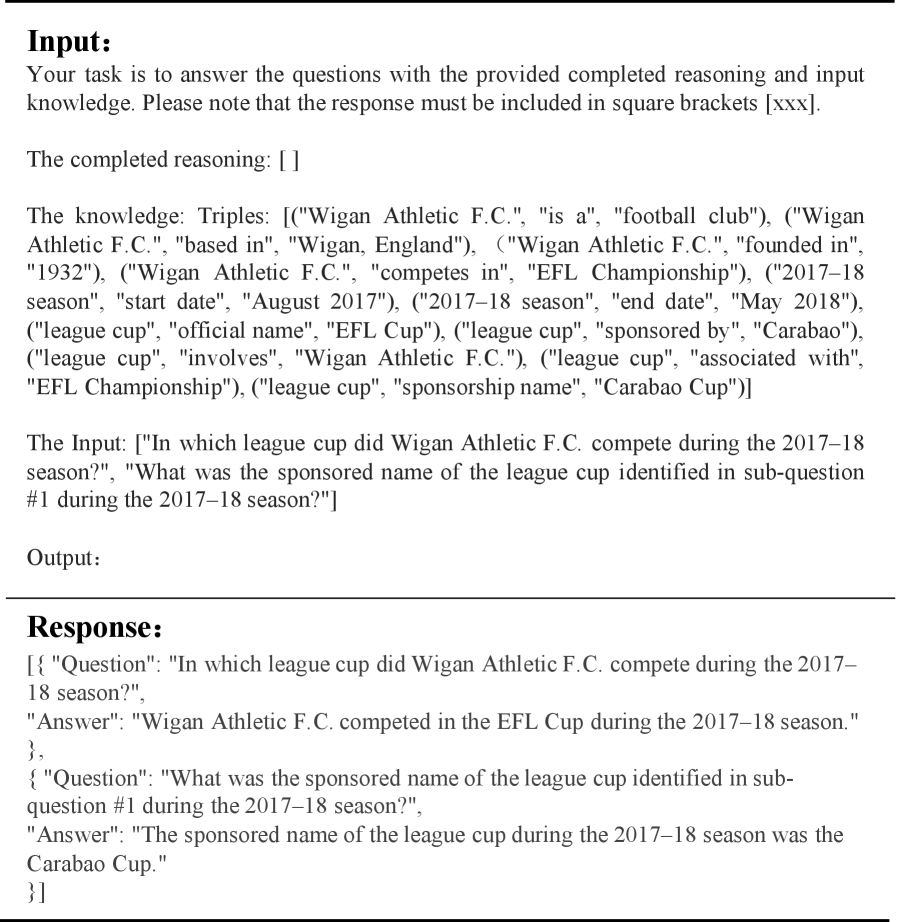
The image displays a technical specification for a question-answering task. It defines an input format containing a task description, reasoning, knowledge data, and questions, followed by a required output format. The content is entirely textual and structured, resembling a prompt template or a test case for an information extraction system.
### Content Details
#### **Input Section**
The section is titled **"Input:"** in bold. The text below it provides instructions:
- **Task Description:** "Your task is to answer the questions with the provided completed reasoning and input knowledge. Please note that the response must be included in square brackets [xxx]."
- **Completed Reasoning:** "The completed reasoning: [ ]" (The brackets are empty).
- **Knowledge Triples:** A list of structured data in the format `(subject, predicate, object)`. The triples are:
1. `("Wigan Athletic F.C.", "is a", "football club")`
2. `("Wigan Athletic F.C.", "based in", "Wigan, England")`
3. `("Wigan Athletic F.C.", "founded in", "1932")`
4. `("Wigan Athletic F.C.", "competes in", "EFL Championship")`
5. `("2017–18 season", "start date", "August 2017")`
6. `("2017–18 season", "end date", "May 2018")`
7. `("league cup", "official name", "EFL Cup")`
8. `("league cup", "sponsored by", "Carabao")`
9. `("league cup", "involves", "Wigan Athletic F.C.")`
10. `("league cup", "associated with", "EFL Championship")`
11. `("league cup", "sponsorship name", "Carabao Cup")`
- **Input Questions:** A list containing two questions:
1. `"In which league cup did Wigan Athletic F.C. compete during the 2017–18 season?"`
2. `"What was the sponsored name of the league cup identified in sub-question #1 during the 2017–18 season?"`
#### **Response Section**
The section is titled **"Response:"** in bold. It shows the expected output format, which is a JSON-like array of objects enclosed in square brackets `[ ]`. Each object contains a `"Question"` and an `"Answer"` key.
- **First Q&A Pair:**
- **Question:** "In which league cup did Wigan Athletic F.C. compete during the 2017–18 season?"
- **Answer:** "Wigan Athletic F.C. competed in the EFL Cup during the 2017–18 season."
- **Second Q&A Pair:**
- **Question:** "What was the sponsored name of the league cup identified in sub-question #1 during the 2017–18 season?"
- **Answer:** "The sponsored name of the league cup during the 2017–18 season was the Carabao Cup."
### Key Observations
1. **Data Source:** All answers are directly derivable from the provided knowledge triples. The first answer uses triples #4, #7, and #9. The second answer uses triples #8 and #11.
2. **Logical Flow:** The second question explicitly references "sub-question #1," creating a dependency. The system must first identify the cup as the "EFL Cup" before retrieving its sponsored name.
3. **Formatting Requirement:** The instruction mandates that the final response be enclosed in square brackets `[xxx]`, which is demonstrated in the example output.
4. **Language:** The entire document is in English. No other languages are present.
### Interpretation
This document serves as a clear specification for a **knowledge-grounded question-answering system**. It demonstrates how to:
- **Structure Input:** Provide a self-contained context with explicit knowledge (triples) and clear questions.
- **Derive Answers:** Use the provided knowledge graph to find precise, factual answers without external information.
- **Format Output:** Return answers in a structured, machine-readable format (JSON array within brackets) that pairs each question with its corresponding answer.
The example highlights the importance of **entity linking** (connecting "league cup" in the question to the specific entity in the knowledge base) and **relationship traversal** (moving from "league cup" to its "official name" and then to its "sponsorship name"). The empty "completed reasoning" field suggests this might be a template where a reasoning trace could be inserted, but for this task, only the final answer derived from the knowledge is required.