## Diagram: Contrastive Learning Paradigms Comparison
### Overview
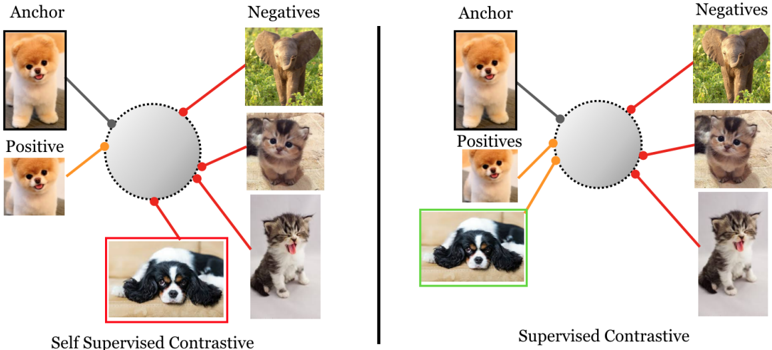
The image compares two contrastive learning approaches: **Self-Supervised Contrastive** (left) and **Supervised Contrastive** (right). Both diagrams use visual examples (animals) to illustrate how anchor images are paired with positive and negative samples during training.
### Components/Axes
- **Left Diagram (Self-Supervised Contrastive)**:
- **Anchor**: Pomeranian dog (central position).
- **Positives**: Two Pomeranian dogs (connected via orange lines).
- **Negatives**: Elephant, tabby cat, and cat with tongue out (connected via red lines).
- **Key Element**: No explicit highlighting of positives/negatives.
- **Right Diagram (Supervised Contrastive)**:
- **Anchor**: Same Pomeranian dog (central position).
- **Positives**: Pomeranian dog and a black-and-white dog (highlighted with a green box).
- **Negatives**: Elephant, tabby cat, and cat with tongue out (connected via red lines).
- **Key Element**: Black-and-white dog is explicitly marked as a positive example.
### Detailed Analysis
- **Color Coding**:
- **Orange lines**: Represent positive pairs (similar examples).
- **Red lines**: Represent negative pairs (dissimilar examples).
- **Black line**: Connects the anchor to the central circle.
- **Spatial Grounding**:
- Anchor is centrally positioned in both diagrams.
- Positives are grouped to the left of the anchor.
- Negatives are grouped to the right of the anchor.
- In the supervised diagram, the black-and-white dog is enclosed in a green box, emphasizing its role as a labeled positive example.
### Key Observations
1. **Self-Supervised Contrastive**: Relies on implicit similarity (e.g., two Pomeranians as positives) without explicit labeling.
2. **Supervised Contrastive**: Uses explicit labels (green box) to guide the model toward correct positive pairs.
3. **Negatives**: Both paradigms use the same set of negative examples (elephant, tabby cat, cat with tongue out).
### Interpretation
- The diagram highlights the core difference between the two approaches: **Supervised Contrastive Learning** incorporates labeled data to refine positive-negative pair selection, while **Self-Supervised Contrastive Learning** relies on unsupervised similarity metrics.
- The green box in the supervised diagram underscores the importance of labeled data in improving model accuracy by explicitly defining valid positive pairs.
- Both paradigms share the same negative examples, suggesting that contrastive learning focuses on distinguishing the anchor from irrelevant samples regardless of supervision.
## No numerical data or trends are present in this conceptual diagram.