\n
## Line Chart: Validation Accuracy vs. Epoch
### Overview
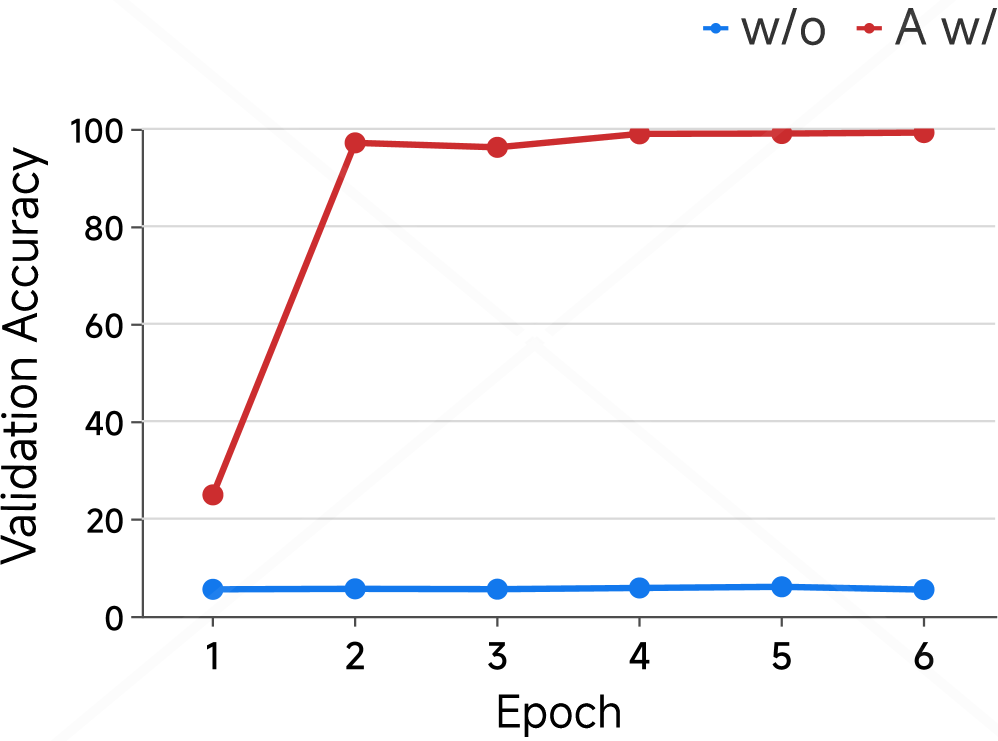
This line chart displays the validation accuracy of a model over six epochs, comparing performance with and without a specific component ("A w/"). The y-axis represents validation accuracy (ranging from 0 to 100), and the x-axis represents the epoch number (from 1 to 6).
### Components/Axes
* **X-axis:** Epoch (labeled at the bottom)
* Markers: 1, 2, 3, 4, 5, 6
* **Y-axis:** Validation Accuracy (labeled on the left)
* Scale: 0 to 100
* **Legend:** Located at the top-right corner.
* "w/o" - Blue line
* "A w/" - Red line
### Detailed Analysis
* **"w/o" Line (Blue):** This line represents the validation accuracy without the component "A w/". The line is relatively flat, indicating minimal improvement in validation accuracy across epochs.
* Epoch 1: Approximately 8%
* Epoch 2: Approximately 9%
* Epoch 3: Approximately 8%
* Epoch 4: Approximately 8%
* Epoch 5: Approximately 8%
* Epoch 6: Approximately 9%
* **"A w/" Line (Red):** This line represents the validation accuracy with the component "A w/". The line shows a significant increase in validation accuracy from Epoch 1 to Epoch 2, followed by a plateau.
* Epoch 1: Approximately 28%
* Epoch 2: Approximately 95%
* Epoch 3: Approximately 97%
* Epoch 4: Approximately 98%
* Epoch 5: Approximately 98%
* Epoch 6: Approximately 99%
### Key Observations
* The "A w/" line consistently outperforms the "w/o" line across all epochs.
* The most significant improvement for the "A w/" line occurs between Epoch 1 and Epoch 2, where the validation accuracy increases from approximately 28% to 95%.
* The "w/o" line remains relatively stable, with validation accuracy fluctuating around 8-9%.
* The "A w/" line plateaus after Epoch 2, indicating diminishing returns from further training.
### Interpretation
The data strongly suggests that the component "A w/" significantly improves the validation accuracy of the model. The dramatic increase in accuracy between Epoch 1 and Epoch 2 indicates that "A w/" is crucial for the model's learning process. The subsequent plateau suggests that the model has largely converged with "A w/" and further training may not yield substantial improvements. The consistently low validation accuracy of the "w/o" line highlights the importance of "A w/" for achieving good performance. This could be a comparison of a model with and without a specific regularization technique, attention mechanism, or data augmentation strategy. The rapid initial improvement suggests a substantial benefit from the added component.