## Line Charts: Metric Values and Normalised Performance Metrics vs. Lambda for Varying Tau
### Overview
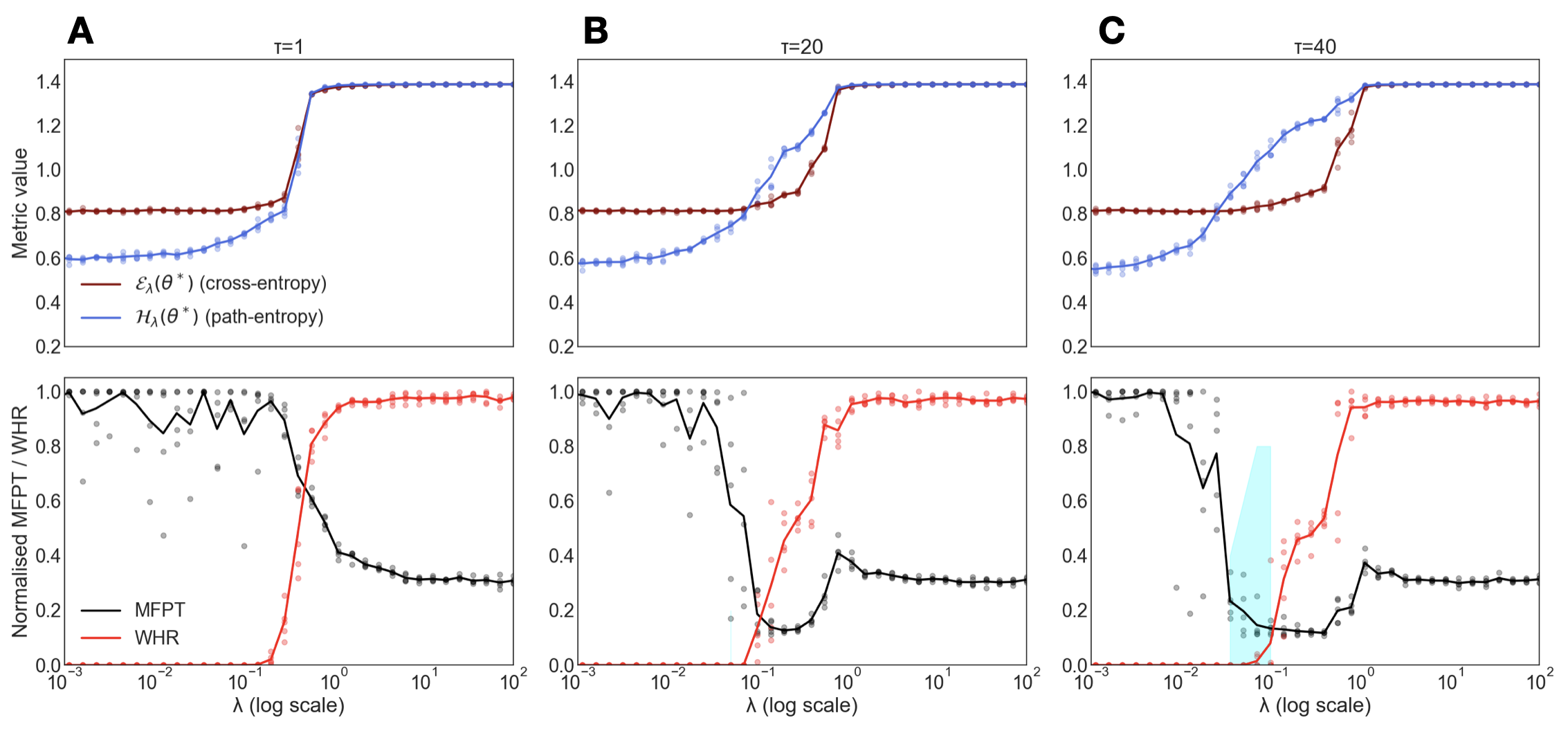
This image presents a set of three two-panel line charts, labeled A, B, and C, which illustrate the relationship between various metrics and a parameter `λ` (lambda) on a logarithmic scale. Each main panel (A, B, C) corresponds to a different value of `τ` (tau), specifically `τ=1`, `τ=20`, and `τ=40`, respectively. The top sub-panels display "Metric value" for cross-entropy and path-entropy, while the bottom sub-panels show "Normalised MFPT / WHR" for MFPT and WHR. All metrics are plotted against `λ` on a logarithmic scale, ranging from 10^-3 to 10^2. A light blue shaded region is present in the bottom sub-panel of chart C.
### Components/Axes
The image is composed of three main vertical panels, labeled A, B, and C, from left to right. Each main panel contains two sub-panels stacked vertically.
**Common X-axis (bottom of each main panel):**
* **Label**: `λ` (log scale)
* **Scale**: Logarithmic, ranging from 10^-3 to 10^2.
* **Tick Markers**: 10^-3, 10^-2, 10^-1, 10^0, 10^1, 10^2.
**Common Y-axis (left side of top sub-panels):**
* **Label**: Metric value
* **Scale**: Linear, ranging from 0.2 to 1.4.
* **Tick Markers**: 0.2, 0.4, 0.6, 0.8, 1.0, 1.2, 1.4.
**Common Y-axis (left side of bottom sub-panels):**
* **Label**: Normalised MFPT / WHR
* **Scale**: Linear, ranging from 0.0 to 1.0.
* **Tick Markers**: 0.0, 0.2, 0.4, 0.6, 0.8, 1.0.
**Legends:**
**Top Sub-panels (located in the bottom-left of panel A's top sub-panel):**
* **Brown line with circular markers**: `E_λ(θ*)` (cross-entropy)
* **Blue line with circular markers**: `H_λ(θ*)` (path-entropy)
**Bottom Sub-panels (located in the bottom-left of panel A's bottom sub-panel):**
* **Black line with circular markers**: MFPT
* **Red line with circular markers**: WHR
**Panel Titles (top-right of each main panel):**
* **Panel A**: `τ=1`
* **Panel B**: `τ=20`
* **Panel C**: `τ=40`
### Detailed Analysis
**Panel A (τ=1)**
* **Top Sub-panel (Metric value vs. λ):**
* **Brown line (`E_λ(θ*)` - cross-entropy)**: Starts at approximately 0.8 at `λ=10^-3` and remains relatively flat until `λ` approaches 10^-1 (around 0.1). It then sharply increases, crossing 1.0 around `λ=0.2` and reaching a plateau at approximately 1.38 for `λ` values greater than 10^0 (1.0). Each data point is marked with a small brown circle.
* **Blue line (`H_λ(θ*)` - path-entropy)**: Starts at approximately 0.6 at `λ=10^-3` and gradually increases, reaching about 0.8 at `λ=10^-1`. It then sharply increases, crossing 1.0 around `λ=0.2` and reaching a plateau at approximately 1.38 for `λ` values greater than 10^0 (1.0). The blue line intersects the brown line around `λ=0.15` at a metric value of approximately 0.85. Each data point is marked with a small blue circle.
* **Bottom Sub-panel (Normalised MFPT / WHR vs. λ):**
* **Black line (MFPT)**: Starts at approximately 1.0 at `λ=10^-3` and fluctuates between 0.8 and 1.0 until `λ` approaches 10^-1 (around 0.1). It then sharply decreases, crossing 0.6 around `λ=0.2` and reaching a plateau at approximately 0.3 for `λ` values greater than 10^0 (1.0). Each data point is marked with a small black circle.
* **Red line (WHR)**: Starts at approximately 0.0 at `λ=10^-3` and remains at 0.0 until `λ` approaches 10^-1 (around 0.1). It then sharply increases, crossing 0.6 around `λ=0.2` and reaching a plateau at approximately 0.98 for `λ` values greater than 10^0 (1.0). Each data point is marked with a small red circle.
* **Grey scattered points**: Numerous grey circular data points are scattered across the plot. For `λ < 10^-1`, they are mostly clustered between 0.8 and 1.0. For `λ > 10^-1`, they show a wider spread, generally decreasing in value, with some points near 0.0 and others up to 1.0.
**Panel B (τ=20)**
* **Top Sub-panel (Metric value vs. λ):**
* **Brown line (`E_λ(θ*)` - cross-entropy)**: Similar to Panel A, starts at approximately 0.8 and remains flat until `λ` approaches 10^-1.5 (around 0.03). It then sharply increases, reaching a plateau at approximately 1.38 for `λ` values greater than 10^0 (1.0).
* **Blue line (`H_λ(θ*)` - path-entropy)**: Starts at approximately 0.58 and gradually increases. The sharp increase begins earlier than in Panel A, around `λ=10^-1.5` (around 0.03), and it reaches a plateau at approximately 1.38 for `λ` values greater than 10^0 (1.0). The blue line intersects the brown line around `λ=0.08` at a metric value of approximately 0.85.
* **Bottom Sub-panel (Normalised MFPT / WHR vs. λ):**
* **Black line (MFPT)**: Similar to Panel A, starts at approximately 1.0 and fluctuates. The sharp decrease begins earlier than in Panel A, around `λ=10^-1.5` (around 0.03), reaching a minimum of approximately 0.15 around `λ=0.1`, and then slightly increasing to a plateau around 0.3 for `λ` values greater than 10^0 (1.0).
* **Red line (WHR)**: Similar to Panel A, starts at approximately 0.0. The sharp increase begins earlier than in Panel A, around `λ=10^-1.5` (around 0.03), reaching a plateau at approximately 0.98 for `λ` values greater than 10^0 (1.0).
* **Grey scattered points**: Similar distribution to Panel A, but the transition zone appears to shift to lower `λ` values.
**Panel C (τ=40)**
* **Top Sub-panel (Metric value vs. λ):**
* **Brown line (`E_λ(θ*)` - cross-entropy)**: Similar to Panels A and B, starts at approximately 0.8 and remains flat until `λ` approaches 10^-2 (around 0.01). It then sharply increases, reaching a plateau at approximately 1.38 for `λ` values greater than 10^0 (1.0).
* **Blue line (`H_λ(θ*)` - path-entropy)**: Starts at approximately 0.58 and gradually increases. The sharp increase begins even earlier than in Panel B, around `λ=10^-2` (around 0.01), and it reaches a plateau at approximately 1.38 for `λ` values greater than 10^0 (1.0). The blue line intersects the brown line around `λ=0.05` at a metric value of approximately 0.85.
* **Bottom Sub-panel (Normalised MFPT / WHR vs. λ):**
* **Black line (MFPT)**: Similar to Panels A and B, starts at approximately 1.0 and fluctuates. The sharp decrease begins even earlier than in Panel B, around `λ=10^-2` (around 0.01), reaching a minimum of approximately 0.1 around `λ=0.08`, and then slightly increasing to a plateau around 0.3 for `λ` values greater than 10^0 (1.0).
* **Red line (WHR)**: Similar to Panels A and B, starts at approximately 0.0. The sharp increase begins even earlier than in Panel B, around `λ=10^-2` (around 0.01), reaching a plateau at approximately 0.98 for `λ` values greater than 10^0 (1.0).
* **Grey scattered points**: Similar distribution to Panels A and B, with the transition zone further shifted to lower `λ` values and a noticeable spread.
* **Light blue shaded region**: A shaded area is present from approximately `λ=0.04` to `λ=0.15`, covering Y-values from approximately 0.0 to 0.8. This region encompasses the minimum of the MFPT curve and the steep rising phase of the WHR curve.
### Key Observations
1. **Sigmoidal Transition**: All primary metrics (cross-entropy, path-entropy, MFPT, WHR) exhibit a sigmoidal-like transition as `λ` increases. They either increase or decrease sharply within a specific range of `λ` values, reaching a plateau on either side of this transition.
2. **Inverse Relationship**: In the top panels, `E_λ(θ*)` (cross-entropy) and `H_λ(θ*)` (path-entropy) generally increase with `λ`. In the bottom panels, MFPT decreases while WHR increases with `λ`.
3. **Shift with τ**: As `τ` increases from 1 to 20 to 40, the entire transition region for all metrics shifts towards lower `λ` values. This means the sharp changes in metric values occur at smaller `λ` for larger `τ`.
* For `τ=1`, the transition is roughly between `λ=0.1` and `λ=1.0`.
* For `τ=20`, the transition is roughly between `λ=0.01` and `λ=0.5`.
* For `τ=40`, the transition is roughly between `λ=0.005` and `λ=0.2`.
4. **MFPT Minimum**: For `τ=20` and `τ=40`, the MFPT curve shows a distinct minimum before slightly increasing to its plateau. This minimum becomes more pronounced and shifts to lower `λ` values as `τ` increases.
5. **WHR Saturation**: WHR consistently saturates near 1.0 for larger `λ` values across all `τ`.
6. **Cross-entropy vs. Path-entropy**: `E_λ(θ*)` starts higher and remains flat for small `λ`, while `H_λ(θ*)` starts lower and gradually increases before the sharp transition. They converge to the same high value after the transition.
7. **Scattered Data**: The grey scattered points in the bottom panels suggest individual trial results or underlying variability, which the black and red lines represent as averaged or smoothed trends.
### Interpretation
The data presented in these charts likely illustrates the behavior of a system or model under varying conditions, controlled by parameters `λ` and `τ`.
The parameter `λ` appears to act as a control or regularization parameter, driving a phase transition in the system's behavior. For very small `λ`, the system is in one state (e.g., high MFPT, low WHR, distinct `E_λ(θ*)` and `H_λ(θ*)` values). As `λ` increases past a critical threshold, the system transitions to a different state (e.g., low MFPT, high WHR, converged `E_λ(θ*)` and `H_λ(θ*)` values).
The parameter `τ` seems to influence the sensitivity of this transition to `λ`. A larger `τ` value makes the system more sensitive to `λ`, causing the transition to occur at smaller `λ` values. This suggests that `τ` might represent a characteristic timescale, temperature, or another intrinsic property that modulates the system's response to `λ`.
Specifically:
* **Cross-entropy (`E_λ(θ*)`) and Path-entropy (`H_λ(θ*)`)**: These metrics, possibly related to information theory or statistical mechanics, show a shift from distinct values at low `λ` to a converged, higher value at high `λ`. This could indicate a change in the system's complexity, predictability, or the nature of its optimal paths/states. The initial flat `E_λ(θ*)` suggests a baseline or default behavior, while `H_λ(θ*)` might be more sensitive to initial changes in `λ`.
* **MFPT (Mean First Passage Time) and WHR (Weighted Hitting Rate)**: These are likely performance metrics. High MFPT and low WHR at small `λ` could indicate inefficient or slow processes. The sharp decrease in MFPT and increase in WHR as `λ` crosses the transition point suggests that the system becomes significantly more efficient or effective. The minimum in MFPT for `τ=20` and `τ=40` is particularly interesting. It implies an optimal `λ` value where the system achieves its fastest performance before potentially becoming slightly less optimal (or reaching a different kind of equilibrium) at even higher `λ`. The light blue shaded region in Panel C highlights this optimal `λ` range for `τ=40`, where MFPT is minimized and WHR is rapidly increasing, indicating a sweet spot for system performance.
In essence, the charts demonstrate a `λ`-driven phase transition, where `τ` acts as a catalyst, shifting the transition point. The interplay between these parameters reveals critical operating regimes for the system, particularly highlighting an optimal `λ` for performance (low MFPT, high WHR) that depends on `τ`.