## Chart: Kernel Timeline Comparison Across Replication Scenarios
### Overview
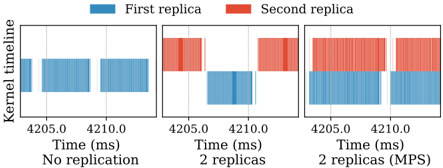
The chart compares kernel timeline distributions across three scenarios: (1) No replication, (2) 2 replicas, and (3) 2 replicas with MPS (Multi-Process Scheduling). It uses vertical bars to represent time intervals (in milliseconds) for two replicas (blue = first replica, red = second replica).
### Components/Axes
- **Y-axis**: "Kernel timeline" (categorical, no numerical scale).
- **X-axis**: "Time (ms)" with approximate values: 4205.0, 4210.0.
- **Legend**:
- Blue: First replica.
- Red: Second replica.
- **Panel Titles**:
- Left: "No replication"
- Middle: "2 replicas"
- Right: "2 replicas (MPS)"
### Detailed Analysis
1. **No replication (Left Panel)**:
- Two blue bars (first replica) span the x-axis range (4205.0–4210.0 ms).
- No red bars (second replica) are present.
2. **2 replicas (Middle Panel)**:
- One blue bar (first replica) and one red bar (second replica) overlap partially.
- Blue bar starts slightly earlier (~4205.0 ms) than the red bar (~4207.0 ms).
3. **2 replicas (MPS) (Right Panel)**:
- Two red bars (second replica) dominate, with no blue bars visible.
- Red bars span the full x-axis range (4205.0–4210.0 ms).
### Key Observations
- **Replication Impact**:
- Adding replicas introduces the second replica (red bars) in the middle and right panels.
- MPS scenario eliminates the first replica (blue bars) entirely, suggesting prioritization or scheduling changes.
- **Temporal Overlap**:
- In the "2 replicas" panel, the first and second replicas overlap partially (~4207.0–4210.0 ms).
- **MPS Behavior**:
- The MPS scenario shows only the second replica active, implying the first replica is deprioritized or paused.
### Interpretation
The data suggests that replication scenarios significantly alter kernel timeline behavior:
1. **No replication**: Only the first replica operates, maintaining a consistent timeline.
2. **2 replicas**: Both replicas coexist, with the second replica starting slightly later but overlapping with the first.
3. **MPS**: The system prioritizes the second replica, suppressing the first replica entirely. This could indicate resource contention, scheduling policies favoring newer replicas, or MPS-specific optimizations.
The absence of the first replica in the MPS scenario raises questions about how MPS manages replica lifecycles or resource allocation. Further investigation into MPS scheduling rules or hardware constraints would clarify these dynamics.