\n
## Heatmap: Pass@1 Performance Comparison - R1-Llama vs. R1-Qwen
### Overview
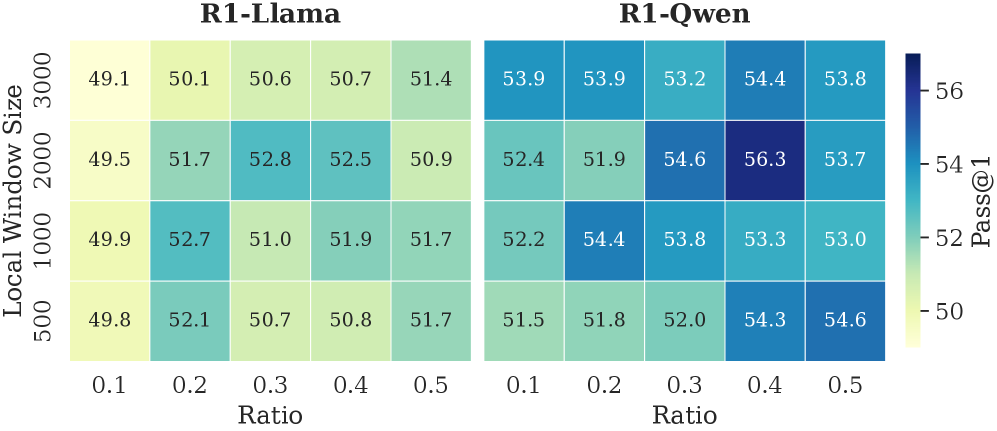
This image presents a heatmap comparing the Pass@1 performance of two models, R1-Llama and R1-Qwen, across varying combinations of 'Ratio' and 'Local Window Size'. The heatmap uses a color gradient to represent the Pass@1 scores, with warmer colors indicating higher performance.
### Components/Axes
* **X-axis:** Ratio, ranging from 0.1 to 0.5, with increments of 0.1.
* **Y-axis:** Local Window Size, with categories 500, 1000, 2000, and 3000.
* **Two Heatmaps:** One for R1-Llama (left) and one for R1-Qwen (right).
* **Colorbar:** Located on the right side, representing Pass@1 scores ranging from approximately 50 to 56.
* **Titles:** "R1-Llama" above the left heatmap and "R1-Qwen" above the right heatmap.
### Detailed Analysis or Content Details
**R1-Llama Heatmap:**
* **Trend:** Generally, performance increases with increasing Local Window Size and Ratio, but the effect is not uniform.
* **Data Points:**
* Ratio 0.1:
* Local Window Size 500: 49.8
* Local Window Size 1000: 49.9
* Local Window Size 2000: 49.5
* Local Window Size 3000: 49.1
* Ratio 0.2:
* Local Window Size 500: 52.1
* Local Window Size 1000: 51.7
* Local Window Size 2000: 50.9
* Local Window Size 3000: 50.1
* Ratio 0.3:
* Local Window Size 500: 50.7
* Local Window Size 1000: 52.7
* Local Window Size 2000: 52.8
* Local Window Size 3000: 50.6
* Ratio 0.4:
* Local Window Size 500: 50.8
* Local Window Size 1000: 51.9
* Local Window Size 2000: 52.5
* Local Window Size 3000: 50.7
* Ratio 0.5:
* Local Window Size 500: 51.7
* Local Window Size 1000: 51.7
* Local Window Size 2000: 51.4
* Local Window Size 3000: 51.4
**R1-Qwen Heatmap:**
* **Trend:** Similar to R1-Llama, performance generally increases with increasing Local Window Size and Ratio, but with some variations.
* **Data Points:**
* Ratio 0.1:
* Local Window Size 500: 51.5
* Local Window Size 1000: 52.2
* Local Window Size 2000: 52.4
* Local Window Size 3000: 53.9
* Ratio 0.2:
* Local Window Size 500: 51.8
* Local Window Size 1000: 54.4
* Local Window Size 2000: 51.9
* Local Window Size 3000: 53.9
* Ratio 0.3:
* Local Window Size 500: 52.0
* Local Window Size 1000: 53.8
* Local Window Size 2000: 54.6
* Local Window Size 3000: 53.2
* Ratio 0.4:
* Local Window Size 500: 54.3
* Local Window Size 1000: 53.3
* Local Window Size 2000: 56.3
* Local Window Size 3000: 54.4
* Ratio 0.5:
* Local Window Size 500: 54.6
* Local Window Size 1000: 53.0
* Local Window Size 2000: 53.7
* Local Window Size 3000: 53.8
### Key Observations
* R1-Qwen consistently outperforms R1-Llama across all combinations of Ratio and Local Window Size.
* For both models, increasing the Local Window Size from 500 to 2000 generally leads to performance improvements, but increasing it further to 3000 doesn't always yield the same benefit.
* The highest Pass@1 score for R1-Llama is 52.8, while the highest for R1-Qwen is 56.3.
* The performance difference between the models is most pronounced at higher Ratio values (0.4 and 0.5).
### Interpretation
The heatmap demonstrates the impact of 'Ratio' and 'Local Window Size' on the Pass@1 performance of two language models, R1-Llama and R1-Qwen. The 'Ratio' likely represents a parameter controlling the amount of context considered during evaluation, while 'Local Window Size' might relate to the size of the input sequence processed at a time.
The consistent outperformance of R1-Qwen suggests that it is more robust to variations in these parameters or benefits more from larger context windows. The non-linear relationship between Local Window Size and performance indicates that there's an optimal window size beyond which the benefits diminish, potentially due to computational constraints or the model's ability to effectively utilize the additional context.
The heatmap provides valuable insights for optimizing the configuration of these models for specific tasks. It suggests that for R1-Qwen, a Ratio of 0.4 or 0.5 and a Local Window Size of 2000 might be a good starting point for achieving high Pass@1 scores. Further investigation could explore the reasons behind the diminishing returns of larger Local Window Sizes and the specific mechanisms that contribute to R1-Qwen's superior performance.