## Scatter Plot: F1 Scores vs. ECE with Token Cost and UQ Method
### Overview
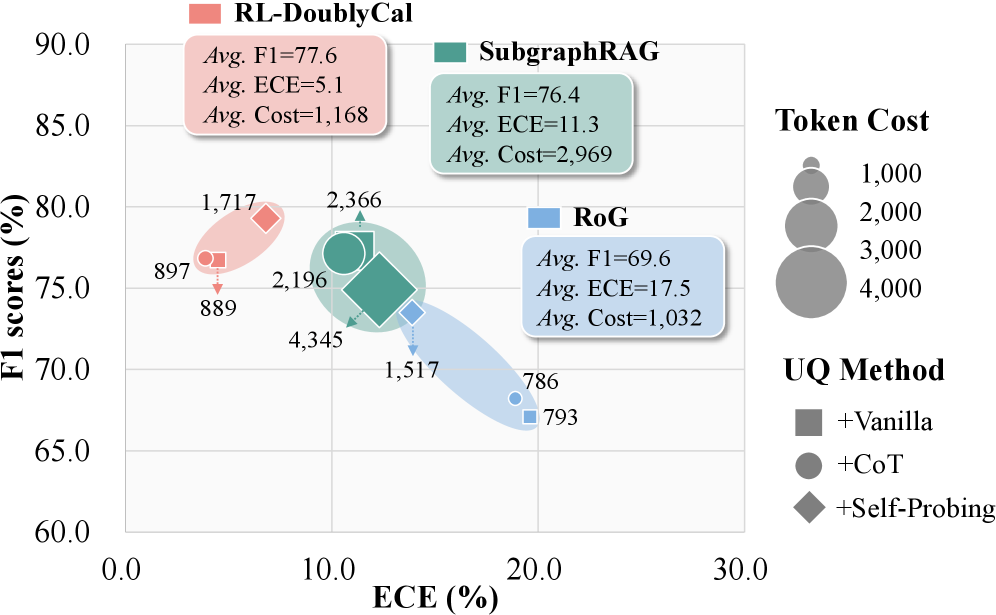
The image is a scatter plot comparing the F1 scores and ECE (Error Corrected Errors) of three different models: RL-DoublyCal, SubgraphRAG, and RoG. The plot also visualizes the token cost associated with each model using the size of the data points, and the UQ (Uncertainty Quantification) method using different shapes.
### Components/Axes
* **X-axis:** ECE (%), ranging from 0.0 to 30.0 with tick marks at 0.0, 10.0, 20.0, and 30.0.
* **Y-axis:** F1 scores (%), ranging from 60.0 to 90.0 with tick marks at 60.0, 65.0, 70.0, 75.0, 80.0, 85.0, and 90.0.
* **Legend (Top-Left):**
* **RL-DoublyCal (Pink):** Avg. F1 = 77.6, Avg. ECE = 5.1, Avg. Cost = 1,168
* **SubgraphRAG (Green):** Avg. F1 = 76.4, Avg. ECE = 11.3, Avg. Cost = 2,969
* **RoG (Blue):** Avg. F1 = 69.6, Avg. ECE = 17.5, Avg. Cost = 1,032
* **Legend (Right):**
* **Token Cost:** Represented by the size of the data points. Larger points indicate higher token cost. Sizes correspond to 1,000, 2,000, 3,000, and 4,000.
* **UQ Method:**
* Square: +Vanilla
* Circle: +CoT
* Diamond: +Self-Probing
### Detailed Analysis
**RL-DoublyCal (Pink):**
* General Trend: Cluster in the top-left.
* Circle (+CoT): F1 ~77%, ECE ~5%, Cost: 897 -> 889
* Diamond (+Self-Probing): F1 ~79%, ECE ~7%, Cost: 1,717
**SubgraphRAG (Green):**
* General Trend: Cluster in the top-middle.
* Circle (+CoT): F1 ~77%, ECE ~9%, Cost: 2,366
* Diamond (+Self-Probing): F1 ~76%, ECE ~11%, Cost: 2,196
* Square (+Vanilla): F1 ~73%, ECE ~12%, Cost: 4,345
**RoG (Blue):**
* General Trend: Cluster in the bottom-right.
* Circle (+CoT): F1 ~69%, ECE ~19%, Cost: 786
* Square (+Vanilla): F1 ~68%, ECE ~19%, Cost: 793
* Diamond (+Self-Probing): F1 ~73%, ECE ~13%, Cost: 1,517
### Key Observations
* RL-DoublyCal generally achieves higher F1 scores with lower ECE compared to the other two models.
* RoG has the lowest token cost but also the lowest F1 scores and highest ECE.
* SubgraphRAG has a higher token cost than RL-DoublyCal and RoG.
* The token cost appears to vary significantly depending on the UQ method used.
### Interpretation
The scatter plot visualizes the trade-offs between F1 score, ECE, and token cost for different models and UQ methods. RL-DoublyCal seems to offer a good balance between accuracy (F1 score), error correction (ECE), and computational cost (token cost). SubgraphRAG, while having competitive F1 scores, comes with a higher token cost. RoG is the most cost-effective but sacrifices accuracy and error correction. The choice of UQ method also impacts the token cost, suggesting that some methods are more computationally expensive than others. The data suggests that optimizing for one metric (e.g., F1 score) may come at the expense of others (e.g., token cost or ECE), and the optimal model depends on the specific application and priorities.