\n
## Screenshot: Prompt-Response Interaction on Formal Verification of a Mathematical Proof
### Overview
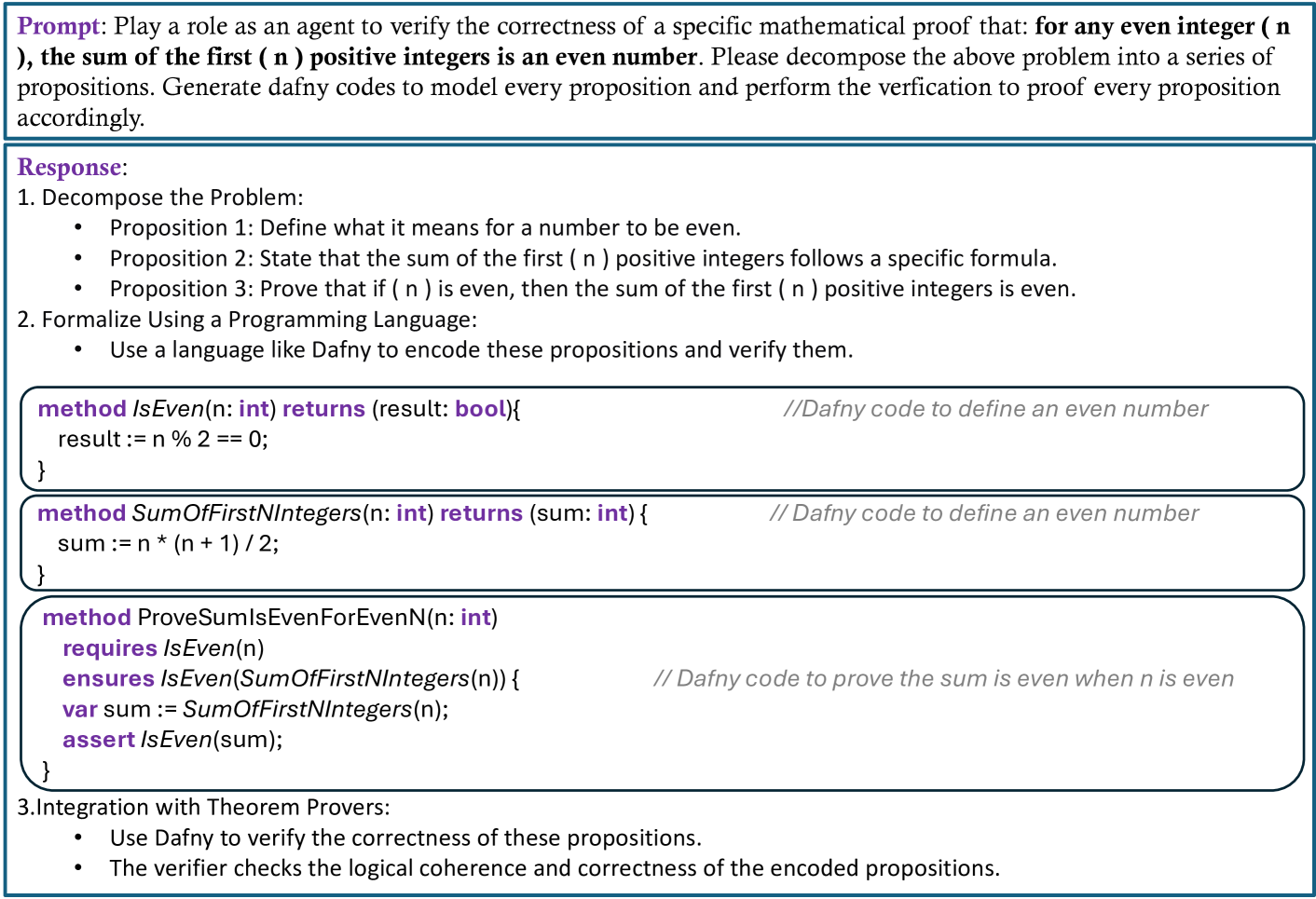
The image displays a structured interaction, likely from an AI assistant or educational tool, where a user prompt asks for the verification of a mathematical proof using the Dafny programming language. The response provides a step-by-step decomposition of the problem and corresponding Dafny code snippets. The entire content is enclosed within a blue border.
### Components/Axes
The image is divided into two primary sections:
1. **Prompt Section (Top):** A box with a purple header labeled "Prompt:" containing the user's request.
2. **Response Section (Bottom):** A larger box with a purple header labeled "Response:" containing the assistant's structured answer.
### Detailed Analysis
#### **Prompt Section Content:**
* **Header:** "Prompt:" (in purple text).
* **Text:** "Play a role as an agent to verify the correctness of a specific mathematical proof that: **for any even integer ( n ), the sum of the first ( n ) positive integers is an even number.** Please decompose the above problem into a series of propositions. Generate dafny codes to model every proposition and perform the verfication to proof every proposition accordingly."
* *Note:* The word "verification" is misspelled as "verfication" in the original text.
#### **Response Section Content:**
* **Header:** "Response:" (in purple text).
* **Step 1: Decompose the Problem:**
* Numbered item "1. Decompose the Problem:"
* Three bullet points:
* "Proposition 1: Define what it means for a number to be even."
* "Proposition 2: State that the sum of the first ( n ) positive integers follows a specific formula."
* "Proposition 3: Prove that if ( n ) is even, then the sum of the first ( n ) positive integers is even."
* **Step 2: Formalize Using a Programming Language:**
* Numbered item "2. Formalize Using a Programming Language:"
* One bullet point: "Use a language like Dafny to encode these propositions and verify them."
* **Three Dafny Code Blocks:**
1. **First Code Block (Proposition 1):**
* Code: `method IsEven(n: int) returns (result: bool){ result := n % 2 == 0; }`
* Inline Comment (right-aligned, gray text): `//Dafny code to define an even number`
2. **Second Code Block (Proposition 2):**
* Code: `method SumOfFirstNIntegers(n: int) returns (sum: int) { sum := n * (n + 1) / 2; }`
* Inline Comment (right-aligned, gray text): `// Dafny code to define an even number` *(Note: The comment is identical to the first block's comment, which appears to be an error in the source image; the code defines the sum formula, not an even number.)*
3. **Third Code Block (Proposition 3):**
* Code:
```
method ProveSumIsEvenForEvenN(n: int)
requires IsEven(n)
ensures IsEven(SumOfFirstNIntegers(n)) {
var sum := SumOfFirstNIntegers(n);
assert IsEven(sum);
}
```
* Inline Comment (right-aligned, gray text): `// Dafny code to prove the sum is even when n is even`
* **Step 3: Integration with Theorem Provers:**
* Numbered item "3.Integration with Theorem Provers:" *(Note: No space after the period in the original.)*
* Two bullet points:
* "Use Dafny to verify the correctness of these propositions."
* "The verifier checks the logical coherence and correctness of the encoded propositions."
### Key Observations
1. **Structural Clarity:** The response follows a clear, logical decomposition from abstract propositions to concrete code implementation.
2. **Code-Comment Discrepancy:** The comment for the `SumOfFirstNIntegers` method is incorrect, stating it defines "an even number" when it actually defines the sum formula `n*(n+1)/2`.
3. **Formal Specification:** The third Dafny method (`ProveSumIsEvenForEvenN`) uses formal specification clauses (`requires`, `ensures`) to state the proof's preconditions and postconditions, which is central to Dafny's verification paradigm.
4. **Self-Contained Logic:** The proof method relies on the previously defined helper methods (`IsEven`, `SumOfFirstNIntegers`), demonstrating modular reasoning.
### Interpretation
This image documents a pedagogical or demonstrative exercise in **formal methods** and **computer-assisted theorem proving**. It illustrates the process of translating an informal mathematical statement into a form that can be mechanically verified.
* **What the data suggests:** The interaction showcases a methodology for breaking down a proof into atomic, verifiable components (propositions) and then using a verification-aware programming language (Dafny) to encode both the definitions and the logical steps. The Dafny verifier would then attempt to prove that the `assert` statement in the final method always holds true given the `requires` clause.
* **How elements relate:** The propositions provide the conceptual framework. The Dafny code provides the formal, machine-checkable implementation of that framework. The `IsEven` and `SumOfFirstNIntegers` methods establish the foundational definitions, while `ProveSumIsEvenForEvenN` encapsulates the core logical implication to be proven.
* **Notable anomalies:** The incorrect comment in the second code block is a minor but notable error in the source material. More substantively, the provided Dafny code for the third proposition is a *sketch* of a proof. The `assert IsEven(sum);` is the statement to be proven, but the code does not include the actual lemmas or arithmetic reasoning Dafny would need to automatically verify it. A complete proof would likely require additional hints or intermediate assertions about the parity of `n` and `(n+1)`. The image thus captures the setup for a proof, not necessarily a fully automated verification.