## Diagram: LLM Dependency and Action Prediction
### Overview
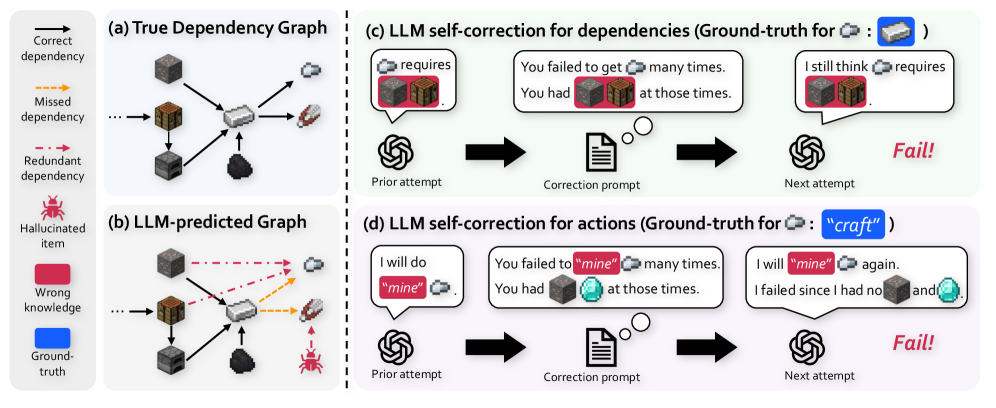
The image presents a comparison between true dependency graphs and Large Language Model (LLM)-predicted graphs for Minecraft item crafting, along with examples of LLM self-correction attempts for dependencies and actions. The image is divided into four sections: (a) True Dependency Graph, (b) LLM-predicted Graph, (c) LLM self-correction for dependencies, and (d) LLM self-correction for actions.
### Components/Axes
**Legend (Left Side):**
* **Correct dependency:** Solid black arrow.
* **Missed dependency:** Dashed orange arrow.
* **Redundant dependency:** Dashed red arrow.
* **Hallucinated item:** Red bug-like icon.
* **Wrong knowledge:** Red filled square.
* **Ground-truth:** Blue filled square.
**Section (a): True Dependency Graph**
* Nodes: Minecraft items (stone, planks, iron ingot, furnace, coal, flint and steel).
* Edges: Solid black arrows indicating correct dependencies.
**Section (b): LLM-predicted Graph**
* Nodes: Minecraft items (stone, planks, iron ingot, furnace, coal, flint and steel, spider).
* Edges: Solid black arrows, dashed orange arrows, and dashed red arrows indicating correct, missed, and redundant dependencies, respectively.
**Section (c): LLM self-correction for dependencies**
* Flow: Prior attempt (LLM icon) -> Correction prompt (document icon) -> Next attempt (LLM icon).
* Speech bubbles containing LLM output.
**Section (d): LLM self-correction for actions**
* Flow: Prior attempt (LLM icon) -> Correction prompt (document icon) -> Next attempt (LLM icon).
* Speech bubbles containing LLM output.
### Detailed Analysis
**Section (a): True Dependency Graph**
* Planks require stone.
* Iron ingot requires furnace and coal.
* Flint and steel requires iron ingot.
* Furnace requires stone.
**Section (b): LLM-predicted Graph**
* Planks require stone.
* Iron ingot requires furnace and coal.
* Iron ingot requires planks (correct dependency).
* Flint and steel requires iron ingot (correct dependency).
* Flint and steel requires planks (missed dependency).
* Flint and steel requires spider (redundant dependency).
**Section (c): LLM self-correction for dependencies (Ground-truth for: Iron Ingot)**
* **Prior attempt:** "requires" [Stone] and [Planks].
* **Correction prompt:** "You failed to get [Iron Ingot] many times. You had [Stone] and [Planks] at those times."
* **Next attempt:** "I still think [Stone] and [Planks] requires [Iron Ingot]." Result: Fail!
**Section (d): LLM self-correction for actions (Ground-truth for: "craft")**
* **Prior attempt:** "I will do "mine" [Iron Ingot]."
* **Correction prompt:** "You failed to "mine" [Iron Ingot] many times. You had [Stone] and [Diamond] at those times."
* **Next attempt:** "I will "mine" [Iron Ingot] again. I failed since I had no [Stone] and [Diamond]." Result: Fail!
### Key Observations
* The LLM-predicted graph in (b) contains both correct and incorrect dependencies, including a "hallucinated item" (spider) as a dependency for flint and steel.
* The self-correction attempts in (c) and (d) fail to achieve the ground-truth dependencies and actions, respectively.
### Interpretation
The image highlights the challenges faced by LLMs in accurately predicting dependencies and actions in a complex environment like Minecraft crafting. The LLM exhibits both correct and incorrect knowledge, and its self-correction mechanisms are not always effective in rectifying errors. The presence of "hallucinated items" and incorrect dependencies suggests that the LLM may be prone to generating information that is not grounded in the true relationships between items and actions. The failure of the self-correction attempts indicates that the LLM struggles to learn from feedback and adjust its predictions accordingly.