\n
## Diagram: Octree Node to Linked Chunk of Points Mapping
### Overview
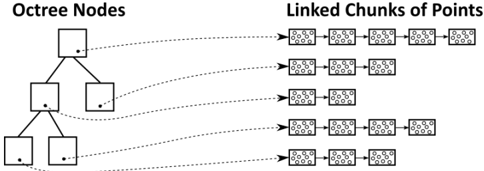
The image is a diagram illustrating the relationship between Octree nodes and linked chunks of points. It depicts a binary tree structure (Octree) on the left, and a series of linked rectangular chunks containing points on the right. Dotted lines connect the Octree nodes to the corresponding chunks of points.
### Components/Axes
The diagram consists of two main sections:
* **Octree Nodes:** A binary tree structure representing the Octree. Each node is represented by a square.
* **Linked Chunks of Points:** A series of rectangular chunks, each containing a collection of points (represented by small circles). These chunks are linked together in a chain.
There are no explicit axes or scales in this diagram. The diagram is purely representational.
### Detailed Analysis or Content Details
The Octree consists of three levels.
* **Level 1:** A single root node.
* **Level 2:** Two child nodes branching from the root.
* **Level 3:** Four leaf nodes branching from the second-level nodes.
Each Octree node is connected to one or more chunks of points via dotted lines. The connections are as follows:
* The root node is connected to four chunks of points.
* The first second-level node is connected to two chunks of points.
* The second second-level node is connected to two chunks of points.
* The first third-level node is connected to one chunk of points.
* The second third-level node is connected to one chunk of points.
* The third third-level node is connected to one chunk of points.
* The fourth third-level node is connected to one chunk of points.
Each chunk of points contains approximately 10-15 points. The chunks are linked together, forming chains of varying lengths. The points within each chunk appear randomly distributed.
### Key Observations
* The diagram illustrates a hierarchical structure where each Octree node corresponds to a set of points.
* The number of chunks of points associated with each node varies.
* The chunks of points are linked, suggesting a spatial relationship between the points they contain.
* The diagram does not provide any quantitative data about the points or the Octree structure.
### Interpretation
This diagram likely represents a spatial partitioning data structure, specifically an Octree, used for efficient storage and retrieval of points in 3D space. The Octree recursively divides the space into eight octants, and each node in the tree represents a region of space. The linked chunks of points represent the actual point data stored within each region.
The connections between the Octree nodes and the chunks of points indicate that the points within a chunk belong to the corresponding region of space represented by the node. The linking of the chunks suggests that points in adjacent chunks may be spatially close to each other, allowing for efficient neighbor searches.
The varying number of chunks associated with each node could indicate that the point distribution is not uniform. Regions with a higher density of points may be subdivided into more chunks.
The diagram is a conceptual illustration and does not provide any specific details about the implementation or performance of the Octree. It serves to convey the basic idea of how an Octree can be used to organize and manage point data in 3D space.