## Diagram: Chain of Thought vs. Latent Thought
### Overview
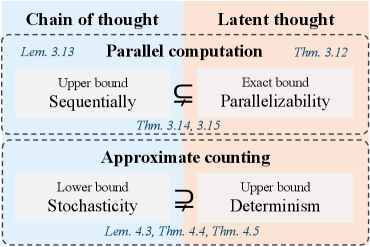
The image presents a diagram comparing "Chain of thought" and "Latent thought" across two categories: "Parallel computation" and "Approximate counting." It uses a visual representation to show the relationship between sequential and parallel computation, and stochasticity and determinism, with references to lemmas and theorems.
### Components/Axes
* **Title:** Chain of thought (left, blue background) and Latent thought (right, orange background).
* **Categories:**
* Parallel computation (top section)
* Approximate counting (bottom section)
* **Sub-categories (Parallel computation):**
* Sequentially (left, under "Chain of thought") - Upper bound
* Parallelizability (right, under "Latent thought") - Exact bound
* **Sub-categories (Approximate counting):**
* Stochasticity (left, under "Chain of thought") - Lower bound
* Determinism (right, under "Latent thought") - Upper bound
* **Symbols:**
* Subset symbol (⊆) is used to indicate a relationship between the left and right sides in both categories.
* **References:**
* Lem. 3.13, Thm. 3.12, Thm. 3.14, 3.15, Lem. 4.3, Thm. 4.4, Thm. 4.5
### Detailed Analysis
* **Parallel Computation:**
* "Sequentially" (Upper bound) is related to "Parallelizability" (Exact bound) with the subset symbol indicating that sequential computation is a subset of parallelizability.
* Reference: Lem. 3.13 (left), Thm. 3.12 (right), Thm. 3.14, 3.15 (center).
* **Approximate Counting:**
* "Stochasticity" (Lower bound) is related to "Determinism" (Upper bound) with the subset symbol indicating that stochasticity is a subset of determinism.
* Reference: Lem. 4.3, Thm. 4.4, Thm. 4.5 (bottom).
### Key Observations
* The diagram contrasts "Chain of thought" with "Latent thought" by associating them with different computational properties.
* The subset symbol (⊆) suggests a hierarchical relationship between the concepts on the left and right sides of each category.
* The references to lemmas and theorems indicate a mathematical or theoretical foundation for these relationships.
### Interpretation
The diagram illustrates a conceptual framework for understanding the relationship between "Chain of thought" and "Latent thought" in the context of computation. It suggests that "Chain of thought" is associated with sequential computation and stochasticity, while "Latent thought" is associated with parallelizability and determinism. The subset relationships imply that the concepts associated with "Chain of thought" are contained within the broader concepts associated with "Latent thought." The references to lemmas and theorems indicate that these relationships are based on formal mathematical or theoretical principles.