\n
## Diagram: Thought Process Comparison
### Overview
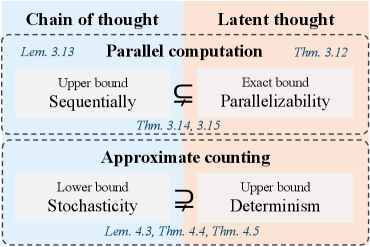
The image presents a diagram comparing two thought processes: "Chain of thought" and "Latent thought," and "Approximate counting". It visually contrasts concepts within each process using bounding boxes and mathematical symbols. The diagram is divided into two main sections, separated by a dashed line, with each section further divided into two sub-sections.
### Components/Axes
The diagram consists of four rectangular sections, each with associated labels and mathematical symbols. The sections are:
* **Top-Left:** "Chain of thought" - "Parallel computation" with label "Lem. 3.13" at the top-left and "Thm. 3.12" at the top-right. Contains "Upper bound" and "Sequentially" on the left, and "Exact bound" and "Parallelizability" on the right, separated by the symbol ⊆ (subset of, with a line through it indicating non-equality). "Thm. 3.14, 3.15" is located below the symbol.
* **Top-Right:** "Latent thought"
* **Bottom-Left:** "Approximate counting" - Contains "Lower bound" and "Stochasticity" on the left, and "Upper bound" and "Determinism" on the right, separated by the symbol ⊉ (subset of, with a line through it indicating non-equality). "Lem. 4.3, Thm. 4.4, Thm. 4.5" is located below the symbol.
* **Bottom-Right:** No explicit label.
The diagram uses a color scheme: the top section is light blue, and the bottom section is light orange. The top section is labeled "Chain of thought" and "Latent thought", while the bottom section is labeled "Approximate counting".
### Detailed Analysis or Content Details
The diagram presents a comparative analysis of thought processes.
* **Chain of thought vs. Latent thought:** This section contrasts "Parallel computation" with the mathematical symbol ⊆ with a line through it, indicating that the upper bound of sequential processing is not a subset of the exact bound of parallelizability. The section is referenced by "Lem. 3.13" and "Thm. 3.12". "Thm. 3.14, 3.15" is also referenced.
* **Approximate counting:** This section contrasts "Stochasticity" with "Determinism" using the mathematical symbol ⊉, indicating that the lower bound of stochasticity is not a subset of the upper bound of determinism. The section is referenced by "Lem. 4.3, Thm. 4.4, Thm. 4.5".
### Key Observations
The diagram highlights the differences between two pairs of concepts: sequential vs. parallel processing and stochasticity vs. determinism. The use of mathematical symbols suggests a formal, logical relationship between these concepts. The dashed line separating the two sections suggests a distinction between the two levels of thought processes.
### Interpretation
The diagram appears to be a visual representation of theoretical relationships within a computational or cognitive framework. The "Chain of thought" section likely refers to a more traditional, sequential processing approach, while "Latent thought" suggests a more parallel or simultaneous processing method. The "Approximate counting" section contrasts probabilistic ("Stochasticity") and certain ("Determinism") approaches to computation.
The mathematical symbols (⊆ with a line through it and ⊉) are crucial. They indicate that the concepts on either side of the symbol are *not* equivalent or subsets of each other. This suggests that moving from sequential to parallel processing, or from stochasticity to determinism, does not simply involve a straightforward inclusion of one concept within the other. There are inherent differences and limitations.
The references to lemmas and theorems ("Lem. 3.13", "Thm. 3.12", etc.) indicate that these relationships are formally proven within a specific mathematical or theoretical context. The diagram serves as a concise visual summary of these relationships. The dashed line suggests a separation between the two thought processes, potentially indicating different levels of abstraction or different stages in a computational process.