## Problem Solving Strategies for Price Reduction
### Overview
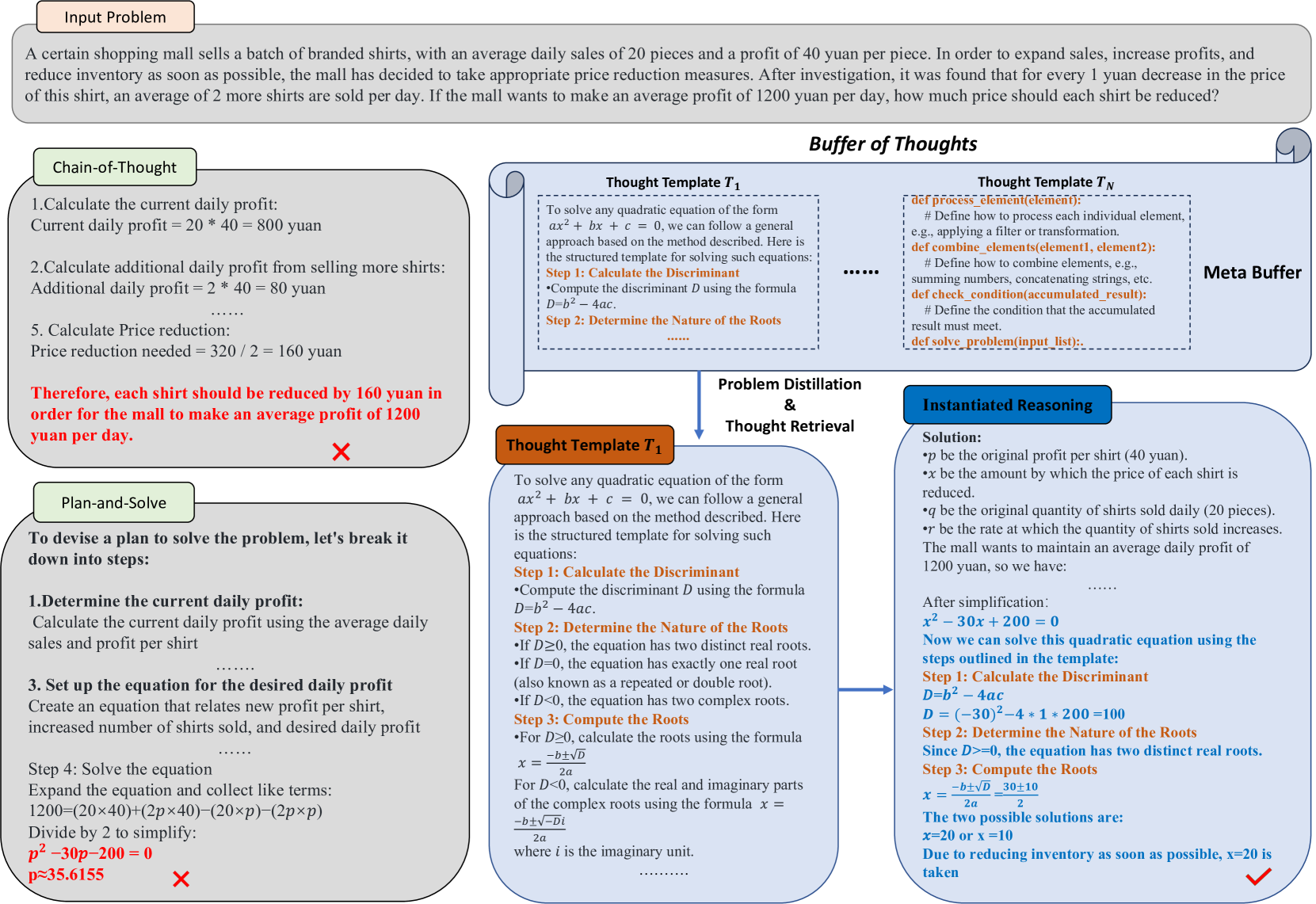
The image presents a problem related to price reduction in a retail setting, along with several approaches to solving it. It includes the problem statement, and four different solution strategies: Chain-of-Thought, Plan-and-Solve, Thought Templates, and Instantiated Reasoning. Each strategy attempts to determine the optimal price reduction for a shirt to achieve a target daily profit.
### Components/Axes
* **Input Problem:** The problem statement describes a shopping mall selling branded shirts with an average daily sales of 20 pieces and a profit of 40 yuan per piece. The goal is to determine the price reduction needed to achieve a daily profit of 1200 yuan, given that for every 1 yuan decrease in price, 2 more shirts are sold per day.
* **Chain-of-Thought:** A step-by-step calculation approach.
* **Plan-and-Solve:** A structured approach to solving the problem, breaking it down into steps.
* **Thought Template T1:** A template for solving quadratic equations, focusing on calculating the discriminant and determining the nature of the roots.
* **Thought Template TN:** A template defining functions for processing elements, combining elements, checking conditions, and solving problems.
* **Problem Distillation & Thought Retrieval:** A process of refining the problem and retrieving relevant knowledge.
* **Meta Buffer:** A storage area for general knowledge and problem-solving strategies.
* **Instantiated Reasoning:** A solution using variables and a quadratic equation, following the steps outlined in the Thought Template.
### Detailed Analysis or ### Content Details
**Input Problem:**
* A shopping mall sells branded shirts.
* Average daily sales: 20 pieces.
* Profit per piece: 40 yuan.
* Goal: Achieve a daily profit of 1200 yuan.
* For every 1 yuan price decrease, 2 more shirts are sold per day.
**Chain-of-Thought:**
1. Calculate the current daily profit: 20 * 40 = 800 yuan
2. Calculate additional daily profit from selling more shirts: 2 * 40 = 80 yuan
3. Calculate Price reduction: Price reduction needed = 320 / 2 = 160 yuan
* Conclusion: Each shirt should be reduced by 160 yuan to make an average profit of 1200 yuan per day.
* This solution is marked with a red "X", indicating it is incorrect.
**Plan-and-Solve:**
1. Determine the current daily profit: Calculate the current daily profit using the average daily sales and profit per shirt.
2. Set up the equation for the desired daily profit: Create an equation that relates new profit per shirt, increased number of shirts sold, and desired daily profit.
3. Solve the equation:
* Expand the equation and collect like terms: 1200 = (20 * 40) + (2p * 40) - (20 * p) - (2p * p)
* Divide by 2 to simplify: p² - 30p - 200 = 0
* p ≈ 35.6155
* This solution is marked with a red "X", indicating it is incorrect.
**Thought Template T1:**
* To solve any quadratic equation of the form ax² + bx + c = 0.
* Step 1: Calculate the Discriminant: D = b² - 4ac
* Step 2: Determine the Nature of the Roots:
* If D ≥ 0, the equation has two distinct real roots.
* If D = 0, the equation has exactly one real root (also known as a repeated or double root).
* If D < 0, the equation has two complex roots.
* Step 3: Compute the Roots:
* For D ≥ 0, x = (-b ± √D) / 2a
* For D < 0, x = (-b ± √-Di) / 2a, where i is the imaginary unit.
**Thought Template TN:**
* `def process_element(element):` # Define how to process each individual element.
* `def combine_elements(element1, element2):` # Define how to combine elements.
* `def check_condition(accumulated_result):` # Define the condition that the accumulated result must meet.
* `def solve_problem(input_list):`
**Instantiated Reasoning:**
* Solution:
* p = original profit per shirt (40 yuan)
* x = amount by which the price of each shirt is reduced
* q = original quantity of shirts sold daily (20 pieces)
* r = rate at which the quantity of shirts sold increases
* The mall wants to maintain an average daily profit of 1200 yuan.
* After simplification: x² - 30x + 200 = 0
* Now we can solve this quadratic equation using the steps outlined in the template:
* Step 1: Calculate the Discriminant: D = b² - 4ac = (-30)² - 4 * 1 * 200 = 100
* Step 2: Determine the Nature of the Roots: Since D >= 0, the equation has two distinct real roots.
* Step 3: Compute the Roots: x = (-b ± √D) / 2a = (30 ± 10) / 2
* The two possible solutions are: x = 20 or x = 10
* Due to reducing inventory as soon as possible, x = 20 is taken.
* This solution is marked with a green checkmark, indicating it is correct.
### Key Observations
* The Chain-of-Thought and Plan-and-Solve approaches provide incorrect solutions.
* The Instantiated Reasoning approach, guided by the Thought Template, arrives at the correct solution.
* The correct price reduction is 20 yuan.
### Interpretation
The image demonstrates different problem-solving strategies applied to a business scenario. The Chain-of-Thought and Plan-and-Solve methods, while intuitive, fail to account for the quadratic relationship between price reduction and increased sales, leading to incorrect results. The Instantiated Reasoning approach, leveraging a structured template for solving quadratic equations, successfully determines the optimal price reduction. This highlights the importance of using appropriate mathematical models and structured problem-solving techniques to address complex business problems. The fact that reducing inventory is a priority suggests there may be storage costs or other factors influencing the decision to choose x=20 over x=10.