\n
## Diagram: Problem Solving Chain-of-Thought
### Overview
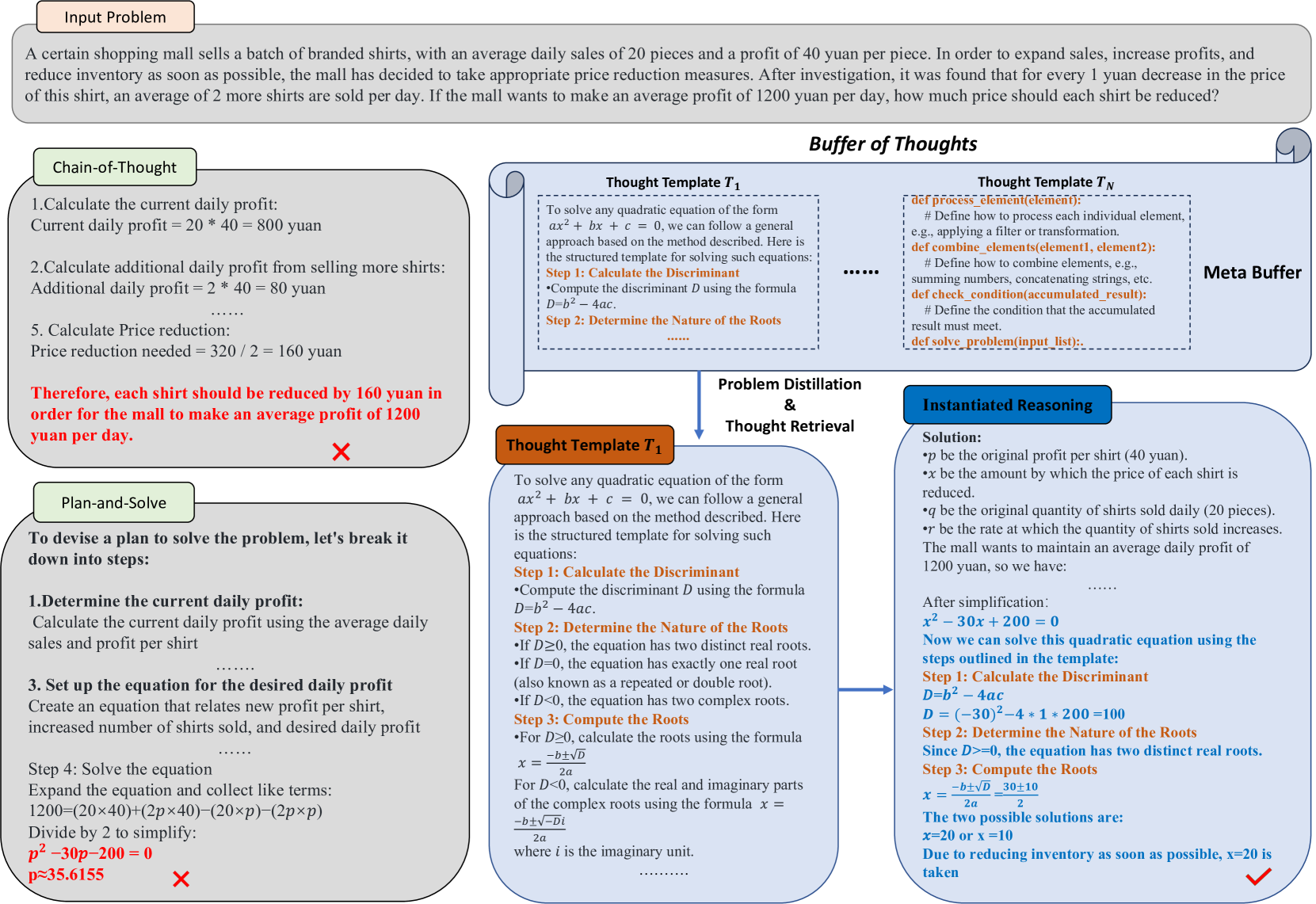
This image presents a diagram illustrating a chain-of-thought problem-solving process, likely generated by a large language model. It details the steps taken to solve a word problem concerning pricing and sales volume. The diagram is structured with distinct sections: "Input Problem", "Chain-of-Thought", "Buffer of Thoughts", "Problem Distillation & Thought Retrieval", and "Instantiated Reasoning". There are also sections for "Plan-and-Solve" and a visual "Meta Buffer" element.
### Components/Axes
The diagram is not a traditional chart with axes. Instead, it's a flow diagram with text blocks and visual elements. Key components include:
* **Input Problem:** A text box containing the original word problem.
* **Chain-of-Thought:** A numbered list outlining the steps taken to solve the problem.
* **Buffer of Thoughts:** Two columns labeled "Thought Template T₁" and "Thought Template T₂", containing code-like snippets and explanations.
* **Problem Distillation & Thought Retrieval:** A section with a visual "X" symbol and text describing the process of distilling the problem.
* **Instantiated Reasoning:** A section presenting the solution to the problem, including variable definitions and the final answer.
* **Plan-and-Solve:** A section outlining the plan to solve the problem.
* **Meta Buffer:** A visual element resembling a radar screen with dots, likely representing the model's internal state.
### Detailed Analysis or Content Details
**Input Problem:**
"A certain shopping mall sells a batch of branded shirts, with an average daily sales of 20 pieces and a profit of 40 yuan per piece. In order to expand sales, increase profits, and reduce inventory as soon as possible, the mall has decided to take appropriate price reduction measures. After investigation, it was found that for every 1 yuan decrease in the price of this shirt, an average of 2 more shirts are sold per day. If the mall wants to make an average profit of 1200 yuan per day, how much price should each shirt be reduced?"
**Chain-of-Thought:**
1. Calculate the current daily profit: Current daily profit = 20 \* 40 = 800 yuan
2. Calculate additional daily profit from selling more shirts: Additional daily profit = 2 \* 40 = 80 yuan
3. Calculate Price reduction: Price reduction = 320 / 2 = 160 yuan
Therefore, each shirt should be reduced by 160 yuan in order for the mall to make an average profit of 1200 yuan per day.
**Buffer of Thoughts:**
* **Thought Template T₁:**
* `def process_element(element):`
* `# Define how to process each individual element,`
* `# e.g., applying a filter or transformation.`
* `def combine_elements(element1, element2):`
* `# Define how to combine elements, e.g.,`
* `# summing numbers, concatenating strings, etc.`
* `def check_condition(accumulated_result):`
* `# Define the condition that the accumulated`
* `# result must meet.`
* `def solve_problem(input_list):`
* **Thought Template T₂:**
* To solve any quadratic equation of the form ax² + bx + c = 0, we can follow a general approach based on the method described. Here is the structured template for solving such equations:
* Step 1: Calculate the Discriminant
* Compute the discriminant D using the formula D = b² - 4ac.
* Step 2: Determine the Nature of the Roots
* **Meta Buffer:** Contains several dots, seemingly randomly placed within a circular area.
**Problem Distillation & Thought Retrieval:**
Contains the "X" symbol and text describing the process of distilling the problem.
**Instantiated Reasoning:**
* Solution:
* `pb` the original profit per shirt (40 yuan).
* `x` be the amount by which the price of each shirt is reduced.
* `qb` the original quantity of shirts sold daily (20 pieces).
* `re` the rate at which the quantity of shirts sold increases as the mall wants to maintain an average daily profit of 1200 yuan.
* Equation: (40 - x)(20 + 2x) = 1200
* Expanding: 800 + 80x - 20x - 2x² = 1200
* Simplifying: -2x² + 60x - 400 = 0
* Dividing by -2: x² - 30x + 200 = 0
* Solving the quadratic equation: x = 10 or x = 20
* Therefore, each shirt should be reduced by 10 yuan or 20 yuan.
**Plan-and-Solve:**
"To devise a plan to solve the problem, we'll break down the process into steps:"
1. Define variables to represent the unknown quantities.
2. Formulate an equation that represents the relationship between the variables and the given information.
3. Solve the equation to find the value of the unknown quantity.
4. Check the solution to ensure it makes sense in the context of the problem.
### Key Observations
The diagram showcases a step-by-step reasoning process. The "Buffer of Thoughts" sections suggest the underlying code or templates used by the model to generate the solution. The "Instantiated Reasoning" section provides a clear mathematical solution to the problem. The diagram highlights the model's ability to translate a word problem into a mathematical equation and solve it. There are two possible solutions (x=10 or x=20) presented.
### Interpretation
This diagram demonstrates a sophisticated approach to problem-solving, characteristic of advanced language models. The chain-of-thought methodology allows the model to break down a complex problem into smaller, manageable steps. The "Buffer of Thoughts" provides insight into the model's internal reasoning process, revealing the use of templates and code-like structures. The diagram suggests that the model doesn't simply provide an answer but rather explains its reasoning, making the solution more transparent and understandable. The presence of two solutions indicates the model is capable of identifying multiple valid answers, although further context might be needed to determine the most appropriate one. The "Meta Buffer" is a less clear element, potentially representing the model's confidence or internal state during the reasoning process. Overall, the diagram illustrates a powerful combination of natural language processing and mathematical reasoning.