## Diagram Type: Problem-Solving Method Comparison (Math Problem: Shirt Profit Optimization)
### Overview
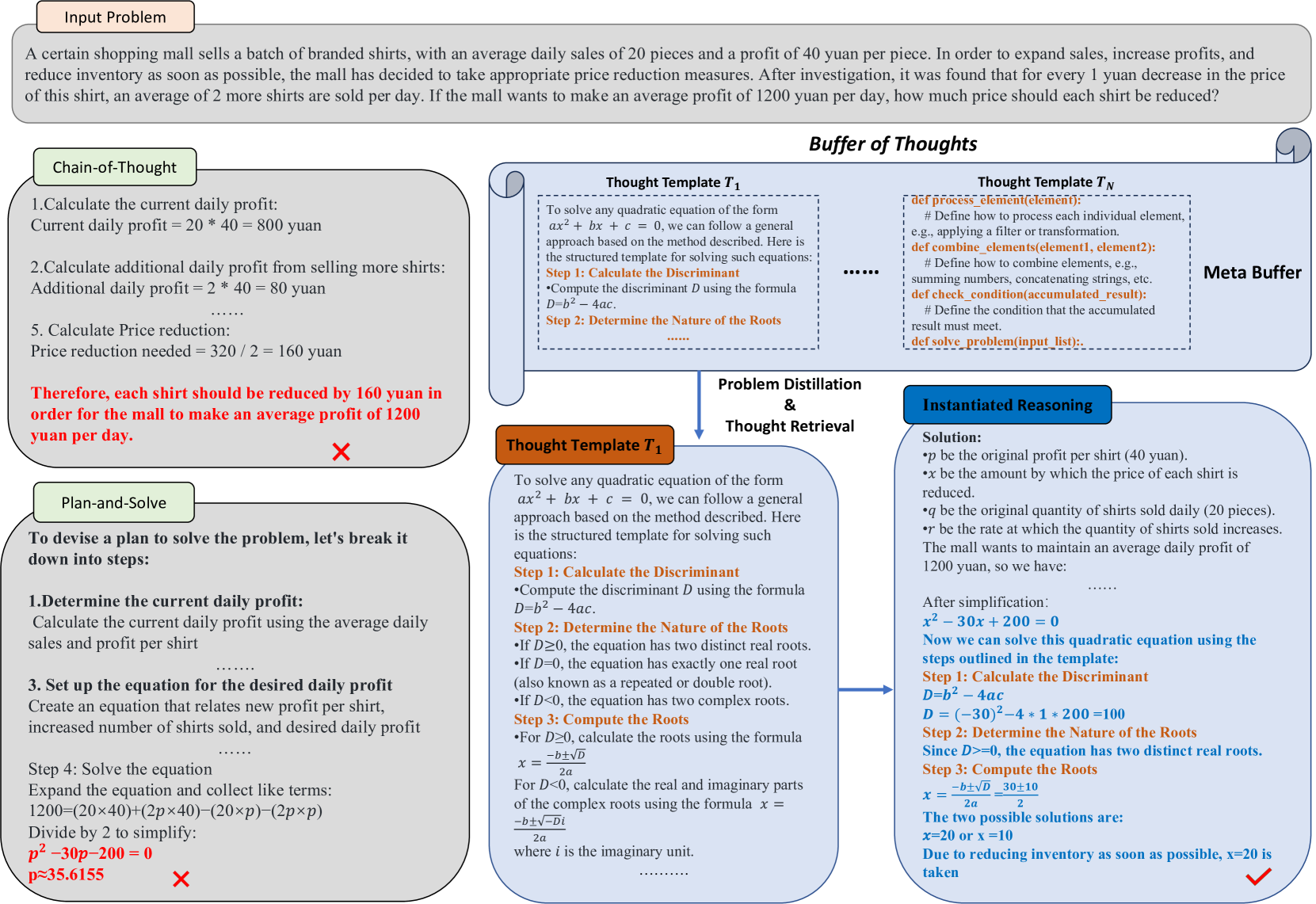
The image illustrates multiple problem-solving approaches (Chain-of-Thought, Plan-and-Solve, Buffer of Thoughts, Instantiated Reasoning) for a math problem about optimizing shirt sales profit. The problem involves a mall selling shirts with initial sales (20/day) and profit (40 yuan/piece), where a 1 yuan price cut increases sales by 2/day, aiming for 1200 yuan daily profit. The diagram compares **incorrect** (Chain-of-Thought, Plan-and-Solve) and **correct** (Instantiated Reasoning) solutions, with a “Buffer of Thoughts” framework for structured problem-solving.
### Components/Axes (Sections)
- **Input Problem (Top)**: Text describing the shirt sales problem.
- **Chain-of-Thought (Left Top)**: Step-by-step (incorrect) solution with a red “X.”
- **Plan-and-Solve (Left Bottom)**: Step-by-step (incorrect) solution with a red “X.”
- **Buffer of Thoughts (Middle Top)**: Thought templates (T₁ for quadratic equations, Tₙ for general problem-solving) and a “Meta Buffer” (functions for processing elements).
- **Problem Distillation & Thought Retrieval (Middle)**: Links the “Buffer of Thoughts” to “Instantiated Reasoning.”
- **Instantiated Reasoning (Right)**: Correct solution with variable definitions, equation setup, and solution (marked with a red check).
### Detailed Analysis
#### 1. Input Problem Text
*“A certain shopping mall sells a batch of branded shirts, with an average daily sales of 20 pieces and a profit of 40 yuan per piece. In order to expand sales, increase profits, and reduce inventory as soon as possible, the mall has decided to take appropriate price reduction measures. After investigation, it was found that for every 1 yuan decrease in the price of this shirt, an average of 2 more shirts are sold per day. If the mall wants to make an average profit of 1200 yuan per day, how much price should each shirt be reduced?”*
#### 2. Chain-of-Thought (Incorrect Solution)
- **Step 1**: Current daily profit = \( 20 \times 40 = 800 \) yuan.
- **Step 2**: Additional daily profit from more shirts = \( 2 \times 40 = 80 \) yuan (incomplete, ignores price reduction’s impact on profit per shirt).
- **Step 5**: Price reduction needed = \( 320 / 2 = 160 \) yuan (flawed logic, marked with a red “X”).
#### 3. Plan-and-Solve (Incorrect Solution)
- **Steps**: Determine current profit → Set up equation → Solve.
- **Equation**: \( 1200 = (20 \times 40) + (2p \times 40) - (20 \times p) - (2p \times p) \) → Simplifies to \( p^2 - 30p - 200 = 0 \) → \( p \approx 35.6155 \) (incorrect, marked with a red “X”).
#### 4. Buffer of Thoughts (Structured Framework)
- **Thought Template \( T_1 \)** (Quadratic Equations):
- Step 1: Calculate the discriminant \( D = b^2 - 4ac \).
- Step 2: Determine the nature of roots ( \( D \geq 0 \): real roots; \( D = 0 \): repeated root; \( D < 0 \): complex roots).
- Step 3: Compute roots using \( x = \frac{-b \pm \sqrt{D}}{2a} \).
- **Meta Buffer**: Functions for general problem-solving:
- `process_element(element)`: Define how to process individual elements (e.g., filter/transform).
- `combine_elements(element1, element2)`: Define how to combine elements (e.g., sum numbers, concatenate strings).
- `check_condition(accumulated_result)`: Define the condition the result must meet.
- `solve_problem(input_list)`: Define the problem-solving logic.
#### 5. Instantiated Reasoning (Correct Solution)
- **Variables**:
- \( p = 40 \) (original profit per shirt, yuan).
- \( x \) = price reduction per shirt (yuan).
- \( q = 20 \) (original daily sales, pieces).
- \( r = 2 \) (sales increase per 1 yuan price cut, pieces/day).
- **Equation**: Profit = (Profit per shirt − Reduction) × (Quantity + Sales Increase)
\( (40 - x)(20 + 2x) = 1200 \)
- **Simplification**: \( x^2 - 30x + 200 = 0 \)
- **Discriminant**: \( D = (-30)^2 - 4(1)(200) = 100 \)
- **Roots**: \( x = \frac{30 \pm \sqrt{100}}{2} = \frac{30 \pm 10}{2} \) → \( x = 20 \) or \( x = 10 \).
- **Choice**: \( x = 20 \) (to reduce inventory faster, marked with a red check).
### Key Observations
- **Incorrect Approaches**: Chain-of-Thought and Plan-and-Solve fail to account for the price reduction’s impact on *both* profit per shirt and quantity sold, leading to flawed logic.
- **Correct Approach**: Instantiated Reasoning uses variable definitions, a correct profit equation, and solves the quadratic equation properly.
- **Buffer of Thoughts**: Provides a structured framework (templates, meta-functions) to guide problem-solving, emphasizing quadratic equation methods.
### Interpretation
The diagram highlights the importance of **systematic problem-solving** (via the “Buffer of Thoughts”) and correct variable/equation setup. The incorrect methods ignore the price reduction’s dual impact (on profit per shirt and sales volume), leading to wrong answers. The correct approach (Instantiated Reasoning) uses the quadratic formula correctly, choosing \( x = 20 \) to align with the goal of reducing inventory (higher sales volume). This demonstrates how structured thinking (templates, meta-functions) improves accuracy in optimization problems with multiple variables.
(Note: All text is in English, with no other languages present.)