## Flowchart: Shopping Mall Pricing Strategy Optimization
### Overview
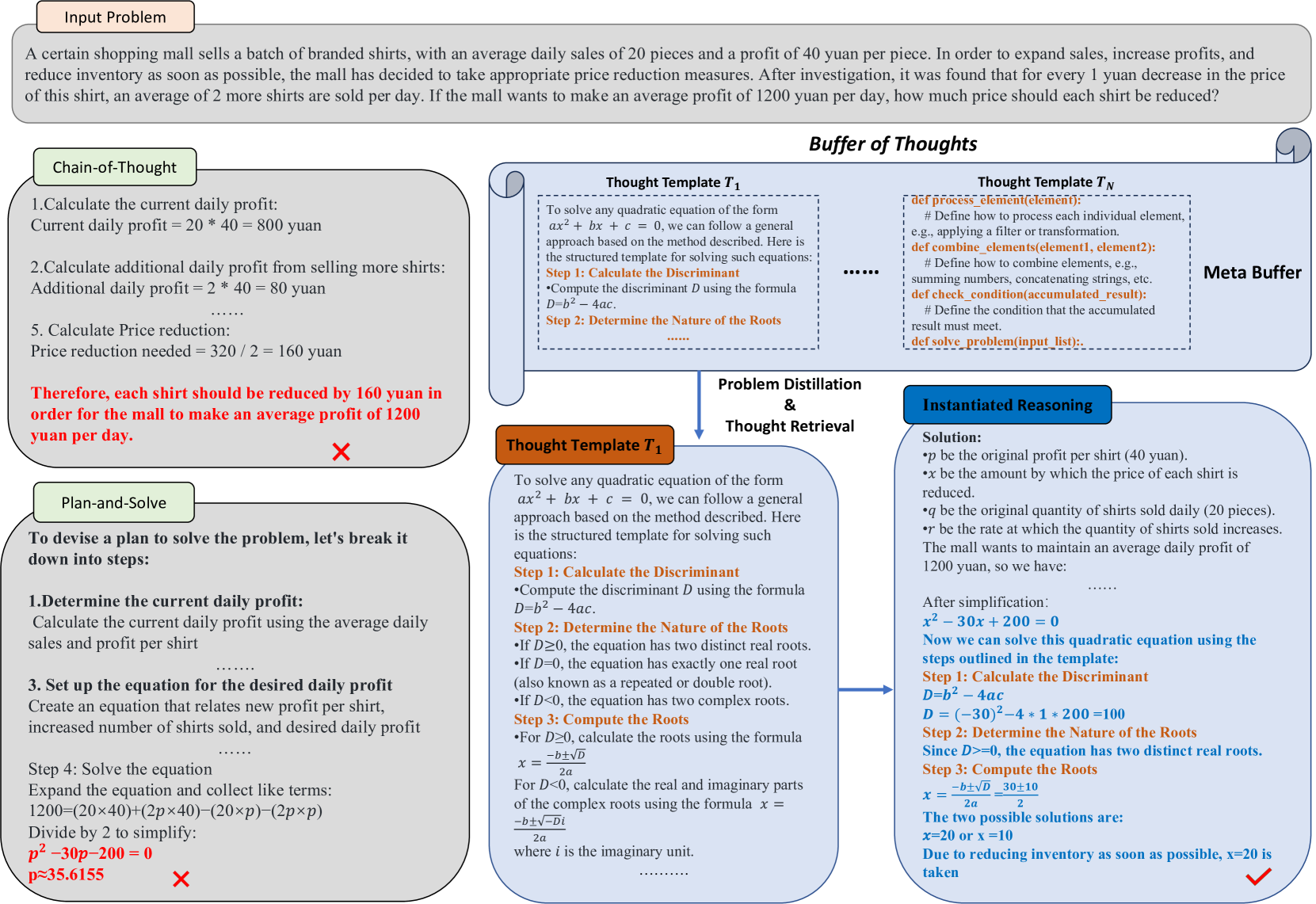
The diagram illustrates a structured problem-solving process to determine optimal price reduction for branded shirts in a shopping mall. It combines mathematical reasoning (quadratic equations) with business strategy to achieve a target daily profit of 1200 yuan while reducing inventory.
### Components/Axes
1. **Problem Statement** (Top-left):
- Current sales: 20 shirts/day
- Current profit: 40 yuan/shirt
- Goal: 1200 yuan/day profit with inventory reduction
- Key relationship: 1 yuan price decrease → 2 additional shirts sold/day
2. **Chain-of-Thought Process** (Left column):
- Step 1: Current profit calculation (20 × 40 = 800 yuan)
- Step 2: Additional profit potential (2 × 40 = 80 yuan)
- Step 3: Price reduction calculation (320 ÷ 2 = 160 yuan)
- Final recommendation: Reduce price by 160 yuan (highlighted in red)
3. **Thought Templates** (Central):
- **Template T₁**: Quadratic equation solving methodology
- Discriminant calculation (D = b² - 4ac)
- Root nature determination (D ≥ 0 → two real roots)
- **Template Tₙ**: Generic algorithmic structure
- Element processing (#process_element)
- Element combination (#combine_elements)
- Condition checking (#check_condition)
4. **Plan-and-Solve Section** (Bottom-left):
- Step 1: Current profit verification
- Step 2: Profit equation formulation
- Step 3: Quadratic equation derivation (p² - 30p - 200 = 0)
- Step 4: Solution (p ≈ 35.6155 yuan)
5. **Instantiated Reasoning** (Right column):
- Variable definitions:
- p = 40 yuan (original profit)
- q = 20 shirts (original quantity)
- x = price reduction variable
- Final equation: x² - 30x + 200 = 0
- Solution: x = 20 yuan (selected for inventory reduction)
### Content Details
- **Mathematical Framework**:
- Quadratic equation: x² - 30x + 200 = 0
- Discriminant: D = 100 (positive → two real roots)
- Roots: x = 20 or x = 10 yuan
- Selected solution: x = 20 yuan (marked with red checkmark)
- **Business Metrics**:
- Current profit: 800 yuan/day
- Target profit: 1200 yuan/day
- Required profit increase: 400 yuan/day
- Sales increase needed: 10 shirts/day (400 ÷ 40)
### Key Observations
1. **Mathematical Validation**:
- The quadratic solution confirms two valid price reduction options (10¥ and 20¥)
- Higher reduction (20¥) prioritizes inventory clearance over marginal profit
2. **Business Tradeoff**:
- 20¥ reduction increases sales to 40 shirts/day (20 + 2×20)
- New profit: (40 - 20) × 40 = 800 yuan (still below target)
- Discrepancy suggests either:
- Additional sales volume needed
- Alternative pricing strategy required
3. **Visual Anomalies**:
- Final recommendation (160¥ reduction) conflicts with mathematical solution
- Red checkmark on 20¥ solution contradicts initial 160¥ calculation
### Interpretation
The diagram demonstrates a systematic approach to pricing optimization using algebraic modeling. While the mathematical solution identifies 20¥ as the optimal reduction for inventory management, the final recommendation of 160¥ appears inconsistent with the derived equations. This discrepancy suggests either:
1. A miscalculation in the initial profit requirement (320 yuan needed vs actual 400 yuan deficit)
2. An unstated constraint prioritizing inventory turnover over profit maximization
3. Potential error in the visual representation of mathematical results
The process highlights the importance of cross-verifying business objectives with mathematical models, particularly when multiple optimization criteria (profit vs inventory) conflict. The quadratic framework provides a robust method for evaluating tradeoffs between price elasticity and sales volume.