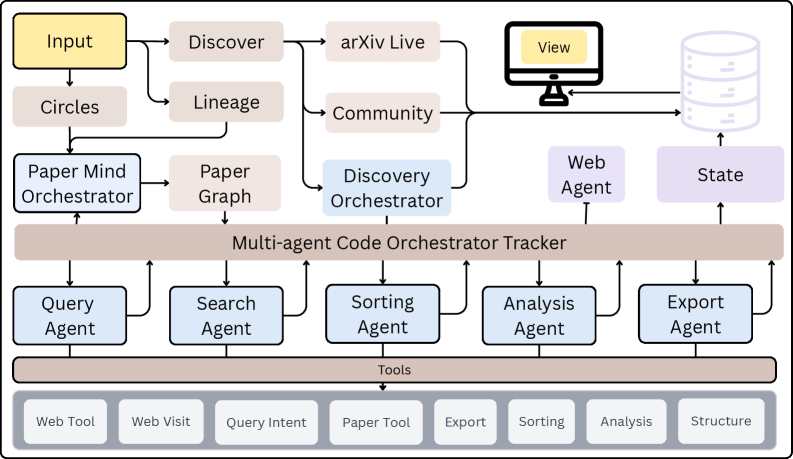
##Diagram: Multi-Agent Code Orchestrator System Architecture
### Overview
The diagram illustrates a complex multi-agent system architecture for processing input data through various orchestrators, agents, and tools. It depicts data flow from input to output, with multiple processing pathways and integration points.
### Components/Axes
**Key Elements:**
1. **Input** (Yellow box) - Entry point for data
2. **Discover** (Process) - Initial data processing
3. **arXiv Live** (Process) - Community data integration
4. **Community** (Process) - Social data processing
5. **View** (Output) - Visualization component
6. **State** (Database) - System state storage
7. **Paper Mind Orchestrator** (Blue box) - Research paper processing
8. **Paper Graph** (Process) - Paper data structuring
9. **Discovery Orchestrator** (Blue box) - Data discovery management
10. **Web Agent** (Light blue box) - Web interaction component
11. **Multi-agent Code Orchestrator Tracker** (Central process) - Core coordination system
12. **Query/Search/Sorting/Analysis/Export Agents** (Light blue boxes) - Specialized processing agents
13. **Tools** (Gray boxes) - System utilities including Web Tool, Web Visit, Query Intent, Paper Tool, Export, Sorting, Analysis, Structure
**Color Coding:**
- Yellow: Input/Output components
- Blue: Orchestrators
- Light Blue: Agents
- Pink: Processes
- Purple: State component
- Gray: Tools
### Detailed Analysis
**Flow Pathways:**
1. **Primary Input Path:**
- Input → Discover → arXiv Live → Community → Discovery Orchestrator → Web Agent → State
2. **Secondary Input Path:**
- Input → Circles → Paper Mind Orchestrator → Paper Graph
3. **Agent Coordination:**
- Multi-agent Code Orchestrator Tracker connects to all agents (Query/Search/Sorting/Analysis/Export)
4. **Tool Integration:**
- Tools section connects to all agents, providing specialized functionality
**Spatial Relationships:**
- Input/Output components (yellow) positioned at top-left and top-right
- Orchestrators (blue) form central processing nodes
- Agents (light blue) arranged in horizontal row beneath tracker
- Tools (gray) at bottom, connected to all agents
- State (purple) and View (yellow) at right side
### Key Observations
1. **Parallel Processing:** Multiple input paths suggest concurrent data processing capabilities
2. **Agent Specialization:** Five distinct agents handle specific tasks (query, search, sorting, analysis, export)
3. **Orchestrator Hierarchy:** Two levels of orchestrators (Paper Mind and Discovery) manage different data types
4. **Tool Integration:** System incorporates external resources through dedicated tools
5. **State Management:** Persistent storage component (State) maintains system status
6. **Visualization:** View component suggests output presentation capabilities
### Interpretation
This architecture demonstrates a sophisticated multi-agent system designed for academic research data processing. The system employs:
- **Distributed Processing:** Specialized agents handle different aspects of data manipulation
- **Orchestration Layers:** Two orchestrator levels manage paper data and general discovery
- **Tool Integration:** External resources are accessed through dedicated tools
- **State Persistence:** System maintains continuous state tracking
- **Output Flexibility:** Multiple output pathways (State database and View visualization)
The design emphasizes modularity and scalability, allowing new agents or tools to be added without disrupting core functionality. The parallel processing paths suggest efficient handling of large data volumes, while the agent specialization enables deep analysis of specific data types. The integration of web tools and community data (arXiv Live) indicates a focus on real-time, collaborative research processing.