## Textual Description with ASCII Art Diagrams
### Overview
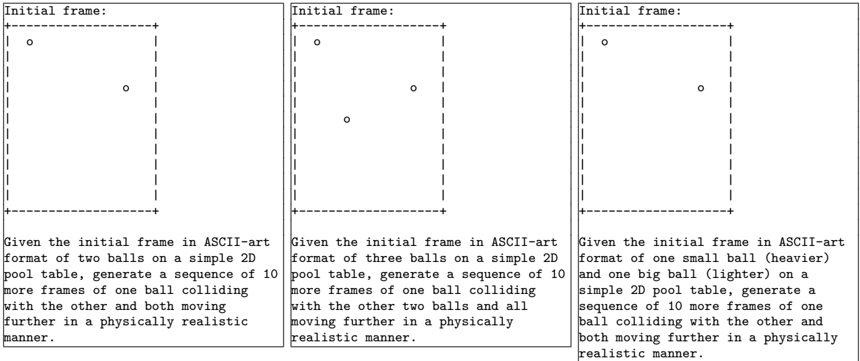
The image contains three distinct sections, each featuring an "Initial frame" label followed by ASCII-art representations of pool balls on a 2D table. Each section includes a task description specifying collision scenarios and requirements for generating subsequent frames. The text is in English, with no other languages present.
---
### Components/Axes
1. **Labels**:
- "Initial frame:" (repeated three times, top-left of each section).
- Task descriptions (bottom of each section).
2. **ASCII Art Diagrams**:
- **Section 1**: Two balls (`o`) positioned at top-left and bottom-right corners of a dashed rectangle.
- **Section 2**: Three balls (`o`) positioned at top-left, center, and bottom-right corners.
- **Section 3**: Two balls (`o`) positioned at top-left and bottom-right corners, with a note about mass differences ("heavier" and "lighter").
3. **Task Descriptions**:
- **Section 1**: Generate 10 frames of one ball colliding with the other, both moving realistically.
- **Section 2**: Generate 10 frames of one ball colliding with two others, all moving realistically.
- **Section 3**: Generate 10 frames of a heavy ball colliding with a lighter ball, both moving realistically.
---
### Detailed Analysis
- **Section 1**:
- **Initial Frame**:
```
+-----------------+
| o |
| |
| |
| o |
+-----------------+
```
- **Task**: Simulate collisions between two balls, emphasizing momentum transfer and trajectory changes.
- **Section 2**:
- **Initial Frame**:
```
+-----------------+
| o |
| |
| o |
| |
| o |
+-----------------+
```
- **Task**: Simulate a multi-body collision, requiring conservation of momentum and energy calculations.
- **Section 3**:
- **Initial Frame**:
```
+-----------------+
| o |
| |
| |
| o |
+-----------------+
```
- **Task**: Simulate a collision between a heavy and light ball, highlighting differences in post-collision velocities.
---
### Key Observations
1. **Consistency in Structure**: All sections follow the same format: "Initial frame:" label, ASCII-art diagram, and task description.
2. **Collision Complexity**:
- Section 1: Binary collision (2 balls).
- Section 2: Ternary collision (3 balls).
- Section 3: Binary collision with mass disparity.
3. **Physical Realism**: All tasks emphasize "physically realistic" motion, implying adherence to Newtonian mechanics (e.g., conservation laws).
---
### Interpretation
The image appears to be an educational exercise in simulating elastic collisions in a 2D pool table environment. Each task isolates a specific physical principle:
- **Section 1**: Basic momentum transfer between two identical masses.
- **Section 2**: Multi-body interactions and vector-based momentum conservation.
- **Section 3**: Mass-dependent velocity changes, where the lighter ball gains greater speed post-collision.
The ASCII art serves as a simplified visualization tool, abstracting the pool table into a grid. The absence of numerical values suggests the focus is on conceptual understanding rather than quantitative analysis. The tasks likely aim to teach physics students or developers how to model realistic motion and collisions in simulations.
**Notable Anomalies**:
- No explicit mention of friction, spin, or table dimensions, which are critical in real-world pool dynamics.
- The "heavier" and "lighter" labels in Section 3 lack quantitative mass ratios, leaving the exact outcome ambiguous.
This structure prioritizes conceptual clarity over technical precision, making it suitable for introductory physics or computer graphics education.