## Diagram: Initial Frames of 2D Pool Table Simulations
### Overview
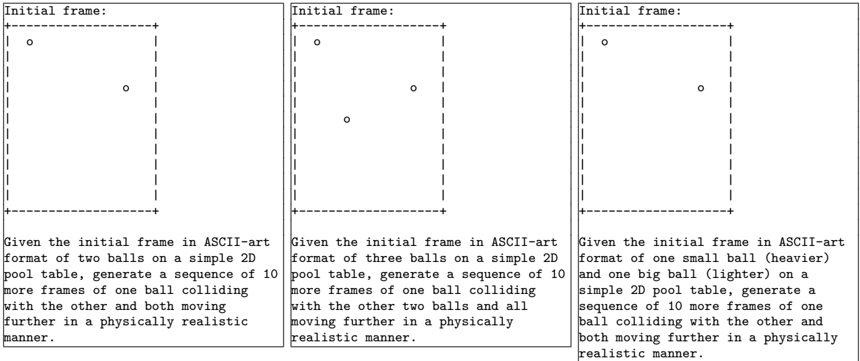
The image presents three separate diagrams, each depicting the initial frame of a 2D pool table simulation. Each diagram shows a rectangular pool table boundary and the initial positions of balls within that boundary. The diagrams are accompanied by descriptive text explaining the simulation setup.
### Components/Axes
Each diagram contains the following components:
* **Title:** "Initial frame:" located at the top of each diagram.
* **Pool Table Boundary:** A rectangle formed by dashed lines, representing the edges of the pool table. The corners of the rectangle are marked with "+".
* **Balls:** Represented by small circles ("o"). The number and arrangement of balls differ in each diagram.
* **Description:** Text below each diagram describing the simulation parameters.
### Detailed Analysis
**Diagram 1:**
* **Balls:** Two balls are present. One is located near the top-left corner of the table, and the other is located approximately in the center of the table.
* **Description:** "Given the initial frame in ASCII-art format of two balls on a simple 2D pool table, generate a sequence of 10 more frames of one ball colliding with the other and both moving further in a physically realistic manner."
**Diagram 2:**
* **Balls:** Three balls are present. One is located near the top-left corner, one is located approximately in the upper-middle of the table, and the third is located approximately in the center of the table.
* **Description:** "Given the initial frame in ASCII-art format of three balls on a simple 2D pool table, generate a sequence of 10 more frames of one ball colliding with the other two balls and all moving further in a physically realistic manner."
**Diagram 3:**
* **Balls:** Two balls are present. One is located near the top-left corner, and the other is located approximately in the center of the table.
* **Description:** "Given the initial frame in ASCII-art format of one small ball (heavier) and one big ball (lighter) on a simple 2D pool table, generate a sequence of 10 more frames of one ball colliding with the other and both moving further in a physically realistic manner."
### Key Observations
* The diagrams are simple ASCII-art representations.
* The number of balls varies between two and three.
* The descriptions indicate that the simulations involve generating 10 additional frames showing the balls colliding and moving.
* The third diagram specifies that the balls have different masses (one heavier, one lighter).
### Interpretation
The image presents the initial conditions for three different 2D pool table simulations. The simulations aim to model the collisions and movement of balls in a physically realistic manner. The variations in the number of balls and their masses suggest different scenarios being explored. The descriptions indicate that the goal is to generate a sequence of frames showing the evolution of the ball positions over time, simulating the physics of collisions and motion.