\n
## Diagram: Pool Ball Collision Scenarios
### Overview
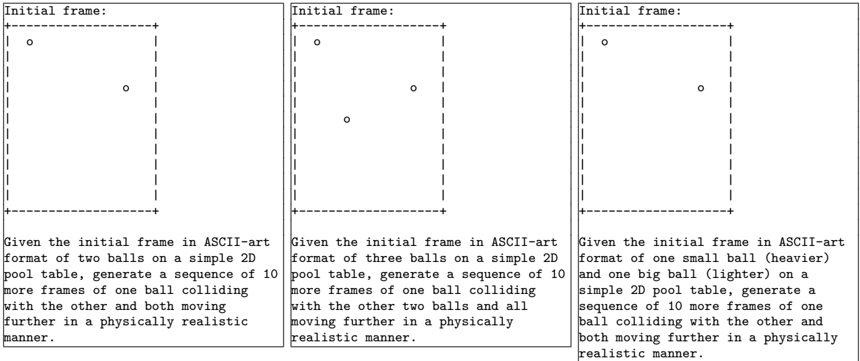
The image presents three separate diagrams, each depicting an initial frame of a pool ball collision scenario rendered in ASCII art. Each diagram is accompanied by a textual description outlining the task of generating a sequence of frames simulating the collision and subsequent movement of the balls.
### Components/Axes
Each diagram consists of:
* A rectangular frame representing a pool table, delineated by '+' and '-' characters.
* 'o' characters representing pool balls.
* Vertical dashed lines indicating the boundaries of the table.
* A textual description below each diagram.
### Detailed Analysis or Content Details
**Diagram 1 (Left):**
* **Initial Frame:** Two balls are present. One ball is positioned near the top-center (approximately 0.15, 0.85 relative to the table dimensions), and the other is near the bottom-right (approximately 0.85, 0.15).
* **Text:** "Given the initial frame in ASCII-art format of two balls on a simple 2D pool table, generate a sequence of 10 more frames of one ball colliding with the other and both moving further in a physically realistic manner."
**Diagram 2 (Center):**
* **Initial Frame:** Three balls are present. One ball is positioned near the top-center (approximately 0.5, 0.85), one near the center (approximately 0.5, 0.5), and one near the bottom-center (approximately 0.5, 0.15).
* **Text:** "Given the initial frame in ASCII-art format of three balls on a simple 2D pool table, generate a sequence of 10 more frames of one ball colliding with the other two balls and all moving further in a physically realistic manner."
**Diagram 3 (Right):**
* **Initial Frame:** Two balls are present. One ball is smaller and positioned near the top-center (approximately 0.15, 0.85), and the other is larger and positioned near the bottom-right (approximately 0.85, 0.15). The text specifies one ball is heavier and the other is lighter.
* **Text:** "Given the initial frame in ASCII-art format of one small ball (heavier) and one big ball (lighter) on a simple 2D pool table, generate a sequence of 10 more frames of one ball colliding with the other and both moving further in a physically realistic manner."
### Key Observations
* Each diagram sets up a different initial condition for a pool ball collision simulation.
* The text consistently requests the generation of 10 subsequent frames, simulating a physically realistic collision.
* The third diagram introduces the concept of ball mass (heavier vs. lighter), suggesting the simulation should account for this factor.
* The diagrams are presented in a side-by-side comparison format.
### Interpretation
The image illustrates a set of initial conditions for a physics simulation task. The goal is to generate a sequence of frames depicting the realistic movement of pool balls after a collision. The variations in the number of balls and their relative masses (in the third scenario) suggest an exploration of how these factors influence the outcome of the collision. The use of ASCII art provides a simplified visual representation of the problem, focusing on the core physics rather than detailed graphics. The task is likely intended as a programming exercise or a demonstration of physics engine capabilities. The consistent request for 10 frames implies a need to observe the evolution of the collision over a short period.