## Diagram: Categorization of Reasoning and Failure Types
### Overview
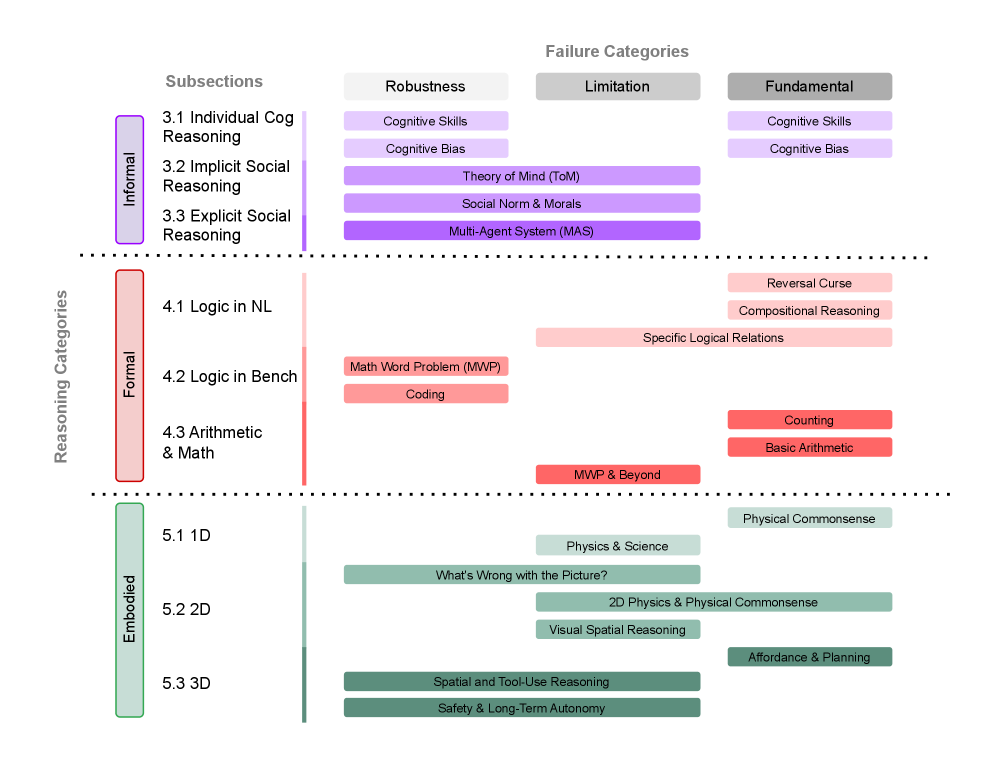
This diagram visually categorizes different types of reasoning and maps them to potential failure categories. It is structured into three main "Reasoning Categories": Informal, Formal, and Embodied. Within each of these, specific "Subsections" of reasoning are listed. These subsections are then associated with various "Failure Categories": Robustness, Limitation, and Fundamental. The diagram uses colored blocks to represent the specific reasoning subsections and the failure types they relate to, indicating a hierarchical or associative relationship.
### Components/Axes
**Main Structural Divisions:**
* **Reasoning Categories (Left Vertical Axis):**
* Informal (Purple colored bar)
* Formal (Red colored bar)
* Embodied (Green colored bar)
* **Subsections (Left Column):**
* **Informal:**
* 3.1 Individual Cog Reasoning
* 3.2 Implicit Social Reasoning
* 3.3 Explicit Social Reasoning
* **Formal:**
* 4.1 Logic in NL
* 4.2 Logic in Bench
* 4.3 Arithmetic & Math
* **Embodied:**
* 5.1 1D
* 5.2 2D
* 5.3 3D
* **Failure Categories (Top Horizontal Axis):**
* Robustness (Light grey header)
* Limitation (Medium grey header)
* Fundamental (Dark grey header)
**Associated Failure Types (Colored Blocks):**
* **Under Robustness:**
* Cognitive Skills (Light purple block)
* Cognitive Bias (Slightly darker purple block)
* **Under Limitation:**
* Theory of Mind (ToM) (Purple block)
* Social Norm & Morals (Purple block)
* Multi-Agent System (MAS) (Purple block)
* Reversal Curse (Light pink block)
* Compositional Reasoning (Light pink block)
* Specific Logical Relations (Light pink block)
* Math Word Problem (MWP) (Red block)
* Coding (Red block)
* MWP & Beyond (Red block)
* Counting (Red block)
* Basic Arithmetic (Red block)
* **Under Fundamental:**
* Cognitive Skills (Light purple block)
* Cognitive Bias (Slightly darker purple block)
* Physical Commonsense (Light grey-green block)
* Physics & Science (Light grey-green block)
* What's Wrong with the Picture? (Light grey-green block)
* 2D Physics & Physical Commonsense (Light grey-green block)
* Visual Spatial Reasoning (Light grey-green block)
* Affordance & Planning (Darker green block)
* Spatial and Tool-Use Reasoning (Dark green block)
* Safety & Long-Term Autonomy (Dark green block)
**Visual Separators:**
Dotted lines separate the Informal, Formal, and Embodied reasoning categories.
### Detailed Analysis or Content Details
The diagram illustrates how specific reasoning subsections are associated with different failure categories.
**Informal Reasoning:**
* **3.1 Individual Cog Reasoning** is associated with **Cognitive Skills** and **Cognitive Bias** under **Robustness**, and also under **Fundamental**.
* **3.2 Implicit Social Reasoning** is associated with **Theory of Mind (ToM)**, **Social Norm & Morals**, and **Multi-Agent System (MAS)** under **Limitation**.
* **3.3 Explicit Social Reasoning** is associated with **Cognitive Skills** and **Cognitive Bias** under **Fundamental**.
**Formal Reasoning:**
* **4.1 Logic in NL** is associated with **Reversal Curse**, **Compositional Reasoning**, and **Specific Logical Relations** under **Limitation**.
* **4.2 Logic in Bench** is associated with **Math Word Problem (MWP)** and **Coding** under **Limitation**.
* **4.3 Arithmetic & Math** is associated with **MWP & Beyond**, **Counting**, and **Basic Arithmetic** under **Limitation**.
**Embodied Reasoning:**
* **5.1 1D** is associated with **Physical Commonsense** under **Fundamental**.
* **5.2 2D** is associated with **Physics & Science**, **What's Wrong with the Picture?**, and **2D Physics & Physical Commonsense** under **Fundamental**. It is also associated with **Visual Spatial Reasoning** under **Fundamental**.
* **5.3 3D** is associated with **Affordance & Planning** under **Fundamental**. It is also associated with **Spatial and Tool-Use Reasoning** and **Safety & Long-Term Autonomy** under **Fundamental**.
### Key Observations
* **Categorization:** The diagram clearly delineates reasoning types into Informal, Formal, and Embodied, and then maps them to failure categories.
* **Overlap:** Some reasoning subsections, particularly those related to cognitive skills and biases, appear under both "Robustness" and "Fundamental" failure categories.
* **Specificity:** Failure categories under "Limitation" are more granular and specific to the type of reasoning (e.g., ToM for social reasoning, MWP for arithmetic).
* **Embodied Reasoning Focus:** Embodied reasoning appears to be primarily linked to "Fundamental" failure categories, often related to physical and spatial understanding.
* **Color Coding:** Consistent color coding is used for reasoning categories (purple, red, green) and for some failure types (purple, pink, light green, dark green), aiding in visual association.
### Interpretation
This diagram presents a conceptual framework for understanding how different types of reasoning might fail. The "Reasoning Categories" (Informal, Formal, Embodied) represent broad domains of cognitive function. The "Subsections" provide more specific examples within these domains. The "Failure Categories" (Robustness, Limitation, Fundamental) suggest different ways in which these reasoning processes can break down.
* **Robustness vs. Limitation vs. Fundamental:** The distinction between these failure categories is not explicitly defined but can be inferred. "Robustness" failures might imply issues with the core mechanisms of reasoning (e.g., general cognitive skills or biases). "Limitation" failures suggest that the reasoning process is insufficient or inadequate for a specific task or domain (e.g., failing to solve a math word problem). "Fundamental" failures could indicate a deeper, more foundational breakdown in the reasoning ability itself, perhaps related to understanding the physical world or complex systems.
* **Interrelationships:** The diagram suggests that certain reasoning types are more prone to specific types of failures. For instance, social reasoning (Implicit Social Reasoning) is linked to limitations in understanding social norms and theory of mind. Formal reasoning, particularly logic and arithmetic, is associated with limitations in problem-solving (MWP, coding). Embodied reasoning is strongly tied to fundamental failures in understanding physical and spatial concepts.
* **Peircean Investigative Reading:** From a Peircean perspective, this diagram could be seen as mapping different "sign-vehicles" (reasoning types) to potential "interpretants" (failure categories). The diagram suggests that the *quality* of the sign-vehicle (the reasoning process) can lead to different types of interpretants (failures). For example, a "formal" sign-vehicle that is not robust enough to handle a "math word problem" results in a "limitation" interpretant. The diagram implies a semiotic relationship where the success or failure of reasoning is dependent on its nature and the context of its application. The overlap of "Cognitive Skills" and "Cognitive Bias" under both "Robustness" and "Fundamental" suggests that these are foundational elements that, when compromised, can lead to both general robustness issues and deeper fundamental breakdowns.
* **Underlying Structure:** The diagram implies that reasoning is not monolithic but is composed of distinct, yet sometimes overlapping, abilities. Failures are not random but are often tied to the specific nature of the reasoning process and the demands placed upon it. The structure suggests a hierarchical or associative mapping, where higher-level reasoning categories encompass more specific subsections, which in turn are susceptible to particular types of failures.