## Diagram: Reasoning Categories and Associated Failure Modes
### Overview
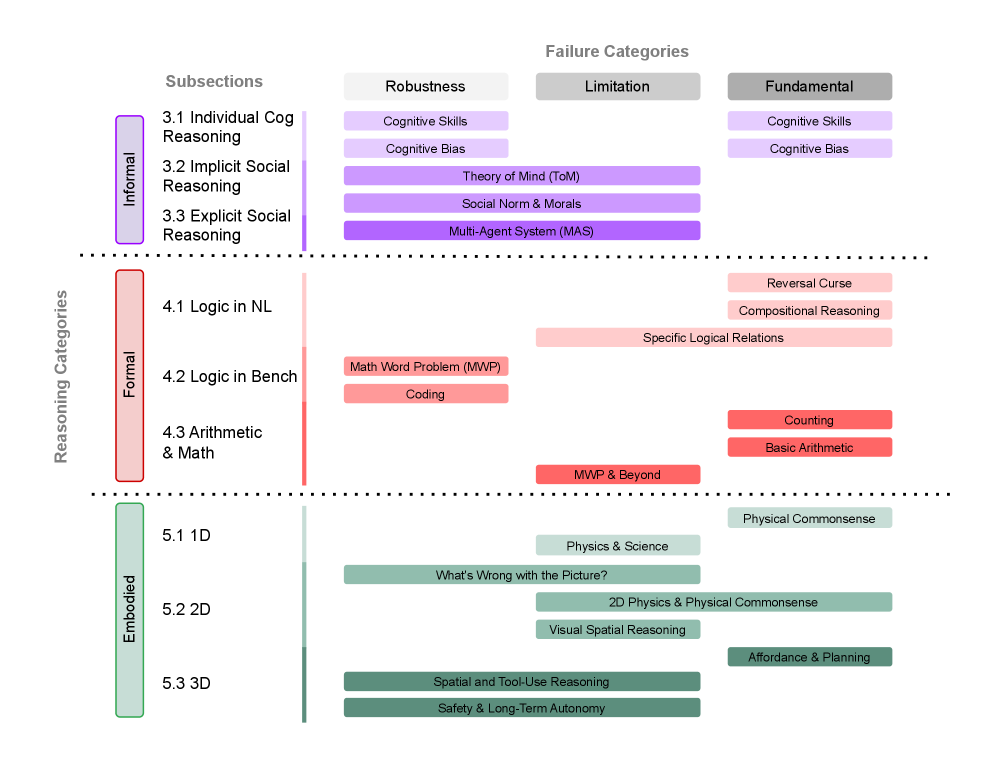
This image is a structured conceptual diagram that maps various types of reasoning (categorized into three major groups) against a taxonomy of failure modes. The diagram organizes reasoning subsections vertically and failure categories horizontally, using colored blocks to indicate which failure modes apply to which reasoning tasks.
### Components/Axes
The diagram is organized into a grid-like structure with the following components:
1. **Primary Vertical Axis (Left):** "Reasoning Categories"
* This axis groups reasoning into three major categories, each with a distinct color and vertical bar:
* **Informal** (Purple bar)
* **Formal** (Red/Pink bar)
* **Embodied** (Green bar)
2. **Secondary Vertical Axis (Center-Left):** "Subsections"
* This lists specific reasoning tasks or domains under each major category. Each has a numerical identifier.
* **Under Informal:**
* 3.1 Individual Cog Reasoning
* 3.2 Implicit Social Reasoning
* 3.3 Explicit Social Reasoning
* **Under Formal:**
* 4.1 Logic in NL
* 4.2 Logic in Bench
* 4.3 Arithmetic & Math
* **Under Embodied:**
* 5.1 1D
* 5.2 2D
* 5.3 3D
3. **Horizontal Axis (Top):** "Failure Categories"
* This axis defines three types of failures, represented by columns:
* **Robustness** (Light grey header)
* **Limitation** (Medium grey header)
* **Fundamental** (Dark grey header)
4. **Data Matrix (Center):** Colored blocks populate the grid, indicating the presence of a specific failure mode for a given reasoning subsection. The color of the block corresponds to the major reasoning category (Purple for Informal, Red/Pink for Formal, Green for Embodied).
### Detailed Analysis
The following table reconstructs the content of the diagram, mapping each reasoning subsection to its associated failure modes as indicated by the colored blocks.
| Reasoning Category | Subsection | Robustness Failures | Limitation Failures | Fundamental Failures |
| :--- | :--- | :--- | :--- | :--- |
| **Informal** | 3.1 Individual Cog Reasoning | Cognitive Skills, Cognitive Bias | | Cognitive Skills, Cognitive Bias |
| | 3.2 Implicit Social Reasoning | Theory of Mind (ToM) | | |
| | 3.3 Explicit Social Reasoning | Social Norm & Morals, Multi-Agent System (MAS) | | |
| **Formal** | 4.1 Logic in NL | | | Reversal Curse, Compositional Reasoning |
| | 4.2 Logic in Bench | Math Word Problem (MWP), Coding | Specific Logical Relations | |
| | 4.3 Arithmetic & Math | | MWP & Beyond | Counting, Basic Arithmetic |
| **Embodied** | 5.1 1D | | Physics & Science | Physical Commonsense |
| | 5.2 2D | What's Wrong with the Picture? | 2D Physics & Physical Commonsense, Visual Spatial Reasoning | |
| | 5.3 3D | Spatial and Tool-Use Reasoning, Safety & Long-Term Autonomy | | Affordance & Planning |
**Spatial Grounding & Color Verification:**
* The legend is implicit: the color of the vertical bar on the far left (Purple, Red, Green) defines the category and matches the color of all blocks in its row group.
* All blocks for "Informal" subsections are shades of purple.
* All blocks for "Formal" subsections are shades of red/pink.
* All blocks for "Embodied" subsections are shades of green.
* The "Failure Categories" headers (Robustness, Limitation, Fundamental) are in grey boxes at the top and do not have associated colors in the data matrix.
### Key Observations
1. **Distribution of Failures:** "Robustness" failures are most commonly associated with the "Informal" and "Embodied" categories. "Fundamental" failures are prominently listed for "Formal" logic tasks and specific "Informal" cognitive skills. "Limitation" failures are scattered across all categories but are notably dense in the "Formal" and "Embodied" sections.
2. **Task-Specific vs. Broad Failures:** Some failures are very specific to a task (e.g., "Reversal Curse" for Logic in NL), while others are broad and apply to multiple subsections (e.g., "Cognitive Skills" appears under both Robustness and Fundamental for Individual Cog Reasoning).
3. **Embodied Reasoning Complexity:** The "Embodied" category shows a progression of failure modes from 1D to 3D, with 3D reasoning introducing high-level failures like "Safety & Long-Term Autonomy" and "Affordance & Planning."
4. **Formal Reasoning Gaps:** The "Formal" category, particularly "Logic in Bench" and "Arithmetic & Math," shows failures across all three columns, suggesting these areas are prone to multiple types of breakdowns.
### Interpretation
This diagram serves as a diagnostic or analytical framework for understanding the vulnerabilities of different reasoning capabilities, likely in the context of artificial intelligence or cognitive science.
* **What it demonstrates:** It systematically links *what* a system is trying to reason about (the subsection) with *how* it might fail (the failure category). This suggests that failure is not monolithic; a system might be robust in one aspect (e.g., handling noise) but fundamentally limited in another (e.g., lacking core logical compositionality).
* **Relationships:** The structure implies that the nature of the reasoning task (Informal/Social vs. Formal/Logical vs. Embodied/Physical) predisposes it to certain classes of errors. For example, social reasoning is linked to failures in modeling other minds (ToM), while physical reasoning is linked to failures in understanding physics and affordances.
* **Notable Patterns:** The presence of "Cognitive Bias" under both Robustness and Fundamental failures for individual reasoning is significant. It implies that biases can be both a fragility to external perturbations (robustness issue) and a core, inherent flaw in the reasoning process itself (fundamental issue). The concentration of "Fundamental" failures in formal logic tasks highlights the deep, intrinsic challenges in achieving perfect logical reasoning.
* **Utility:** This framework could be used to guide the evaluation of AI systems, identify research priorities for improving specific reasoning types, or understand the limitations of current models by categorizing observed errors into this taxonomy.