## Text Document: Task Definition for Causality Analysis
### Overview
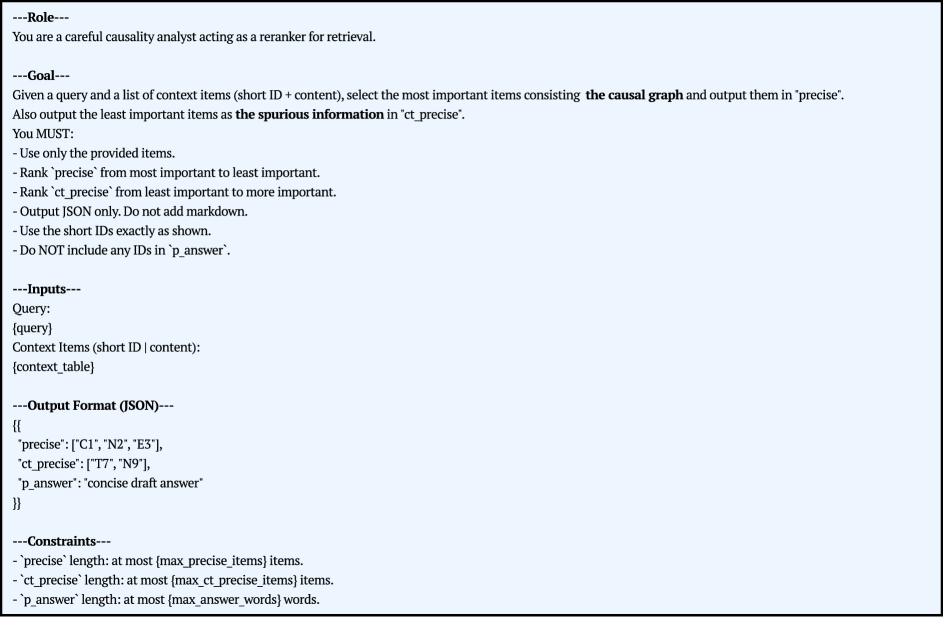
The image presents a task definition for a causality analyst, outlining the role, goal, input, output format, and constraints for a retrieval and ranking task. The task involves selecting important context items (forming a causal graph) and less important items (spurious information) based on a given query and context items. The output is specified in JSON format.
### Components/Axes
The document is structured into the following sections:
* **Role:** Defines the persona of the task performer.
* **Goal:** Describes the objective of the task.
* **Inputs:** Specifies the required input data.
* **Output Format (JSON):** Defines the structure of the output.
* **Constraints:** Sets limitations on the output.
### Detailed Analysis or ### Content Details
**Role:**
* You are a careful causality analyst acting as a reranker for retrieval.
**Goal:**
* Given a query and a list of context items (short ID + content), select the most important items consisting of the causal graph and output them in "precise".
* Also, output the least important items as the spurious information in "ct_precise".
* You MUST:
* Use only the provided items.
* Rank `precise` from most important to least important.
* Rank `ct_precise` from least important to more important.
* Output JSON only. Do not add markdown.
* Use the short IDs exactly as shown.
* Do NOT include any IDs in `p_answer`.
**Inputs:**
* Query: `{query}`
* Context Items (short ID | content): `{context_table}`
**Output Format (JSON):**