\n
## Textual Document: Causal Analysis Task Description
### Overview
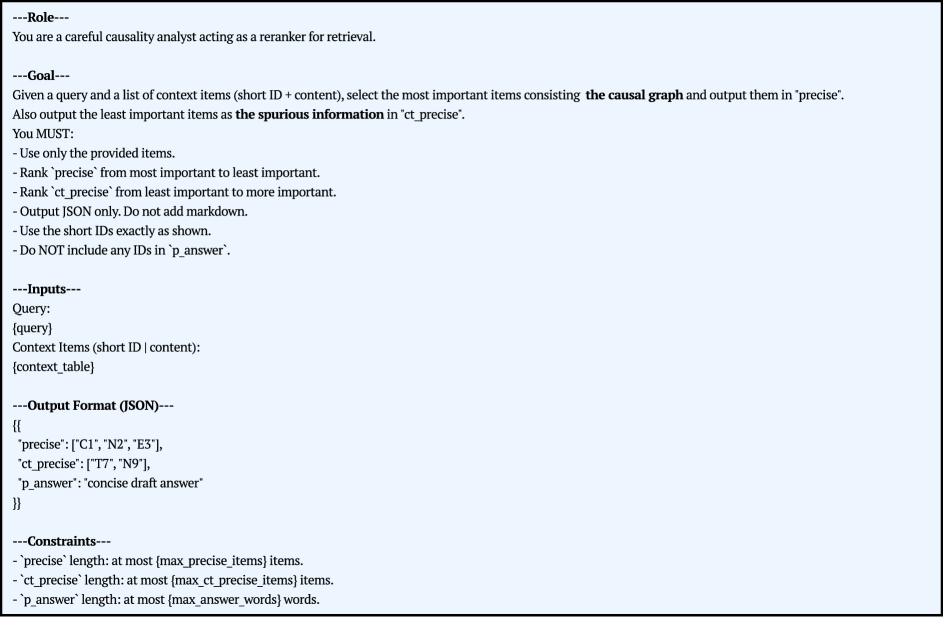
The image presents a textual description of a task for a "careful causality analyst acting as a reranker for retrieval." It outlines the goal, inputs, output format, and constraints of the task. The document appears to be a set of instructions for a machine learning model or a human annotator.
### Components/Axes
The document is structured into sections denoted by "---[Section Title]---". The sections are:
* **Role:** Describes the role of the analyst.
* **Goal:** Defines the objective of the task.
* **Inputs:** Specifies the input data.
* **Output Format (JSON):** Details the expected output structure.
* **Constraints:** Lists limitations on the output.
### Detailed Analysis or Content Details
Here's a transcription of the text, section by section:
**Role:**
"You are a careful causality analyst acting as a reranker for retrieval."
**Goal:**
"Given a query and a list of context items (short ID + content), select the most important items consisting the causal graph and output them in ‘precise’. Also output the least important items as the spurious information in ‘ct_precise’.
You MUST:
- Use only the provided items.
- Rank ‘precise’ from most important to least important.
- Rank ‘ct_precise’ from least important to more important.
- Output JSON only. Do not add markdown.
- Use the short IDs exactly as shown.
- Do NOT include any IDs in ‘p_answer’."
**Inputs:**
"Query:
[query]
Context Items (short ID | content):
[context, table]"
**Output Format (JSON):**
```json
{
'precise': ['C1', 'N2', 'E3'],
'ct_precise': ['T7', 'N9'],
'p_answer': 'concise draft answer'
}
```
**Constraints:**
"- ‘precise’ length: at most (max_precise_items) items.
- ‘ct_precise’ length: at most (max_ct_precise_items) items.
- ‘p_answer’ length: at most (max_answer_words) words."
### Key Observations
The document emphasizes the importance of adhering to the specified JSON output format and constraints. The task involves ranking context items based on their relevance to a given query, distinguishing between important causal factors ('precise') and spurious information ('ct_precise'). The use of short IDs is crucial, and they should not appear in the 'p_answer' field. The document uses placeholders like "[query]", "[context, table]", "(max_precise_items)", etc., indicating that these values will be provided as input.
### Interpretation
This document describes a task designed to evaluate a system's ability to identify causal relationships within a set of contextual information. The "reranker" role suggests that the system is intended to refine an initial ranking of context items, potentially generated by a retrieval system. The separation of 'precise' and 'ct_precise' indicates a focus on filtering out irrelevant or misleading information. The constraints on output length suggest a need for concise and focused responses. The overall goal is to build a system that can accurately identify the key causal factors relevant to a given query, while discarding spurious information. The JSON output format is likely used for automated evaluation and integration with other components of a larger system.