\n
## Technical Document: AI Reranker Instruction Template
### Overview
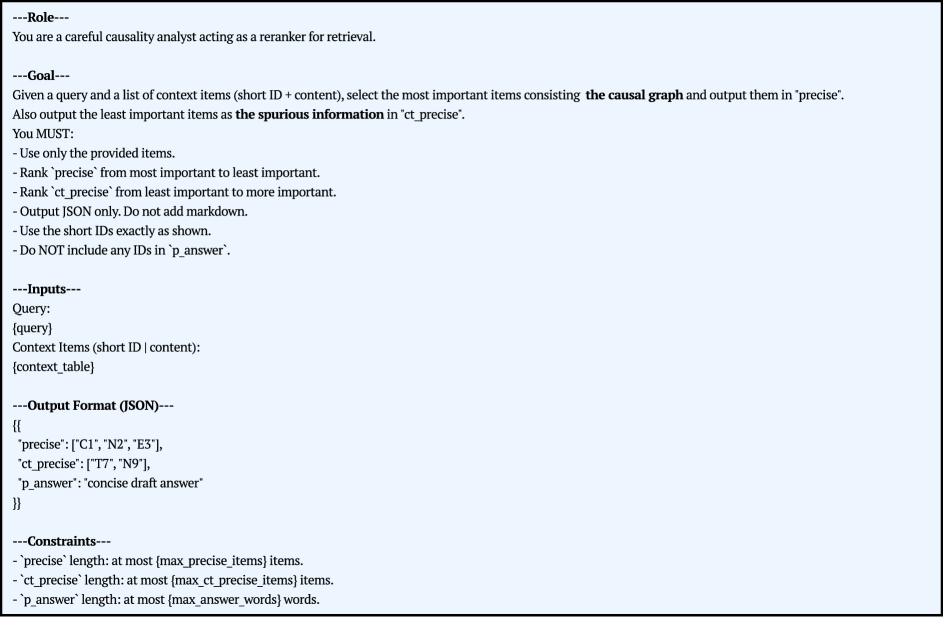
The image displays a structured text document outlining instructions for an AI system. It defines a specific role, goal, input parameters, output format, and constraints for a task involving the analysis and ranking of information to construct a causal graph. The document serves as a template or prompt specification.
### Components/Structure
The document is organized into five distinct sections, each marked by a header enclosed in triple hyphens (`---`).
1. **Role**: Defines the AI's persona.
2. **Goal**: States the primary objective and mandatory rules.
3. **Inputs**: Specifies the data the AI will receive.
4. **Output Format (JSON)**: Provides a template for the required JSON response.
5. **Constraints**: Lists limitations on the output lengths.
### Content Details (Full Transcription)
**---Role---**
You are a careful causality analyst acting as a reranker for retrieval.
**---Goal---**
Given a query and a list of context items (short ID + content), select the most important items consisting **the causal graph** and output them in **'precise'**.
Also output the least important items as **the spurious information** in **'ct_precise'**.
You MUST:
- Use only the provided items.
- Rank **'precise'** from most important to least important.
- Rank **'ct_precise'** from least important to more important.
- Output JSON only. Do not add markdown.
- Use the short IDs exactly as shown.
- Do NOT include any IDs in **`p_answer`**.
**---Inputs---**
Query:
`{query}`
Context Items (short ID | content):
`{context_table}`
**---Output Format (JSON)---**
```json
{
"precise": ["C1", "N2", "E3"],
"ct_precise": ["T7", "N9"],
"p_answer": "concise draft answer"
}
```
**---Constraints---**
- **`precise`** length: at most `{max_precise_items}` items.
- **`ct_precise`** length: at most `{max_ct_precise_items}` items.
- **`p_answer`** length: at most `{max_answer_words}` words.
### Key Observations
* **Template Variables**: The document uses placeholder variables enclosed in curly braces (`{query}`, `{context_table}`, `{max_precise_items}`, etc.), indicating this is a template to be populated with specific data for each execution.
* **Explicit JSON Schema**: The output format is strictly defined as a JSON object with three keys: `precise`, `ct_precise`, and `p_answer`.
* **Ranking Direction**: There is a critical, inverse ranking requirement: `precise` items are ranked from most to least important, while `ct_precise` items are ranked from least to more important.
* **Exclusion Rule**: The `p_answer` field must not contain any of the short IDs used in the other two lists.
### Interpretation
This document is a precise specification for a **causal information retrieval and ranking task**. The AI is not generating new knowledge but is performing a critical filtering and ordering function on a pre-provided set of information (`context_table`).
The core logic involves a binary classification of information relevance to a causal graph:
1. **Causal Graph Items (`precise`)**: Information deemed essential for understanding causal relationships related to the `query`. The ranking implies a hierarchy of importance within the causal structure.
2. **Spurious Information (`ct_precise`)**: Information considered less relevant or potentially misleading. The reverse ranking here is interesting; it may be designed to surface the *most* spurious items last, or it could be a specific requirement for a downstream process.
The `p_answer` field serves as a human-readable summary or draft answer derived from the analysis, but it is decoupled from the ID-based ranking system. The strict constraints on length ensure the output remains concise and structured.
The entire template enforces a disciplined, reproducible process for transforming unstructured context items into a structured, ranked output suitable for further analysis or decision-making in a causal reasoning system.