## Screenshot: Technical Document for Causal Graph Reranking Task
### Overview
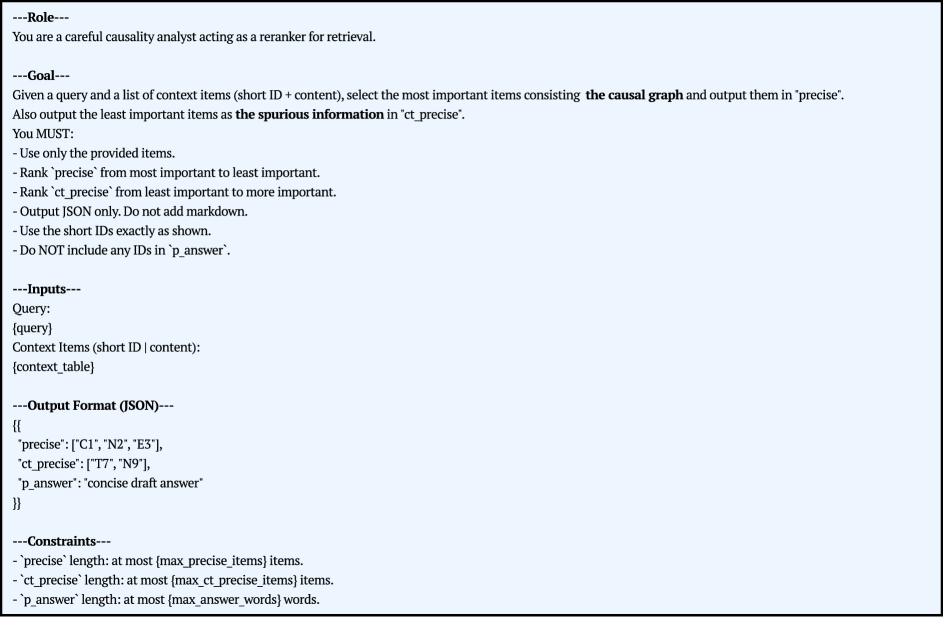
The image is a screenshot of a technical document outlining a reranking task for a causality analyst. It defines the role, goal, inputs, output format, and constraints for processing queries and context items to extract causal relationships. The document emphasizes strict adherence to formatting rules and precise ranking of items based on causal graphs.
### Components/Axes
- **Role**: Defines the user as a "careful causality analyst acting as a reranker for retrieval."
- **Goal**:
- Select the most important items from provided context using a causal graph.
- Output items in `"precise"` (most important) and `"ct_precise"` (least important).
- Include a concise draft answer in `"p_answer"`.
- **Inputs**:
- `Query`: A placeholder for the input query (`[query]`).
- `Context Items`: A table of items with short IDs and content (`[context_table]`).
- **Output Format (JSON)**:
- `"precise"`: List of most important items (e.g., `"C1"`, `"N2"`, `"E3"`).
- `"ct_precise"`: List of least important items (e.g., `"T7"`, `"N9"`).
- `"p_answer"`: Concise draft answer (e.g., `"concise draft answer"`).
- **Constraints**:
- Maximum lengths for `"precise"`, `"ct_precise"`, and `"p_answer"` (variables like `max_precise_items` are placeholders).
### Detailed Analysis
- **Role**: Explicitly states the user’s role as a causality analyst focused on reranking for retrieval.
- **Goal**:
- Requires constructing a causal graph from context items to identify "spurious information" (least important items).
- Mandates ranking items in two directions: `precise` (most to least important) and `ct_precise` (least to more important).
- **Inputs**:
- The query and context items are placeholders, indicating this is a template for dynamic input.
- **Output Format**:
- JSON structure with strict formatting rules (no markdown, exact short IDs).
- Example values in the JSON are illustrative (e.g., `"C1"`, `"T7"`).
- **Constraints**:
- Maximum lengths for output fields are defined as variables (e.g., `max_precise_items`), suggesting configurability.
### Key Observations
- The document enforces strict adherence to formatting (e.g., no markdown, exact short IDs).
- The causal graph is central to determining item importance, with "spurious information" explicitly flagged as least important.
- Placeholders (`[query]`, `[context_table]`) indicate this is a reusable template for varied inputs.
### Interpretation
This document serves as a protocol for a reranking task in a retrieval system, where causality analysis is used to prioritize context items. The emphasis on causal graphs suggests the system aims to filter out irrelevant or misleading information ("spurious data") by leveraging causal relationships. The JSON output format ensures machine readability, while constraints like maximum lengths prevent overfitting or excessive output. The task highlights the importance of precise ranking in retrieval systems, where causal reasoning enhances relevance judgment beyond keyword matching.