\n
## Diagram: Hypothesis Testing with Language Model
### Overview
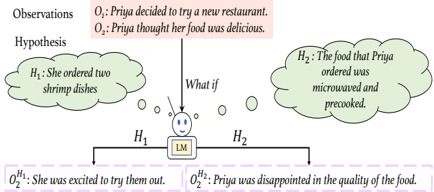
This diagram illustrates a hypothesis testing process involving a Language Model (LM) responding to initial observations. It depicts two competing hypotheses (H1 and H2) stemming from observations (O1 and O2), and how the LM generates subsequent observations (O1' and O2') based on evaluating these hypotheses.
### Components/Axes
The diagram consists of the following components:
* **Observations (O1, O2):** Located at the top-left, presented in a light pink box.
* **Hypothesis (H1, H2):** Two cloud-shaped boxes, positioned on either side of the central LM.
* **Language Model (LM):** A central rectangular box with a face, representing the core processing unit.
* **Subsequent Observations (O1', O2'):** Located at the bottom, presented in a light purple box.
* **Arrows:** Indicate the flow of information and influence between components.
* **Text Labels:** Descriptive text associated with each component.
### Detailed Analysis or Content Details
**Observations:**
* O1: "Priya decided to try a new restaurant."
* O2: "Priya thought her food was delicious."
**Hypotheses:**
* H1: "She ordered two shrimp dishes." (Located on the left)
* H2: "The food that Priya ordered was microwaved and precooked." (Located on the right)
**Language Model (LM):**
* The LM is depicted as a grey box with a smiling face.
* An arrow points from the observations (O1, O2) to the LM, labeled "What if".
* Two arrows emanate from the LM, labeled H1 and H2, pointing towards the subsequent observations.
**Subsequent Observations:**
* O1': "She was excited to try them out." (Associated with H1)
* O2': "Priya was disappointed in the quality of the food." (Associated with H2)
### Key Observations
The diagram demonstrates a branching scenario where the LM evaluates two different hypotheses based on initial observations. Each hypothesis leads to a different subsequent observation, suggesting the LM can generate diverse outcomes based on its internal reasoning. The "What if" arrow indicates the LM is performing a counterfactual reasoning process.
### Interpretation
This diagram illustrates a simplified model of how a language model might engage in hypothesis testing. The initial observations set the context, and the LM explores alternative explanations (hypotheses) for those observations. The LM then generates new observations based on each hypothesis, effectively simulating different possible scenarios. This process highlights the LM's ability to reason about cause and effect, and to generate plausible continuations of a given narrative. The diagram suggests that the LM doesn't simply recall information, but actively constructs explanations and explores possibilities. The contrasting outcomes (excitement vs. disappointment) demonstrate the LM's capacity for nuanced and context-dependent reasoning. The use of a smiling face on the LM box could be interpreted as anthropomorphizing the model, suggesting a degree of agency or intentionality. However, it's important to remember that the LM is ultimately a statistical model, and its outputs are based on patterns learned from data.