## Line Chart: Error Progression with Action Overlays--Shannon
### Overview
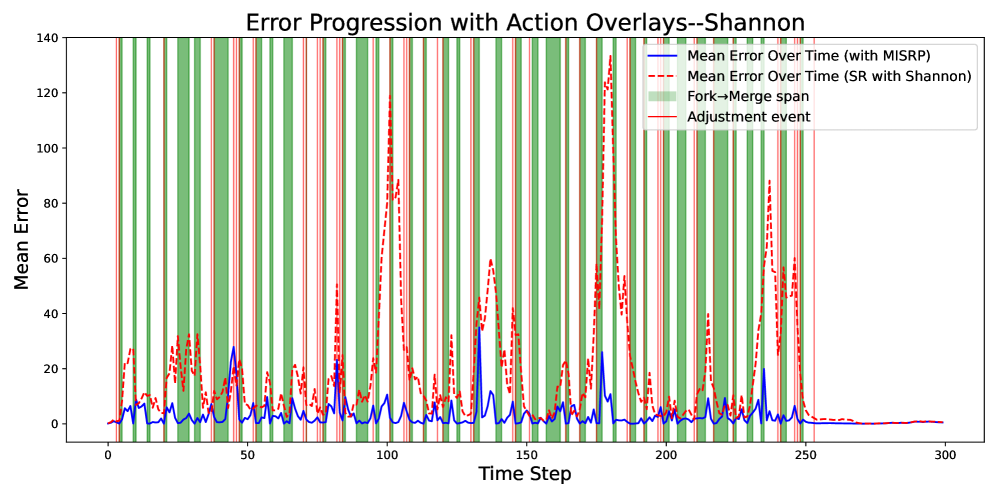
The image is a line chart that visualizes the error progression over time for two different methods: one with MISRP and the other with SR with Shannon. The chart also indicates "Fork->Merge span" and "Adjustment event" using vertical bands.
### Components/Axes
* **Title:** Error Progression with Action Overlays--Shannon
* **X-axis:** Time Step, ranging from 0 to 300 in increments of 50.
* **Y-axis:** Mean Error, ranging from 0 to 140 in increments of 20.
* **Legend (Top-Right):**
* Blue Line: Mean Error Over Time (with MISRP)
* Red Dashed Line: Mean Error Over Time (SR with Shannon)
* Green Vertical Bands: Fork->Merge span
* Red Vertical Lines: Adjustment event
### Detailed Analysis
* **Mean Error Over Time (with MISRP) - Blue Line:**
* Trend: Generally low and relatively stable, with small spikes.
* Values: Starts around 0, fluctuates between 0 and 20 until time step 250, then stabilizes near 0.
* **Mean Error Over Time (SR with Shannon) - Red Dashed Line:**
* Trend: More volatile with significant spikes, generally higher than the MISRP error.
* Values: Starts around 0, spikes to approximately 30 around time step 25, reaches peaks of approximately 100 around time step 100, and approximately 90 around time step 240, then stabilizes near 0 after time step 260.
* **Fork->Merge span - Green Vertical Bands:**
* Position: Multiple instances throughout the time steps, indicating periods of forking and merging.
* Frequency: Occur relatively frequently, especially before time step 250.
* **Adjustment event - Red Vertical Lines:**
* Position: Multiple instances throughout the time steps.
* Frequency: Occur more frequently before time step 250.
### Key Observations
* The SR with Shannon method (red dashed line) exhibits significantly higher error spikes compared to the MISRP method (blue line).
* Both methods converge to a low error rate after time step 260.
* The "Fork->Merge span" and "Adjustment event" markers appear to correlate with periods of increased error, particularly for the SR with Shannon method.
### Interpretation
The chart suggests that the MISRP method is more stable and results in lower mean error over time compared to the SR with Shannon method, especially during periods marked by "Fork->Merge span" and "Adjustment event". The SR with Shannon method, while potentially capable of reaching low error rates, is more susceptible to error spikes during these events. The convergence of both methods to low error rates after time step 260 indicates a potential stabilization or learning phase. The "Fork->Merge span" and "Adjustment event" markers likely represent critical points in the process that significantly impact the error rate, particularly for the SR with Shannon method.