## Decision Tree: Dice Roll Probability
### Overview
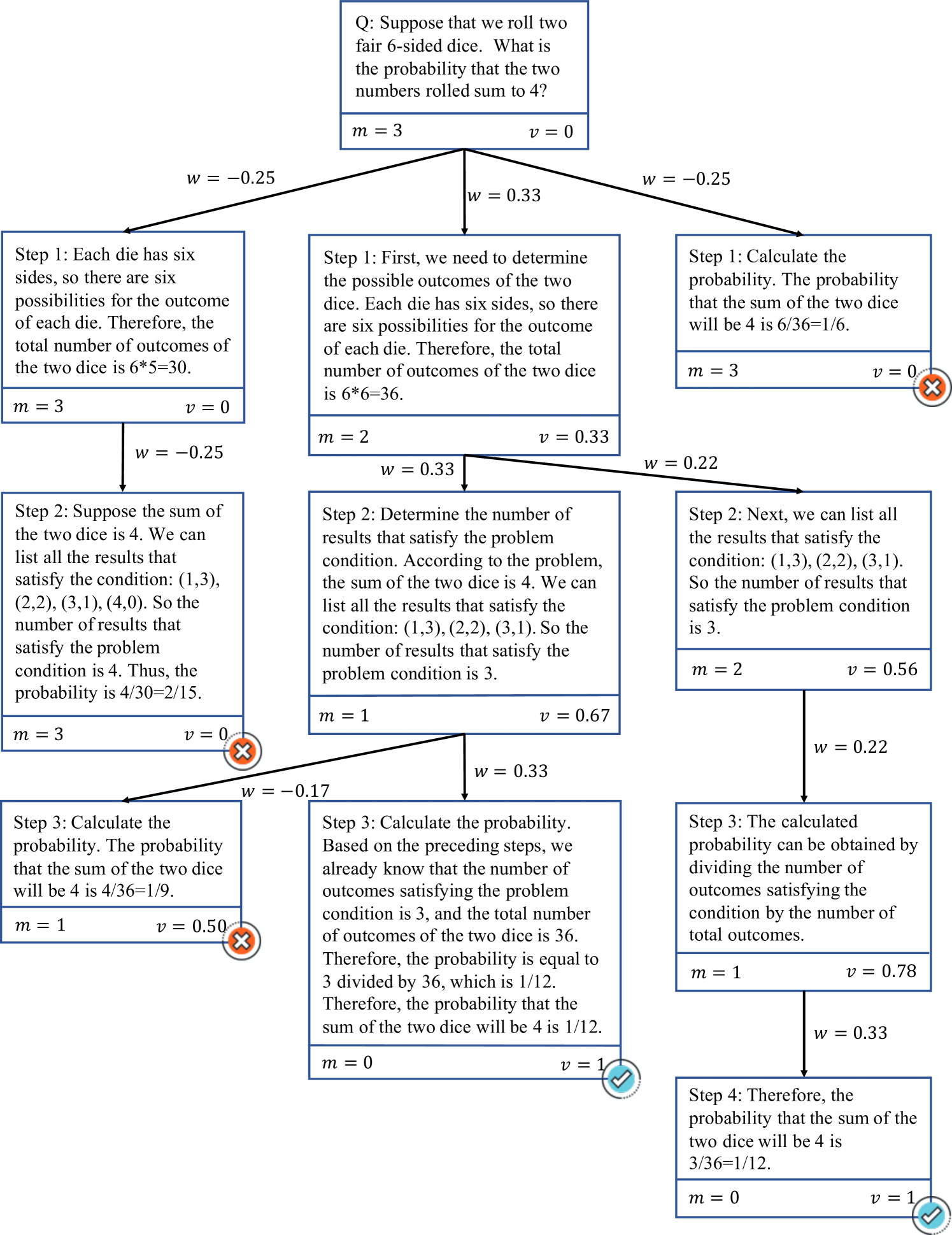
The image is a decision tree diagram illustrating different approaches to calculating the probability of rolling a sum of 4 with two fair six-sided dice. Each node represents a step in the calculation, with branches representing different strategies or intermediate results. The diagram includes text descriptions of each step, along with associated 'm' and 'v' values, and 'w' values on the branches. The tree starts with the initial question and branches out to different methods of solving the problem, some leading to incorrect answers (marked with a red 'X') and others to the correct answer (marked with a green checkmark).
### Components/Axes
* **Nodes:** Each node contains a step-by-step explanation of the calculation.
* **Branches:** Arrows connecting the nodes, labeled with 'w' values.
* **m:** A numerical value associated with each node, potentially representing a metric or counter.
* **v:** A numerical value associated with each node, potentially representing a probability or intermediate result.
* **Root Node:** Top node containing the initial question.
* **Leaf Nodes:** Bottom nodes representing the final results.
* **Correct/Incorrect Markers:** Green checkmarks indicate correct solutions, while red 'X' marks indicate incorrect solutions.
### Detailed Analysis
**Root Node:**
* Text: "Q: Suppose that we roll two fair 6-sided dice. What is the probability that the two numbers rolled sum to 4?"
* m = 3
* v = 0
**First Level Nodes (from left to right):**
* **Node 1 (Left):**
* Text: "Step 1: Each die has six sides, so there are six possibilities for the outcome of each die. Therefore, the total number of outcomes of the two dice is 6*5=30."
* m = 3
* v = 0
* **Node 2 (Middle):**
* Text: "Step 1: First, we need to determine the possible outcomes of the two dice. Each die has six sides, so there are six possibilities for the outcome of each die. Therefore, the total number of outcomes of the two dice is 6*6=36."
* m = 2
* v = 0.33
* **Node 3 (Right):**
* Text: "Step 1: Calculate the probability. The probability that the sum of the two dice will be 4 is 6/36=1/6."
* m = 3
* v = 0
* Incorrect (Red 'X')
**Second Level Nodes (from left to right):**
* **Node 1 (from Left Node 1):**
* Text: "Step 2: Suppose the sum of the two dice is 4. We can list all the results that satisfy the condition: (1,3), (2,2), (3,1), (4,0). So the number of results that satisfy the problem condition is 4. Thus, the probability is 4/30=2/15."
* m = 3
* v = 0
* **Node 2 (from Middle Node 2):**
* Text: "Step 2: Determine the number of results that satisfy the problem condition. According to the problem, the sum of the two dice is 4. We can list all the results that satisfy the condition: (1,3), (2,2), (3,1). So the number of results that satisfy the problem condition is 3."
* m = 1
* v = 0.67
* **Node 3 (from Right Node 3):**
* Text: "Step 2: Next, we can list all the results that satisfy the condition: (1,3), (2,2), (3,1). So the number of results that satisfy the problem condition is 3."
* m = 2
* v = 0.56
**Third Level Nodes (from left to right):**
* **Node 1 (from Left Node 1):**
* Text: "Step 3: Calculate the probability. The probability that the sum of the two dice will be 4 is 4/36=1/9."
* m = 1
* v = 0.50
* Incorrect (Red 'X')
* **Node 2 (from Middle Node 2):**
* Text: "Step 3: Calculate the probability. Based on the preceding steps, we already know that the number of outcomes satisfying the problem condition is 3, and the total number of outcomes of the two dice is 36. Therefore, the probability is equal to 3 divided by 36, which is 1/12. Therefore, the probability that the sum of the two dice will be 4 is 1/12."
* m = 0
* v = 1
* Correct (Green Checkmark)
* **Node 3 (from Right Node 3):**
* Text: "Step 3: The calculated probability can be obtained by dividing the number of outcomes satisfying the condition by the number of total outcomes."
* m = 1
* v = 0.78
**Fourth Level Node (from Right Node 3):**
* Text: "Step 4: Therefore, the probability that the sum of the two dice will be 4 is 3/36=1/12."
* m = 0
* v = 1
* Correct (Green Checkmark)
**Branch Values (w):**
* Root to Left Node 1: w = -0.25
* Root to Middle Node 2: w = 0.33
* Root to Right Node 3: w = -0.25
* Left Node 1 to its child: w = -0.25
* Middle Node 2 to its child: w = 0.33
* Right Node 3 to its child: w = 0.22
* Left Node 1 child to its child: w = -0.17
* Right Node 3 child to its child: w = 0.22
* Right Node 3 child to its child: w = 0.33
### Key Observations
* The tree explores different initial assumptions and calculation methods.
* Some branches lead to incorrect probabilities due to flawed logic or calculations (e.g., calculating the total number of outcomes as 6\*5=30 instead of 6\*6=36).
* The correct probability (1/12) is reached through two different paths.
* The 'm' and 'v' values seem to track some internal state of the calculation, but their exact meaning is not explicitly defined in the diagram.
* The 'w' values on the branches might represent weights or probabilities associated with choosing a particular path.
### Interpretation
The decision tree illustrates the importance of careful consideration of all possible outcomes when calculating probabilities. It shows how different approaches, even if seemingly logical at first, can lead to incorrect results if fundamental principles are violated. The diagram highlights the correct method of calculating the probability of rolling a sum of 4 with two dice, which involves determining the total number of possible outcomes (36) and the number of outcomes that satisfy the condition (3). The tree also demonstrates that there can be multiple ways to arrive at the correct answer, as shown by the two branches leading to the probability of 1/12. The incorrect paths serve as a reminder of common mistakes and pitfalls in probability calculations. The 'm' and 'v' values could represent the model's confidence and the estimated probability at each step, respectively, while 'w' could represent the weight or likelihood of choosing a particular branch based on the model's assessment.