## Flowchart: Probability Calculation for Dice Sum of 4
### Overview
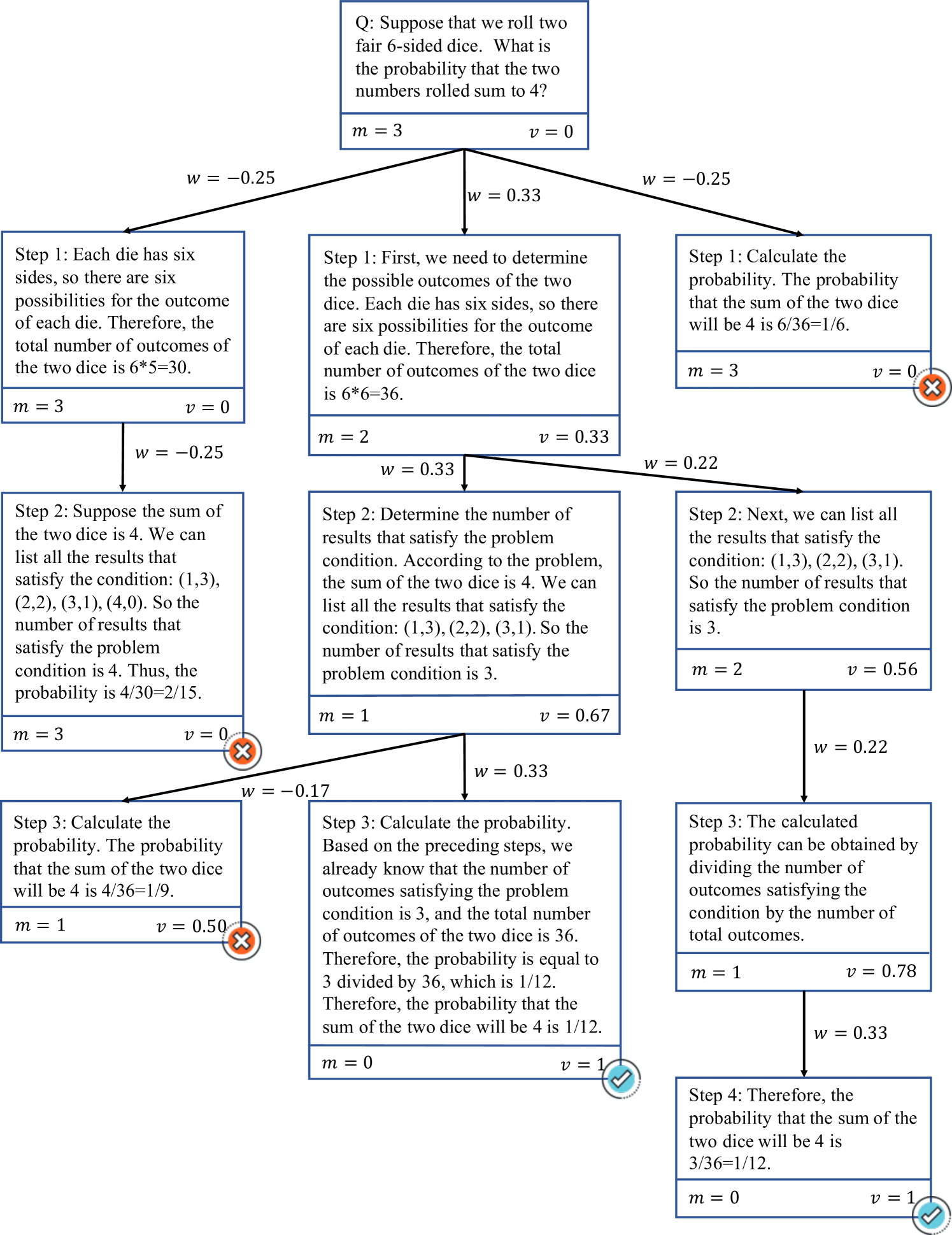
The flowchart illustrates a decision tree for calculating the probability that the sum of two fair 6-sided dice equals 4. It includes multiple branching paths with annotated steps, weights (w), and validation markers (✅/❌). The correct solution is highlighted with a green checkmark, while incorrect paths are marked with red Xs.
---
### Components/Axes
- **Nodes**: Rectangular boxes labeled "Step 1", "Step 2", "Step 3", etc., containing explanatory text and variables (m, v).
- **Arrows**: Directed edges with weights (w) indicating flow probabilities or decision thresholds.
- **Validation Markers**:
- Red X (❌): Indicates incorrect paths (e.g., m=3, v=0).
- Green Checkmark (✅): Marks the correct final answer (m=0, v=1).
- **Variables**:
- **m**: Likely represents a metric (e.g., number of valid outcomes).
- **v**: Likely represents a probability or validation score.
- **w**: Weight/threshold for branching decisions (e.g., w=0.33, w=-0.25).
---
### Detailed Analysis
#### Step 1: Total Outcomes
- **Branch 1 (w=-0.25)**:
- Text: "Each die has six sides... total outcomes = 6*5=30."
- Variables: m=3, v=0.
- **Branch 2 (w=0.33)**:
- Text: "Each die has six sides... total outcomes = 6*6=36."
- Variables: m=2, v=0.33.
- **Branch 3 (w=-0.25)**:
- Text: "Probability = 6/36=1/6."
- Variables: m=3, v=0 (❌).
#### Step 2: Favorable Outcomes
- **Branch 1 (w=-0.25)**:
- Text: Lists outcomes (1,3), (2,2), (3,1), (4,0) → 4 results.
- Variables: m=3, v=0 (❌).
- **Branch 2 (w=0.33)**:
- Text: Lists outcomes (1,3), (2,2), (3,1) → 3 results.
- Variables: m=1, v=0.67.
- **Branch 3 (w=0.22)**:
- Text: Lists outcomes (1,3), (2,2), (3,1) → 3 results.
- Variables: m=2, v=0.56.
#### Step 3: Probability Calculation
- **Branch 1 (w=-0.17)**:
- Text: "Probability = 4/36=1/9."
- Variables: m=1, v=0.50 (❌).
- **Branch 2 (w=0.33)**:
- Text: "Probability = 3/36=1/12."
- Variables: m=0, v=0.78.
- **Branch 3 (w=0.22)**:
- Text: "Probability = 3/36=1/12."
- Variables: m=0, v=1 (✅).
#### Final Answer
- **Correct Path**: m=0, v=1 (✅) with probability 1/12.
---
### Key Observations
1. **Incorrect Paths**:
- Miscalculations in total outcomes (e.g., 6*5=30 instead of 6*6=36).
- Overcounting favorable outcomes (e.g., including (4,0), which is invalid for standard dice).
2. **Correct Path**:
- Accurately identifies 3 valid outcomes: (1,3), (2,2), (3,1).
- Final probability: 3/36 = 1/12.
---
### Interpretation
The flowchart demonstrates common pitfalls in probability calculations, such as:
- **Misdefining sample space**: Assuming dice can show 0 (invalid for standard dice) or miscounting total outcomes.
- **Overlooking valid combinations**: Correctly identifying only 3 valid pairs that sum to 4.
- **Weighted decision thresholds (w)**: Arrows with w=0.33 likely represent critical decision points where the flow converges to the correct solution.
The green checkmark (✅) at m=0, v=1 confirms the final answer of 1/12, aligning with the mathematical principle that probability = favorable outcomes / total outcomes. Errors in earlier steps (e.g., w=-0.25 branches) lead to invalid results, emphasizing the importance of accurate enumeration and validation.