\n
## Line Chart: Neuron Activation Distribution
### Overview
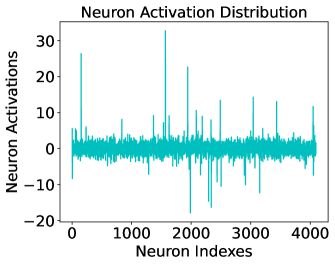
The image displays a line chart titled "Neuron Activation Distribution." It visualizes the activation values of approximately 4,000 individual neurons, plotted against their sequential index. The chart is characterized by a dense, noisy baseline centered near zero, punctuated by several prominent positive and negative spikes.
### Components/Axes
* **Title:** "Neuron Activation Distribution" (centered at the top).
* **Y-Axis:**
* **Label:** "Neuron Activations" (rotated vertically on the left side).
* **Scale:** Linear scale ranging from approximately -20 to +30.
* **Major Ticks:** Marked at intervals of 10: -20, -10, 0, 10, 20, 30.
* **X-Axis:**
* **Label:** "Neuron Indexes" (centered at the bottom).
* **Scale:** Linear scale from 0 to 4000.
* **Major Ticks:** Marked at intervals of 1000: 0, 1000, 2000, 3000, 4000.
* **Data Series:** A single, continuous line plotted in a cyan/teal color.
* **Legend:** None present.
### Detailed Analysis
The data represents a distribution of activation values across a population of neurons.
* **Baseline Activity:** The vast majority of neurons exhibit low-magnitude activations, forming a dense, noisy band centered around the 0 line. The typical activation range for this baseline appears to be between approximately -5 and +5.
* **Positive Spikes (High Activations):** Several neurons show significantly elevated positive activations. The most prominent spike occurs near neuron index ~1500, reaching a peak value of approximately **30**. Other notable positive spikes are visible near:
* Index ~100: ~25
* Index ~2000: ~22
* Index ~3000: ~15
* Index ~3500: ~12
* **Negative Spikes (Inhibitions):** A smaller number of neurons display strong negative activations. The most significant negative spike is located near neuron index ~2000, dropping to approximately **-18**. Another clear negative spike is near index ~2500, reaching about -12.
* **Spatial Distribution:** The spikes are irregularly distributed across the neuron index range. There is no clear, repeating pattern or clustering; the high-magnitude activations appear sporadically.
### Key Observations
1. **Sparse High Activation:** The distribution is highly non-uniform. While most neurons are near-zero, a small subset (<1%) shows activations an order of magnitude larger than the baseline.
2. **Asymmetry:** The maximum positive activation (~30) is greater in magnitude than the maximum negative activation (~-18).
3. **No Clear Index-Based Pattern:** The high-activation neurons are not concentrated at the beginning, middle, or end of the index range. They appear randomly interspersed.
4. **Noise Floor:** The persistent, low-amplitude oscillation across all indexes suggests a baseline level of noise or minor activity in the network.
### Interpretation
This chart likely represents the output of a layer in an artificial neural network (e.g., a deep learning model) at a specific point in time or for a specific input.
* **Functional Implication:** The pattern suggests a **sparse activation** regime. In such a regime, only a few neurons are strongly activated for a given input, while most remain quiet. This is a common and often desirable property in efficient neural networks, as it can lead to better generalization and lower computational cost.
* **Outlier Significance:** The neurons with extreme positive or negative activations (the spikes) are likely the most "important" or responsive units for the particular input that generated this data. They may be detecting specific, salient features.
* **Network Health:** The presence of both strong positive and negative activations indicates the network is utilizing both excitatory and inhibitory signals. The clean baseline (centered at zero) suggests the network's activations are well-normalized, which is typically a sign of stable training.
* **Investigative Lead:** If this chart represents a trained model, analyzing the specific inputs that cause the largest spikes could reveal what features those particular neurons have learned to detect. Conversely, if this is from an untrained or poorly trained network, the random spike pattern might indicate instability.