\n
## Diagram: Ethics Guidelines for Trustworthy AI
### Overview
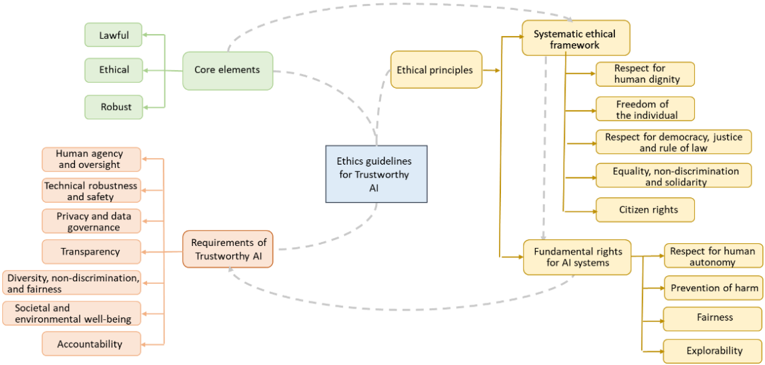
The image is a diagram illustrating the components and relationships within "Ethics guidelines for Trustworthy AI". It presents a hierarchical structure with central concepts branching out into core elements, requirements, ethical principles, and a systematic ethical framework. The diagram uses a tree-like structure with boxes connected by lines, indicating relationships and dependencies.
### Components/Axes
The diagram is organized around the central box labeled "Ethics guidelines for Trustworthy AI". Four main branches extend from this central concept:
1. **Core elements** (left side)
2. **Requirements of Trustworthy AI** (bottom-left side)
3. **Ethical principles** (top-right side)
4. **Systematic ethical framework** (bottom-right side)
Each of these branches further subdivides into more specific components.
### Detailed Analysis or Content Details
**1. Core elements:**
* Lawful
* Ethical
* Robust
**2. Requirements of Trustworthy AI:**
* Human agency and oversight
* Technical robustness and safety
* Privacy and data governance
* Transparency
* Diversity, non-discrimination, and fairness
* Societal and environmental well-being
* Accountability
**3. Ethical principles:**
This branch connects directly to "Ethics guidelines for Trustworthy AI" and then to "Systematic ethical framework".
**4. Systematic ethical framework:**
* Respect for human dignity
* Freedom of the individual
* Respect for democracy, justice and rule of law
* Equality, non-discrimination and solidarity
* Citizen rights
* Fundamental rights for AI systems
* Respect for human autonomy
* Prevention of harm
* Fairness
* Explorability
The diagram uses dashed lines to connect "Requirements of Trustworthy AI" to "Core elements" and "Ethical principles". A solid line connects "Ethical principles" to "Systematic ethical framework".
### Key Observations
The diagram emphasizes the interconnectedness of various aspects of trustworthy AI. The "Ethics guidelines for Trustworthy AI" serve as the central hub, with core elements, requirements, ethical principles, and a systematic framework all contributing to its realization. The dashed lines suggest that the requirements are informed by both the core elements and the ethical principles. The systematic ethical framework is directly derived from the ethical principles.
### Interpretation
This diagram visually represents a holistic approach to developing and deploying trustworthy AI. It suggests that ethical considerations are not merely an add-on but are fundamental to the entire process, from the initial core elements to the final systematic framework. The diagram highlights the importance of aligning AI systems with human values and societal norms. The inclusion of elements like "Privacy and data governance" and "Diversity, non-discrimination, and fairness" indicates a commitment to responsible AI development. The diagram's structure implies a hierarchical relationship, where the core elements lay the foundation, the requirements define the necessary characteristics, the ethical principles provide guidance, and the systematic framework ensures consistent application. The dashed lines indicate a feedback loop, suggesting that the requirements are continuously refined based on core elements and ethical principles. The diagram is a conceptual model rather than a quantitative representation of data; it aims to illustrate relationships and dependencies rather than present specific values or measurements.