## Diagram: Ethics Guidelines for Trustworthy AI
### Overview
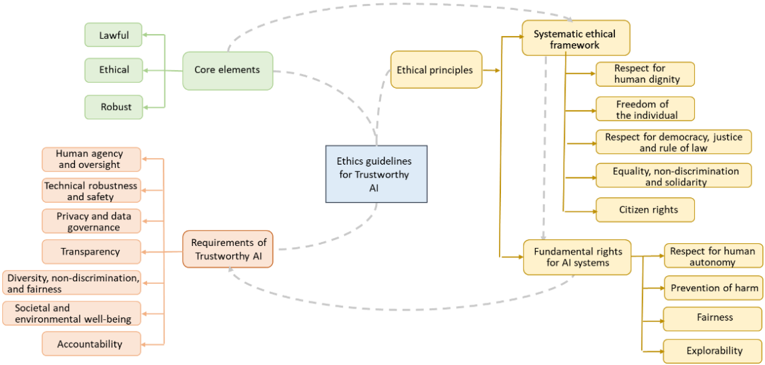
This image is a conceptual diagram illustrating the structure and components of the "Ethics guidelines for Trustworthy AI." It is a hierarchical mind map or concept map with a central node branching out into four main categories, each with its own sub-elements. The diagram uses color-coding and connecting lines to show relationships and groupings.
### Components/Structure
The diagram is organized around a central blue box and expands into four primary branches, each with a distinct color theme.
**Central Node:**
* **Text:** "Ethics guidelines for Trustworthy AI"
* **Position:** Center of the diagram.
* **Color:** Blue box with white text.
**Primary Branches (connected to the central node via dashed lines):**
1. **Top-Left Branch (Green Theme):**
* **Main Node:** "Core elements"
* **Sub-nodes (connected by solid lines):**
* "Lawful"
* "Ethical"
* "Robust"
2. **Bottom-Left Branch (Orange Theme):**
* **Main Node:** "Requirements of Trustworthy AI"
* **Sub-nodes (connected by solid lines, listed top to bottom):**
* "Human agency and oversight"
* "Technical robustness and safety"
* "Privacy and data governance"
* "Transparency"
* "Diversity, non-discrimination, and fairness"
* "Societal and environmental well-being"
* "Accountability"
3. **Top-Right Branch (Yellow Theme):**
* **Main Node:** "Ethical principles"
* **Sub-nodes (connected by solid lines, listed top to bottom):**
* "Respect for human dignity"
* "Freedom of the individual"
* "Respect for democracy, justice and rule of law"
* "Equality, non-discrimination and solidarity"
* "Citizen rights"
4. **Bottom-Right Branch (Yellow Theme):**
* **Main Node:** "Fundamental rights for AI systems"
* **Sub-nodes (connected by solid lines, listed top to bottom):**
* "Respect for human autonomy"
* "Prevention of harm"
* "Fairness"
* "Explainability"
**Visual Connections:**
* Dashed grey lines connect the central "Ethics guidelines" node to the four main branch nodes ("Core elements," "Requirements," "Ethical principles," "Fundamental rights").
* Solid lines connect each main branch node to its respective sub-nodes.
* The "Ethical principles" and "Fundamental rights for AI systems" branches are grouped together on the right side, both using a yellow color scheme, suggesting a close relationship.
### Detailed Analysis
The diagram presents a structured taxonomy for trustworthy AI ethics.
* **Hierarchy:** The information flows from the central concept ("Ethics guidelines") outward to four pillars, which then decompose into specific, actionable components.
* **Categorization:**
* **Foundational Attributes (Green):** "Core elements" define the essential nature of a trustworthy system: it must be lawful, ethical, and robust.
* **Operational Requirements (Orange):** "Requirements" list seven concrete technical and governance areas that must be addressed in AI system design and deployment.
* **Philosophical & Legal Foundations (Yellow):** The right side splits into broader "Ethical principles" (societal values) and more specific "Fundamental rights for AI systems" (principles directly applicable to AI interaction). The latter can be seen as a subset or application of the former.
### Key Observations
1. **Comprehensive Scope:** The diagram covers a wide spectrum from high-level principles (e.g., "Respect for human dignity") to practical requirements (e.g., "Privacy and data governance").
2. **Interconnectedness:** While presented as separate branches, the elements are inherently linked. For example, "Transparency" (a Requirement) is essential for "Explainability" (a Fundamental right), and both support "Accountability."
3. **Rights-Centric Focus:** The explicit inclusion of "Fundamental rights for AI systems" as a major branch highlights a framework focused on protecting human and societal interests in the context of AI.
4. **Balance:** The diagram balances positive goals ("Promote fairness") with protective measures ("Prevention of harm").
### Interpretation
This diagram serves as a foundational framework for developing, assessing, and regulating AI systems. It argues that **Trustworthy AI is not a single feature but a multi-dimensional construct.**
* **What it suggests:** To be trustworthy, an AI system must simultaneously satisfy legal standards, ethical norms, and technical robustness. It must be designed with specific human-centric requirements in mind and must uphold core societal values and individual rights.
* **Relationships:** The structure implies that the "Core elements" (Lawful, Ethical, Robust) are the overarching goals. The "Requirements" are the means to achieve them, particularly the "Robust" and "Ethical" aspects. The "Ethical principles" and "Fundamental rights" provide the moral and legal compass that guides both the core elements and the specific requirements.
* **Notable Implication:** The separation of "Ethical principles" (broad societal values) from "Fundamental rights for AI systems" (more specific operational principles) is significant. It suggests that translating high-level ethics into concrete rights (like "Explainability") is a critical step in making AI governance actionable. The framework moves from the abstract ("justice") to the applicable ("prevention of harm").
**Language:** All text in the diagram is in English.