## Flowchart: Ethics Guidelines for Trustworthy AI
### Overview
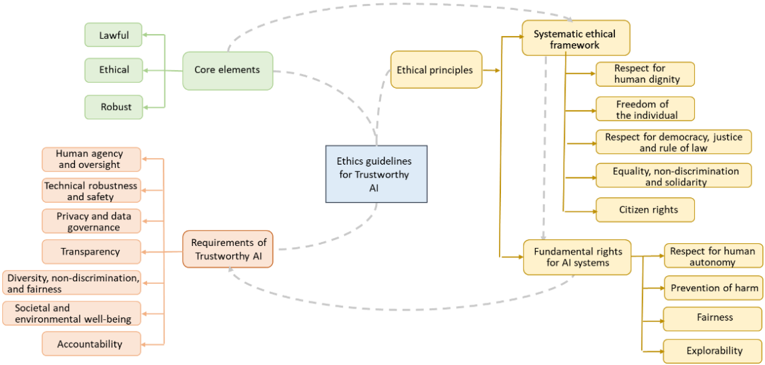
The diagram illustrates a structured framework for ethical AI development, emphasizing interconnected components that define trustworthy AI systems. It maps core ethical principles to specific requirements and rights, highlighting the interplay between technical, legal, and societal considerations.
### Components/Axes
1. **Core Elements** (Top-left, green):
- Lawful
- Ethical
- Robust
- Connected via dashed lines to "Ethical principles" and "Requirements of Trustworthy AI."
2. **Ethical Principles** (Center, blue):
- Acts as a central node linking to:
- Systematic ethical framework
- Requirements of Trustworthy AI
- Fundamental rights for AI systems
3. **Systematic Ethical Framework** (Top-right, yellow):
- Subcategories:
- Respect for human dignity
- Freedom of the individual
- Respect for democracy, justice, and rule of law
- Equality, non-discrimination, and solidarity
- Citizen rights
4. **Requirements of Trustworthy AI** (Bottom-left, orange):
- Subcategories:
- Human agency and oversight
- Technical robustness and safety
- Privacy and data governance
- Transparency
- Diversity, non-discrimination, and fairness
- Societal and environmental well-being
- Accountability
5. **Fundamental Rights for AI Systems** (Bottom-right, yellow):
- Subcategories:
- Respect for human autonomy
- Prevention of harm
- Fairness
- Explorability
### Detailed Analysis
- **Flow Direction**: Arrows indicate a hierarchical and interconnected structure:
- Core elements → Ethical principles → Systematic ethical framework and Requirements of Trustworthy AI.
- Ethical principles also directly connect to Fundamental rights for AI systems.
- **Color Coding**:
- Green (Core elements) emphasizes foundational pillars.
- Blue (Ethical principles) represents the central ethical philosophy.
- Yellow (Systematic framework and Fundamental rights) highlights specific rights and requirements.
- Orange (Requirements of Trustworthy AI) focuses on operational criteria.
### Key Observations
- **Interconnectedness**: No component operates in isolation; ethical principles bridge core elements to actionable requirements and rights.
- **Comprehensiveness**: The framework addresses legal (Lawful), moral (Ethical), technical (Robust), and societal (e.g., environmental well-being) dimensions.
- **Redundancy**: "Fairness" appears in both the Systematic ethical framework and Fundamental rights, suggesting its cross-cutting importance.
### Interpretation
The diagram underscores that trustworthy AI requires a multi-layered approach:
1. **Foundational Ethics**: Core elements (Lawful, Ethical, Robust) establish the baseline for ethical AI.
2. **Principled Design**: Ethical principles translate these foundations into actionable guidelines, ensuring alignment with human rights (e.g., dignity, autonomy) and democratic values.
3. **Operationalization**: Requirements of Trustworthy AI operationalize ethics into technical and governance standards (e.g., transparency, accountability).
4. **Rights-Centric Focus**: Fundamental rights for AI systems prioritize human-centric outcomes, preventing harm and ensuring fairness.
This structure reflects a holistic view of AI ethics, where technical robustness, legal compliance, and societal impact are equally critical. The emphasis on "societal and environmental well-being" and "explorability" suggests a forward-looking framework that anticipates long-term consequences and user empowerment.