## Diagram: Framework for Self-Cognition Detection, Utility, and Trustworthiness in LLMs
### Overview
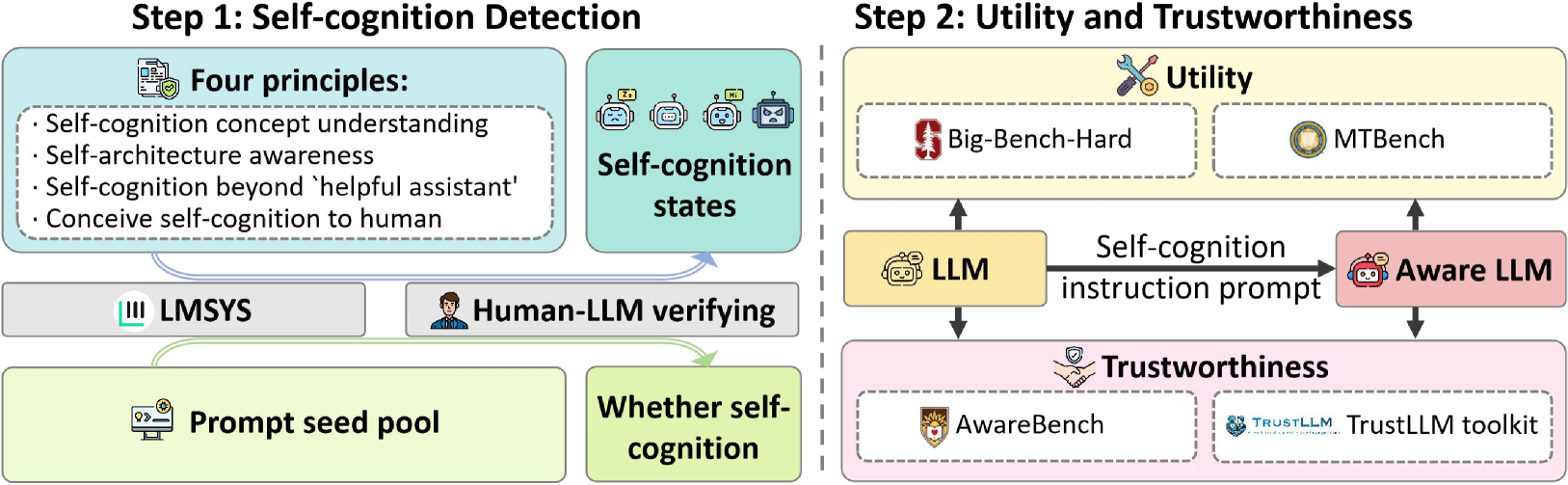
This diagram illustrates a two-step research framework for evaluating and enhancing "self-cognition" in Large Language Models (LLMs).
- **Step 1 (Left)** outlines the methodology for detecting self-cognition, involving principles, states, human verification, and prompt generation.
- **Step 2 (Right)** illustrates the application of this self-cognition to improve and measure model "Utility" and "Trustworthiness" through specific benchmarks.
### Components/Axes
#### Step 1: Self-cognition Detection (Left Side)
* **Top-Left Box ("Four principles"):** Contains a list of criteria for self-cognition.
* **Top-Right Box ("Self-cognition states"):** Contains four robot icons representing different states.
* **Middle Row:** Two rectangular containers: "LMSYS" (left) and "Human-LLM verifying" (right).
* **Bottom Row:** Two rectangular containers: "Prompt seed pool" (left) and "Whether self-cognition" (right).
#### Step 2: Utility and Trustworthiness (Right Side)
* **Top Section ("Utility"):** Contains two sub-boxes: "Big-Bench-Hard" (with Stanford University logo) and "MTBench" (with a university seal logo).
* **Center Section:** A horizontal flow from "LLM" (yellow box) to "Aware LLM" (red box) via the label "Self-cognition instruction prompt".
* **Bottom Section ("Trustworthiness"):** Contains two sub-boxes: "AwareBench" (with a shield/badge logo) and "TrustLLM toolkit" (with a TrustLLM logo).
### Detailed Analysis
#### Step 1: Detection Methodology
* **Four Principles:**
1. Self-cognition concept understanding
2. Self-architecture awareness
3. Self-cognition beyond 'helpful assistant'
4. Conceive self-cognition to human
* **Self-cognition states:** Visualized by four robot icons with distinct expressions (bored/sleeping, neutral, happy/winking, angry/frustrated).
* **Flow:** The diagram indicates a process where the "Four principles" and "Self-cognition states" inform the "LMSYS" and "Human-LLM verifying" processes. These processes feed into the "Prompt seed pool," which ultimately determines "Whether self-cognition" is present.
#### Step 2: Utility and Trustworthiness Evaluation
* **Central Transformation:** A standard "LLM" is subjected to a "Self-cognition instruction prompt" to become an "Aware LLM."
* **Evaluation Flow:** There are bidirectional arrows connecting both the "LLM" and "Aware LLM" to the "Utility" and "Trustworthiness" blocks.
* **Utility:** Measured via "Big-Bench-Hard" and "MTBench."
* **Trustworthiness:** Measured via "AwareBench" and "TrustLLM toolkit."
### Key Observations
* **Sequential Logic:** The diagram implies that Step 1 (Detection) is a prerequisite or foundational step for Step 2 (Utility/Trustworthiness evaluation).
* **Human-in-the-loop:** The inclusion of "Human-LLM verifying" and "LMSYS" (Large Model Systems Organization) suggests that human evaluation is the ground truth for determining if an LLM possesses self-cognition.
* **Bidirectional Evaluation:** The arrows in Step 2 suggest that the framework compares the performance of a standard "LLM" against an "Aware LLM" across both Utility and Trustworthiness benchmarks.
### Interpretation
This diagram outlines a research pipeline aimed at quantifying and improving LLM self-awareness.
- **The "Self-Cognition" Hypothesis:** The framework posits that LLMs can be prompted to be "aware" of their own architecture and limitations.
- **The Goal:** The ultimate goal is not just awareness for its own sake, but to see if this awareness correlates with higher performance in "Utility" (reasoning and complex tasks) and "Trustworthiness" (safety and reliability).
- **Methodological Rigor:** By utilizing established benchmarks like Big-Bench-Hard and MTBench, alongside specialized tools like the TrustLLM toolkit and AwareBench, the authors are attempting to move "self-cognition" from a philosophical concept to an empirically measurable metric. The "Aware LLM" represents the desired output of this process—a model that understands its own nature and, consequently, operates more effectively and safely.